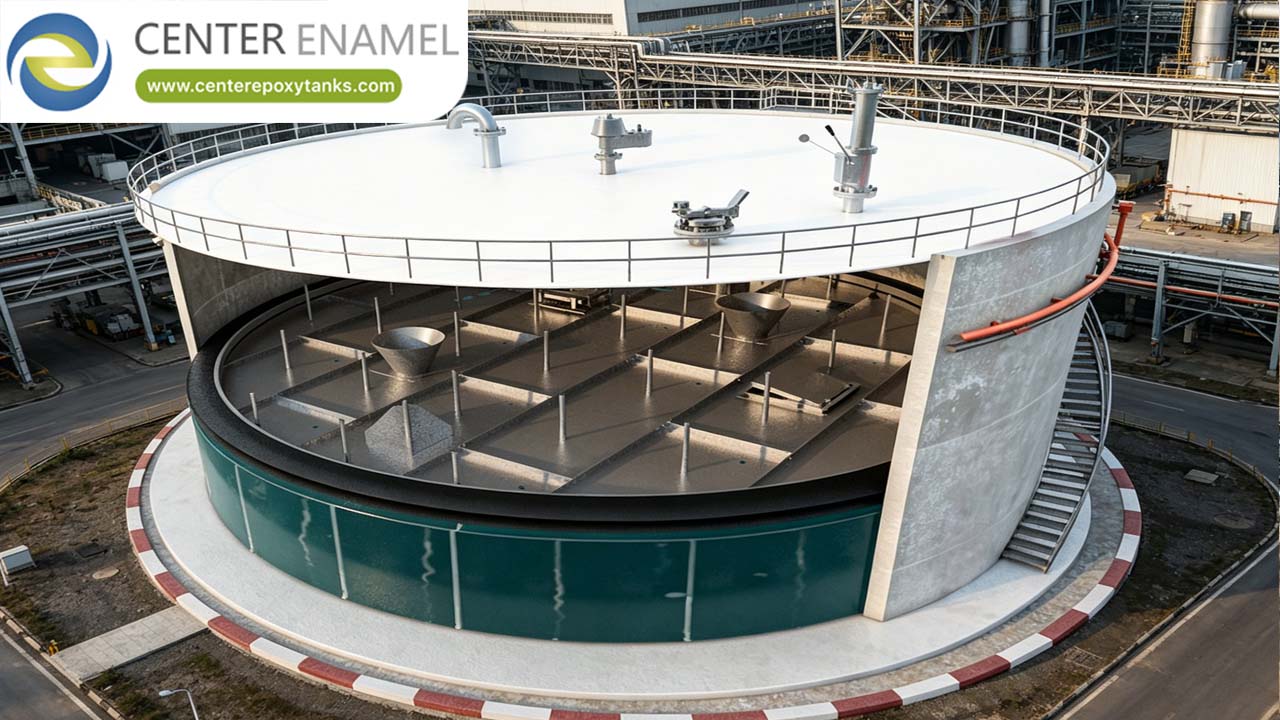
Petroleum Liquid Storage in External Floating Roof Tanks: Technical Engineering & Compliance Guide
In midstream logistics and bulk petroleum terminal management, petroleum liquid storage in external floating roof tanks (EFRTs) represents the definitive engineering standard for high-capacity, aboveground containment of volatile hydrocarbons. Deployed globally for ultra-large-diameter vessels holding crude oil, gasoline, diesel, and jet fuel, EFRTs provide an efficient compromise between structural economy, maximum operational safety, and aggressive environmental compliance.
Unlike fixed-roof configurations that permit hazardous gases to accumulate in a spacious upper headspace, an External Floating Roof Tank features an open top housing a buoyant structural deck. This deck rests directly on the liquid surface, rising and falling in sync with terminal fluid levels. By eliminating the vapor zone (ullage), the tank suppresses the thermodynamic drivers of evaporation, mitigating up to 95% to 99% of Volatile Organic Compound (VOC) emissions and eliminating internal explosive atmospheres.
Operating an open-top structure requires strict adherence to international mechanical standards. To navigate regional air-quality frameworks, terminal operators, EPC contractors, and storage assets must maintain total alignment with API Standard 650 Annex C, strict rim seal tolerances, and heavy-weather emergency drainage mechanics.
1. Structural Architecture: Pontoon vs. Double-Deck Designs
The core objective of EFRT engineering is maintaining uninterrupted contact between the roof deck and the stored petroleum liquid. Under API 650 Annex C requirements, structural integrity and failsafe buoyancy are achieved through two primary deck configurations:
A. Single-Deck Pontoon Roofs
The single-deck pontoon roof consists of a continuous, thin center deck plate surrounded by a segmented ring of liquid-tight peripheral pontoons.
● Mechanical Dynamic: The inner deck skin handles minor fluid flexing, while the outer annular pontoons provide the buoyancy required to keep the entire system stable.
● Buoyancy Target: API 650 Annex C mandates that single-deck roofs must remain fully buoyant even if the primary center deck and any two adjacent pontoon compartments suffer physical punctures and fill with product.
B. Double-Deck Roofs
The definitive selection for extreme large-diameter applications and intense solar conditions. Double-deck configurations enclose a continuous, compartmentalized dead-air space between complete top and bottom steel plates across the entire tank diameter.
● Thermodynamic Performance: The internal dead-air space serves as a powerful insulation layer. It acts as a thermal barrier against solar radiation, preventing the underlying petroleum liquid from reaching boiling or high-evaporation thresholds. This structure is highly stable against heavy wind forces and localized physical punctures.
2. Advanced Rim Sealing Systems and VOC Mitigation
The perimeter gap between the outer edge of the floating deck and the inner vertical tank shell is the most vulnerable path for vapor escape. Regulatory bodies enforce strict rules regarding seal integrity and allowable gap spaces:
A. Primary Seal Layouts
● Mechanical Shoe Seals: The industrial gold standard for petroleum storage. A metallic shoe plate is held flush against the tank shell by a spring-loaded counterweight mechanism. This metallic barrier extends at least 10 cm (4 inches}) below and 30 cm (12 inches}) above the fluid line, providing excellent resistance to abrasive crude oil components.
● Liquid-Mounted Seals: Composed of a tough, flexible fabric envelope filled with polyurethane foam or a specialized liquid product. It mounts flush against the liquid line, completely eliminating any vapor space beneath the seal envelope.
B. Secondary Seal Buffers
To capture any vapors bypassing the primary barrier, regulations mandate a continuous, rim-mounted secondary seal stretching from the floating deck directly to the tank wall.
● Gap Tolerances: For vapor-mounted systems, the maximum gap width between the secondary seal and the tank shell must not exceed 3.2mm (1/8 inch}). Total cumulative gaps cannot exceed 20 cm}^2 per meter of the tank's diameter, ensuring near-zero VOC emissions into the atmosphere.
3. Critical Auxiliary Systems: Drainage, Grounding, and Vents
Because an EFRT lacks a fixed cover shield, it functions as a dynamic system exposed to ambient wind, rain, and electrical storms. Maintaining buoyancy requires precise auxiliary engineering:
A. Articulated and Flexible Roof Drainage Systems
Accumulating rainwater on an open-top deck can compromise buoyancy and sink the roof. EFRTs incorporate a high-capacity center drain system to clear water away:
● Rigid Articulated Joint Pipes: Steel pipes connected via heavy mechanical swivel joints that fold and unfold smoothly as the deck tracks vertically.
● High-Strength Flexible Hoses: Multi-layered, chemical-resistant elastomeric lines that run continuously from the center deck screen to a shell nozzle, rapidly evacuating heavy rain loads (up to 250mm/hour) without requiring mechanical joints.
● Emergency Overflow Drains: Back-up open pipe systems that activate if the main drain line plugs, keeping accumulated water from exceeding a critical depth (typically 10 cm} or 4 inches}) on the steel deck.
B. Lightning Earthing & Shunts
Open-top petroleum storage tanks are highly vulnerable to atmospheric lightning strikes, which can ignite escaping rim vapors. To mitigate this risk, tanks are equipped with low-impedance grounding shunts and heavy-duty grounding cables. These shunts maintain continuous contact with the tank shell, safely dissipating electrostatic charges directly into the earth and preventing rim fires.
C. Automatic Bleeder and Rim Vents
● Bleeder Vents: Designed to break the internal vacuum when the roof is lowered onto its structural leg supports during maintenance cleaning or full tank drawdowns.
● Rim Vents: Configured to open only when the roof is resting on its legs, relieving localized vapor pressure shifts during terminal filling operations.
4. Technical Comparison Matrix: EFRT Engineering Parameters
Functional Category | Technical Rule / Standard | Center Enamel Engineering Target |
Buoyancy Safety Threshold | API 650 Annex C Baseline | Stable with 2 adjacent pontoons or bottom deck plate breached. |
VOC Evaporation Control | EPA / API 2517 Standard | 95% to 99% reduction in routine breathing and standing losses. |
Max Allowed Seal Rim Gap | Regional Regulatory Criteria | < 3.2mm (1/8 inch}) maximum gap spacing tolerance across shell. |
Emergency Rainfall Load | International Environmental Code | Continuous roof flotation under 250mm/24-hr storm accumulation. |
Grounding Mechanics | API 545 / NFPA 780 Framework | Continuous low-impedance metallic shunts for lightning dissipation. |
5. The Single-Source Hybrid Upgrade Advantage
The primary challenge of managing traditional EFRT projects is procurement fragmentation. Sourcing the open carbon steel tank shell from one vendor, the complex floating roof deck from a second, and specialized rim seals from a third frequently introduces installation delays and component compatibility errors.
Shijiazhuang Zhengzhong Technology Co., Ltd (Center Enamel) completely eliminates this risk by serving as a single-source turnkey containment ecosystem provider. Center Enamel designs and pre-fabricates the complete storage assembly simultaneously within its automated manufacturing lines using advanced CNC machinery.
Furthermore, for terminals in severe monsoon, heavy snow, or desert sandstorm regions, Center Enamel delivers the ultimate protection upgrade: manufacturing and installing a column-free, clear-span Aluminum Geodesic Dome Roof over the open-top EFR tank.
By placing an API 650 Appendix G compliant aluminum dome over an EFRT, the asset is converted into an internal floating environment. This hybrid setup completely shields the tank from rainwater ingress—eliminating the need for complex internal roof drain lines—protects the dynamic rim seals from UV and ozone degradation, and extends the seal service life by up to 50% while completely removing the internal vertical columns that can bind floating decks.
Future-Proofing Midstream Infrastructure
Succeeding in large-scale petroleum liquid storage in external floating roof tanks requires balancing environmental safety with long-term asset durability. The industry rewards manufacturers that blend strict structural code compliance with factory automation, strict environmental risk reduction, and single-source ecosystem accountability.
Through its extensive global portfolio of over 30,000 completed installations, nearly 200 manufacturing patents, absolute compliance with global codes, and unique full-system vertical integration, Shijiazhuang Zhengzhong Technology Co., Ltd (Center Enamel) remains the trusted choice for engineering firms, EPC contractors, and global terminal operators worldwide.
Protect your terminal assets, preserve product yield, and maintain strict environmental compliance. Contact Center Enamel today for an expert technical consultation and an API 650-compliant project quote.


