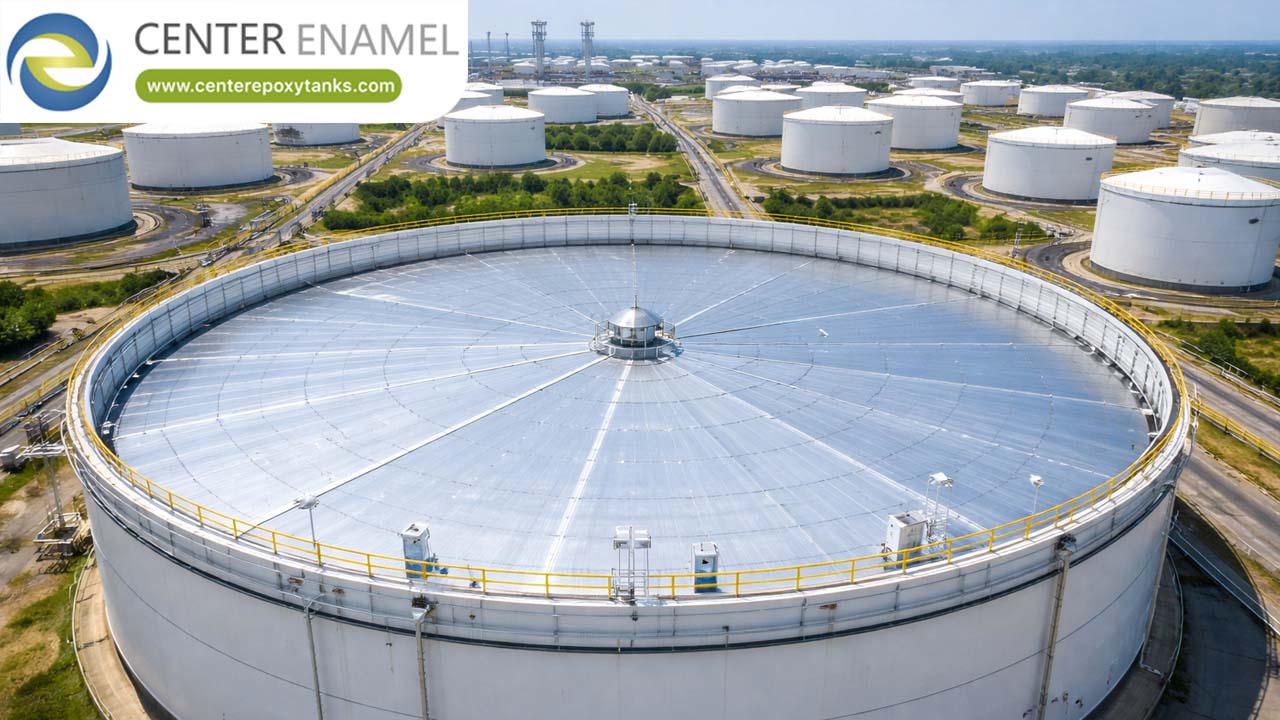
Design and Study of Floating Roofs for Oil Storage Tanks: A Comprehensive Engineering Analysis
In the modern oil refining, storage, and midstream logistics sectors, the design and study of floating roofs for oil storage tanks represent a critical frontier in mechanical and environmental engineering. Aboveground storage tanks (ASTs) holding volatile hydrocarbons—such as crude oil, gasoline, naphtha, and aviation fuels—face ongoing challenges regarding volatile organic compound (VOC) emissions, product evaporative losses, and internal explosive environments.
To mitigate these challenges, the global petroleum industry relies on floating roof technology. By floating directly on the liquid surface, these roofs eliminate the vapor headspace (ullage), suppressing up to 98% to 99%+ of evaporative breathing and working losses.
However, engineering a dynamic structural deck that must track vertically inside a steel shell for decades requires advanced physics and material science. A comprehensive study of floating roof design involves balancing multi-variable structural mechanics, redundant buoyancy physics, rim seal chemistry, and severe weather resilience in strict accordance with API Standard 650.
1. Structural Design Classifications: IFR vs. EFR Systems
The design and study of floating roofs are fundamentally split into two operational frameworks based on atmospheric exposure:
A. Internal Floating Roofs (IFR) – API 650 Annex H
Internal floating roofs operate inside a fixed-roof tank environment, shielded from external wind, rain, and snow loads.
● Skin-and-Pontoon Types: Constructed from lightweight aluminum or stainless steel decks supported by a series of high-buoyancy tubular pontoons. This design offers high capital efficiency and ease of retrofitting.
● Full-Contact Honeycomb Types: Formed from interlocking sandwich panels that rest directly on the liquid without a vapor gap underneath. This configuration provides maximum emission mitigation and exceptional structural rigidity, allowing maintenance crews to walk safely across the deck during turnarounds.
B. External Floating Roofs (EFR) – API 650 Annex C
External floating roofs operate in open-top tank shells and are exposed to ambient weather conditions. They are typically deployed on large-diameter crude oil tanks (>50m).
● Single-Deck Pontoon EFR: Features a continuous center deck plate surrounded by an annular ring of liquid-tight pontoon compartments.
● Double-Deck Welded Steel EFR: Features continuous top and bottom steel plates that enclose a compartmentalized dead-air insulation layer. This structure provides optimal resistance to extreme wind shears and prevents center-deck vapor ballooning caused by intense solar heat.
2. Mathematical Modeling and Buoyancy Stability Studies
A primary focus in the study of floating roofs is ensuring continuous flotation and structural stability under normal and emergency load configurations.
The Redundant Buoyancy Formula
API Standard 650 enforces strict safety margins for floating deck buoyancy. Structural engineering designs must guarantee that the roof remains entirely stable and buoyant under two strict failure scenarios:
To achieve this, engineers utilize Finite Element Analysis (FEA) to model localized tank tolerances, liquid density variations, and seismic sloshing effects. The buoyancy study calculates the necessary total volume of the localized pontoon chambers to provide a minimum 2x buoyancy safety factor relative to the total dead weight of the roof structure and its auxiliary attachments.
3. Boundary Engineering: Rim Seal Dynamics and VOC Suppression
The study of vapor loss confirms that the perimeter gap between the outer rim of the floating roof and the inner vertical tank shell is the primary pathway for VOC escape. Therefore, rim seal design is heavily scrutinized in any floating roof engineering assessment.
● Primary Mechanical Shoe Seals: Utilized extensively in crude storage, a metallic shoe plate is held flush against the tank wall by spring-loaded or counterweighted pantograph linkages. This arrangement provides continuous mechanical contact while extending below the liquid line to trap vapors.
● Secondary Wiper Seals: Positioned directly above the primary seal, these elastomeric blades (constructed from Viton, PTFE, or specialized fluoroelastomers) actively wipe the tank shell during filling and emptying cycles. They accommodate out-of-round shell distortions to maintain a "Zero-Gap" fit (<3.2mm tolerance).
4. Auxiliary Systems Study: Drainage and Grounding Mechanics
For open-top External Floating Roof Tanks (EFRTs), water accumulation on the deck represents a significant operational risk that can cause the roof to tilt or sink.
A. Advanced Drainage Design
Modern EFR designs integrate high-capacity center drain systems to clear rainwater away rapidly:
● Articulated Swivel-Joint Pipes: Heavy-duty steel pipelines configured with mechanical swivel joints that articulate smoothly as the roof tracks vertically.
● Flexible Hose Systems: Continuous, multi-layered chemical-resistant elastomeric lines that direct storm water out of the tank shell without requiring mechanical joints, engineered to handle intense rainfall loads up to 250mm/hour.
B. Lightning Earthing and Electrostatic Protection
Because open-top tanks are vulnerable to lightning strikes, the study of floating roof safety mandates advanced grounding systems. Tanks must be equipped with low-impedance continuous stainless steel grounding shunts that maintain constant contact with the tank shell. This setup safely dissipates atmospheric electrical charges into the earth, eliminating the risk of static sparking that could ignite rim vapors.
5. Technical Design Matrix: Floating Roof Engineering Parameters
Design Parameter | Internal Floating Roofs (IFR) | External Floating Roofs (EFR) |
Governing Design Code | API Standard 650 Annex H | API Standard 650 Annex C |
Material Base Options | High-Strength Aluminum Alloys, Stainless Steel (304/316L) | Heavy-Gauge Carbon Steel, Corrosion-Resistant Alloys |
Vapor Suppression Efficiency | 98% to 99%+ VOC reduction | 95% to 98% VOC reduction |
Environmental Exposure | Shielded entirely by a fixed outer roof cover | Directly exposed to ambient elements (Rain, snow, sun) |
Primary Fluid Focus | Refined fuels, aviation gasoline, light chemical solvents | Large-scale crude oil reserves, heavy refinery intermediates |
6. Single-Source Solution: Why Center Enamel Leads Global Floating Roof Engineering
With a distinguished history of manufacturing excellence dating back to 2008 and an active international footprint spanning over 100 countries—including the USA, Australia, Canada, Malaysia, Indonesia, the UAE, and Saudi Arabia—Shijiazhuang Zhengzhong Technology Co., Ltd (Center Enamel) is an established global leader in containment infrastructure.
Backed by a professional R&D team holding nearly 200 proprietary patents, Center Enamel eliminates the risks of procurement fragmentation by serving as a single-source turnkey containment ecosystem provider.
Sourcing the tank shell from one vendor and the floating roof from another frequently results in installation delays and split-warranty disputes due to mismatched tolerances. Center Enamel solves this by designing and manufacturing the entire assembly simultaneously inside its automated factory using advanced CNC machinery. This ensures perfect concentric alignment and unified structural calculations.
The Hybrid Optimization Upgrade
For facilities operating in severe weather zones, Center Enamel provides an advanced hybrid configuration: installing a column-free, clear-span Aluminum Geodesic Dome Roof over an open-top floating roof tank.
By placing an API 650 Appendix G compliant aluminum dome over the tank shell, the asset is converted into an internal floating environment. This hybrid setup completely shields the tank from rainwater ingress—eliminating the need for complex internal roof drain lines—protects the dynamic rim seals from UV degradation, and extends the seal service life by up to 50% while removing the internal vertical support columns that can bind floating decks.
Data-Driven Storage Asset Longevity
The design and study of floating roofs for oil storage tanks underscore the necessity of combining structural compliance with automated factory precision, advanced metallurgy, and full-system horizontal integration.
Through its extensive global portfolio of over 30,000 completed installations, absolute compliance with international codes, and unique single-source execution, Center Enamel remains the trusted choice for engineering firms, EPC contractors, and global terminal operators worldwide.
Optimize your bulk storage terminal efficiency, preserve product yield, and maintain strict environmental compliance. Contact Center Enamel today for a technical engineering consultation and a code-compliant floating roof project quote.


