Internal Floating Roofs for the Oil & Gas Industry: Maximizing Safety and Efficiency
What is the role of an Internal Floating Roof in the Oil & Gas industry? In the storage of volatile petroleum products, the primary challenge is the management of the "vapor space." An Internal Floating Roof (IFR) is a buoyant deck that sits directly on the liquid surface inside a fixed-roof tank. It eliminates the headspace where flammable gases accumulate, providing a dual-layer defense that reduces Volatile Organic Compound (VOC) emissions by up to 99%. For refineries and terminals, IFR technology is a critical investment for fire safety, environmental compliance, and product conservation.
1. Technical Mechanics: How IFRs Protect Hydrocarbons
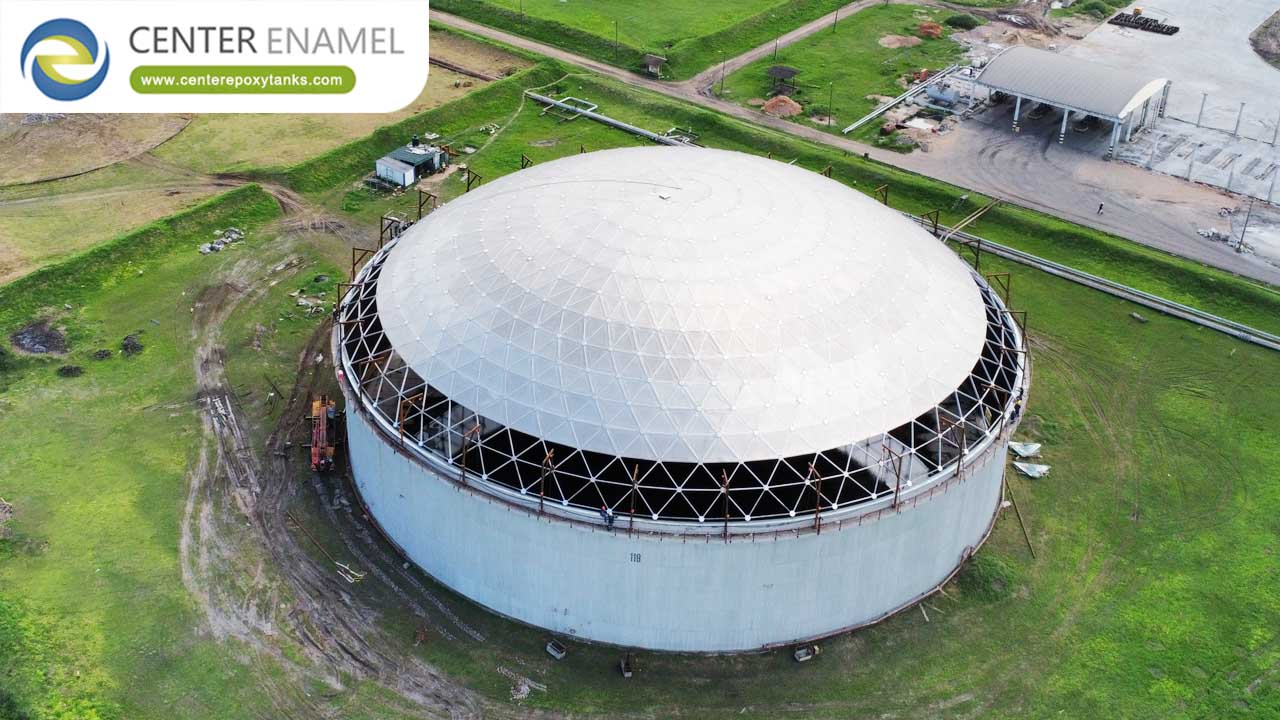
The Oil & Gas industry utilizes IFRs to decouple the stored product from the atmosphere. Unlike external systems, the IFR is shielded by a fixed outer roof, typically a steel cone or an Aluminum Geodesic Dome.
● Vapor Suppression: By resting on the liquid, the IFR prevents the phase change from liquid to gas. This stops "breathing losses" caused by daily temperature fluctuations.
● Contamination Barrier: The fixed outer roof prevents rainwater, snow, and debris from reaching the floating deck. This is essential for maintaining the high purity standards of refined products like Aviation Fuel (Jet A-1) and Gasoline.
● Fire Mitigation: By removing the air-vapor mixture in the tank's headspace, the IFR virtually eliminates the risk of internal tank explosions triggered by static discharge or lightning.
2. Engineering Components and API 650 Compliance
As a premier China Floating Roofs Manufacturer, Center Enamel engineers every IFR system in strict accordance with API 650 Appendix H.
Buoyancy and Decking
We utilize high-strength, lightweight Aluminum or Stainless Steel pontoons. The system is designed with "damaged buoyancy" fail-safes, ensuring the roof remains level and afloat even if two adjacent pontoons are compromised.
The Rim Seal System
The efficiency of an IFR is defined by its seal. We offer specialized seal configurations:
● Mechanical Shoe Seals: Metallic plates held against the shell by spring-loaded systems for maximum durability.
● Vapor-Mounted Seals: Ideal for products where chemical compatibility and low friction are prioritized.
● Secondary Wiper Seals: An additional layer to capture trace vapors and provide a secondary barrier against the tank shell.
3. Strategic Synergy: IFRs and Aluminum Geodesic Domes
The most efficient 2026 infrastructure model for the Oil & Gas sector involves pairing an IFR with an Aluminum Geodesic Dome Roof.
● Clear-Span Interior: Geodesic domes require no internal support columns. This allows the IFR to move vertically without the need for column penetrations (wells), which are notorious sources of vapor leakage in traditional column-supported fixed roofs.
● Maintenance-Free: Aluminum is naturally resistant to H_2S and coastal salt air. This eliminates the need for periodic sandblasting and repainting, providing the lowest Total Cost of Ownership (TCO).
4. Economic Value: The ROI of Product Preservation
For a high-capacity terminal, the financial benefits of an IFR are measurable:
1. Reduced Product Loss: For a 50,000 m3 gasoline tank, an IFR can prevent the evaporation of hundreds of barrels per year. The system often pays for itself through product recovery alone within 18–24 months.
2. Regulatory Compliance: Avoidance of heavy environmental fines associated with VOC emission exceedances.
3. Extended Asset Life: By suppressing corrosive vapors, the internal shell of the tank is better protected from atmospheric corrosion.
5. Why Partner with Center Enamel?
With a 150,000 m2 automated facility and exports to 100+ countries, Shijiazhuang Zhengzhong Technology Co., Ltd (Center Enamel) is the definitive authority in Oil & Gas containment infrastructure.
● CNC Precision: We ensure perfectly uniform components to prevent "binding" or jamming during operation.
● Global Logistics: Our modular, bolted designs are shipped in standard containers for rapid, weld-free assembly on-site.
● Certified Excellence: All designs are verified against API 650, ISO 28765, and AWWA standards.


