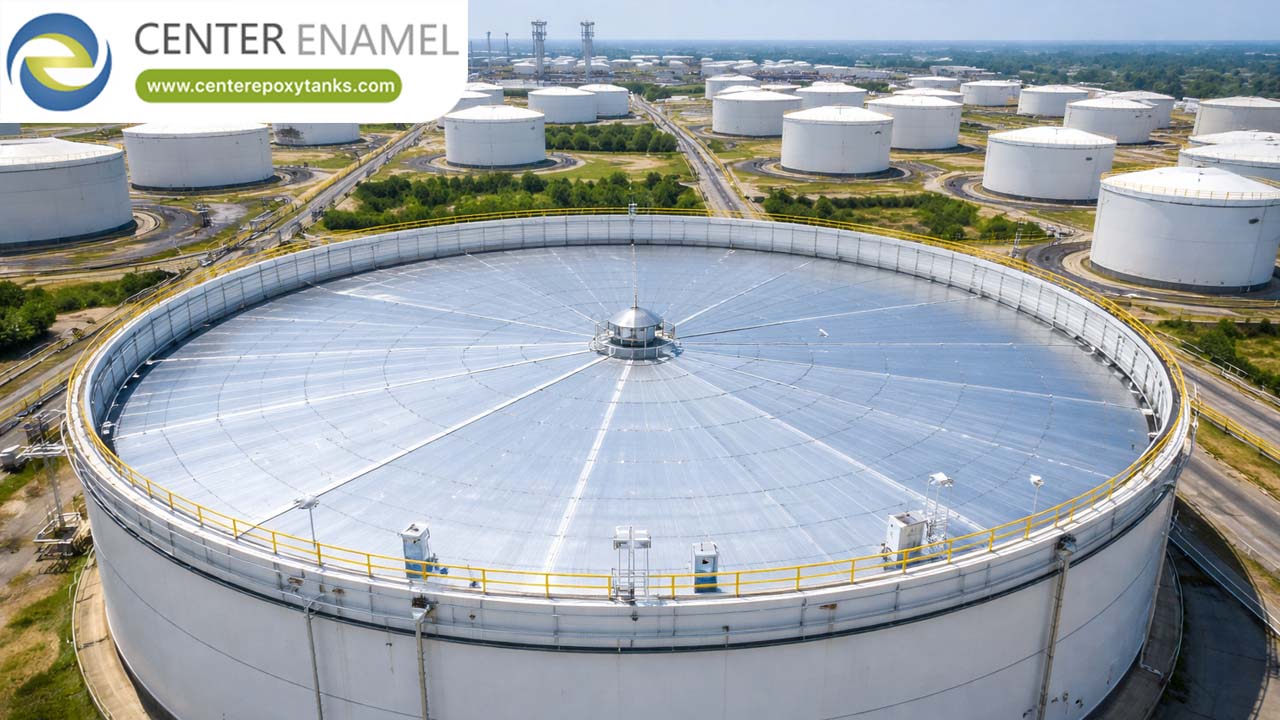
Internal Floating Roofs for Oil Refineries - Vapour Control Under a Fixed Roof
Refineries store a lot of volatile, high-value product: gasoline, naphtha, jet fuel, reformate. For those streams an external floating roof works, but it leaves the deck exposed to rain, wind, sunlight and debris, and it puts roof drainage on the maintenance list. An internal floating roof gives the same vapour control with a fixed roof over the top - which is why it is the default choice for refined products at most refineries.
The design is governed by API 650 Appendix H and by one detail that catches people out: the space between the deck and the fixed roof must be ventilated. Engineered by Shijiazhuang Zhengzhong Technology Co., Ltd. (Center Enamel), an internal floating roof is specified as a system - deck, seals, fittings, grounding and venting - because every part of it has to be right for the vapour control to hold.
1. What Is an Internal Floating Roof?
A buoyant deck that floats on the liquid inside a fixed-roof tank, sealed to the shell with a rim seal. The fixed roof keeps weather out; the deck removes the vapour space. The result is vapour control without exposing the sealing system to the elements.
· Two-Roof Arrangement: A fixed or dome roof carries weather loads; the internal deck handles vapour control.
· Deck Types: Pan, skin-and-pontoon, and aluminium or stainless sandwich panel decks, selected on product, diameter and purity requirements.
· Rim Seal: A primary seal, usually with a secondary element, closes the annular gap to the shell.
· Support Legs: Adjustable legs hold the deck at landing height so the tank can be emptied.
· Fittings: Vacuum breaker, gauge hatch, sample hatch, manway and anti-static shunts are fitted through the deck.
2. Why Do Refineries Prefer Internal Over External Roofs?
Because the product is valuable enough that every kilogram of vapour matters, and because a covered deck lasts longer. There is no rainwater to drain, no snow load, no wind-driven deck movement, and no UV exposure on the seal.
· Better Loss Control: A protected deck and seal system typically achieves higher loss reduction than an exposed one.
· No Roof Drainage: Rain never reaches the deck, so the dominant cause of external deck failure is removed.
· Longer Seal Life: Shielded from sunlight and weather, seals degrade far more slowly.
· No Wind or Snow Load: The fixed roof carries environmental loads, so the deck only has to float.
· Cleaner Product: Dust, debris and rainwater are kept out of the stored product.
3. How Is the Space Above the Deck Vented?
Through fixed-roof and shell vents sized to API 2000. This is the most important safety detail on an IFR tank: vapour can accumulate between the deck and the fixed roof, and that space must be ventilated for normal breathing and for fire exposure.
· API 2000 Sizing: Venting is sized for normal thermal breathing and for emergency fire exposure, not for one case alone.
· Circulation Vents: Vents are arranged to promote circulation through the roof space rather than leaving stagnant pockets.
· Entry Classification: The roof space is treated as a confined space with gas testing before entry, because vapour can accumulate there.
· Flame Arresters: Fitted where the project specification or the product requires them, and maintained on schedule.
· Vapour Recovery Interface: Where recovery is installed, the vents and recovery connection are designed together.
Evaluation Criterion | Internal Floating Roof | External Floating Roof |
Weather exposure | Protected by fixed roof | Fully exposed |
Roof drainage required | No | Yes - drains are the main failure mode |
Seal life | Long - shielded from UV and weather | Shorter |
Loss reduction | Very high | High |
Confined space consideration | Roof space must be gas tested | Open to atmosphere |
Engineering Assurance and Project Support
Every welded oil tank delivered by Shijiazhuang Zhengzhong Technology Co., Ltd. (Center Enamel) is designed to API 650 with shell courses sized by the one-foot method and checked for wind, seismic and hydrostatic load cases, or to EN 14015 and the Eurocodes where the site is European. Shell plate is shot-blasted to Sa 2.5 and coated to a documented dry film thickness, longitudinal and annular plate welds are examined by radiography or ultrasonic testing to the acceptance level written into the purchase order, and every tank is hydrostatically tested and dimensionally surveyed before hand-over. Internal floating roofs are supplied to API 650 Appendix H with deck, seals, fittings, shunts, support legs and the fixed-roof venting calculation, plus a confined-space entry note in the operating manual.
Frequently Asked Questions (FAQ)
What is the difference between an internal and an external floating roof?
An external floating roof is the tank's only roof and is exposed to weather, so it carries a drainage system. An internal floating roof floats inside a fixed-roof tank, so the fixed roof carries rain, snow and wind and the deck only has to float. That removes roof drainage entirely and greatly extends seal life, which is why internal roofs are preferred for refined products.
Which standard covers internal floating roofs?
API 650 Appendix H covers internal floating roofs for welded steel tanks, and it addresses deck design, buoyancy, seals, fittings, grounding and venting. Venting of the space between the deck and the fixed roof is separately sized to API 2000 for both normal breathing and emergency fire exposure.
Is the space above an internal floating roof hazardous?
It can be. Vapour can accumulate between the deck and the fixed roof, so that space is treated as a confined space and gas tested before entry. This is why circulation vents are arranged to prevent stagnant pockets and why the venting calculation is part of the design package rather than an afterthought.
Can the internal floating roof be customised for our tanks?
Yes. Deck type and material, buoyancy reserve, primary and secondary seal specification, fittings, support leg landing height, shunts and grounding, and the fixed-roof venting arrangement are all engineered to your tank diameter, product volatility and site conditions.


