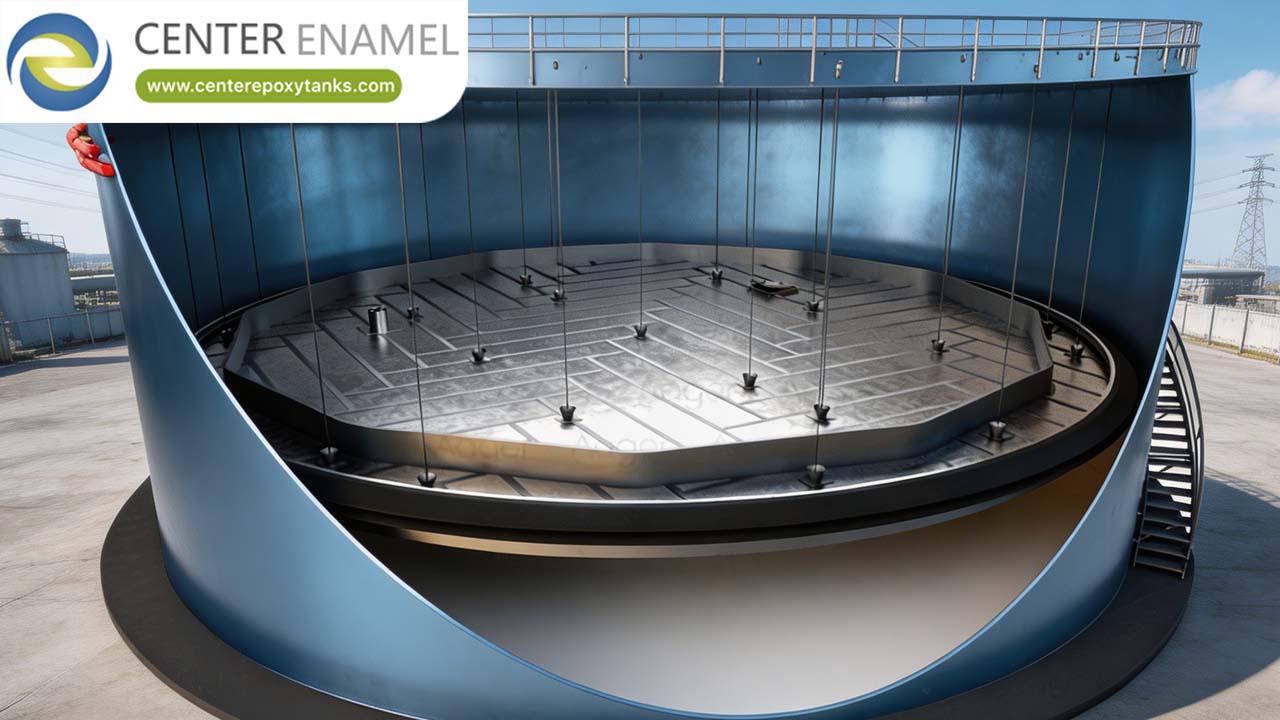
Internal Floating Roofs for Crude Oil Tanks - When a Covered Deck Beats an Open One
Conventional practice puts external floating roofs on crude tanks, and for good reason - they are proven, inspectable from above, and simple to repair. But there are sites where an open deck is the wrong answer: desert locations where sand and dust load the deck and abrade the seal, high-rainfall sites where drainage becomes a permanent maintenance burden, and terminals handling sour crude where the seal and underside are exposed to a corrosive vapour.
In those cases a fixed roof over an internal deck changes the economics. Engineered by Shijiazhuang Zhengzhong Technology Co., Ltd. (Center Enamel), an internal floating roof on a crude tank removes rainwater, dust and sunlight from the seal environment, at the cost of a confined roof space and a cleaning requirement before internal inspection.
1. When Does an Internal Roof Beat an External One on Crude?
When the environment attacks an exposed deck faster than the roof space costs to manage. High rainfall, airborne dust or sand, and sour vapour all shift the balance toward a covered deck.
· High Rainfall Sites: An internal deck has no rainwater to shed, which removes the dominant cause of external deck failure.
· Dust and Sand Exposure: A fixed roof keeps abrasive dust off the seal and out of the product.
· Sour Crude: Covering the deck reduces the vapour that reaches the seal and the deck underside environment.
· High Product Value: Where the crude is light and valuable, the extra loss control of a covered deck pays back.
· Emission Stringency: Where the site is under tight emission limits, the additional control can be decisive.
2. What Are the Trade-Offs of a Covered Deck on Crude?
Three: a confined vapour space above the deck that must be ventilated and gas tested, a cleaning and gas-freeing requirement before internal inspection, and the fact that deck problems are hidden until the tank is opened.
· Confined Roof Space: Vapour can accumulate between deck and fixed roof, so the space is ventilated and treated as confined space.
· Inspection Requires Cleaning: Internal examination means emptying, cleaning and gas-freeing, so inspection intervals are planned carefully.
· Hidden Deterioration: Seal and deck condition cannot be walked from above; it is assessed at internal examination.
· Venting Requirement: Roof space venting is sized to API 2000 for thermal breathing and fire exposure.
· Entry Discipline: Permits, gas testing and bonding checks are required before anyone enters the tank.
3. How Does Sediment Affect an Internal Deck?
The same way it affects an external one: the deck must be able to land level. Landing height is set from the sediment profile with margin, and the bottom is designed so sediment can be removed without disturbing the deck.
· Landing Height: Support legs are set above the expected sediment depth so the deck rests level when the tank is emptied.
· Sediment Profiling: Bottom surveys at inspection establish the actual accumulation rate.
· Cleaning Access: Manways and deck openings are positioned so cleaning equipment reaches the floor.
· Sump and Draw-Off: Water and sludge are drawn off routinely so the sediment layer does not grow into the landing height.
· Mixing Provision: Where specified, mixing keeps solids suspended rather than settled.
Evaluation Criterion | Internal Floating Roof on Crude | External Floating Roof on Crude |
Rainwater management | None required | Drains are the main failure mode |
Dust and sand exposure | Sealed out | Abrades seal and contaminates product |
Seal life | Longer - protected from weather | Shorter |
In-service inspection access | Limited - internal entry needed | Deck visible from above |
Vapour space management | Roof space must be vented | Open to atmosphere |
Engineering Assurance and Project Support
Every welded oil tank delivered by Shijiazhuang Zhengzhong Technology Co., Ltd. (Center Enamel) is designed to API 650 with shell courses sized by the one-foot method and checked for wind, seismic and hydrostatic load cases, or to EN 14015 and the Eurocodes where the site is European. Shell plate is shot-blasted to Sa 2.5 and coated to a documented dry film thickness, longitudinal and annular plate welds are examined by radiography or ultrasonic testing to the acceptance level written into the purchase order, and every tank is hydrostatically tested and dimensionally surveyed before hand-over. We compare both options against your rainfall, dust load, crude assay and inspection interval, and supply whichever wins with the buoyancy, venting and grounding calculations and the operating manual.
Frequently Asked Questions (FAQ)
Is an internal floating roof suitable for crude oil?
Yes, where the conditions favour it. External floating roofs remain the conventional choice for large crude tanks, but an internal roof wins where heavy rainfall makes drainage a permanent burden, where airborne dust or sand abrades an exposed seal, or where sour vapour shortens the life of external seals and fittings.
What is the main disadvantage of an internal roof on a crude tank?
Inspection access. The deck cannot be walked from above, so condition is assessed at internal examination, which requires emptying, cleaning and gas-freeing. There is also a confined vapour space between deck and fixed roof that must be ventilated to API 2000 and gas tested before entry.
How is sediment handled with an internal deck?
The same way as with an external deck: support legs are set above the expected sediment depth so the deck lands level, water and sludge are drawn off routinely, and manways and deck openings are positioned so the floor can be cleaned at inspection. The landing height is set from the sediment profile measured at previous inspections.
Can the roof be customised for our crude tanks?
Yes. Deck type and material, buoyancy reserve, sour-compatible seals and gaskets, shunts and grounding, fittings, landing height set from your sediment profile and the fixed-roof venting arrangement are all engineered to your tank, crude assay and site conditions.


