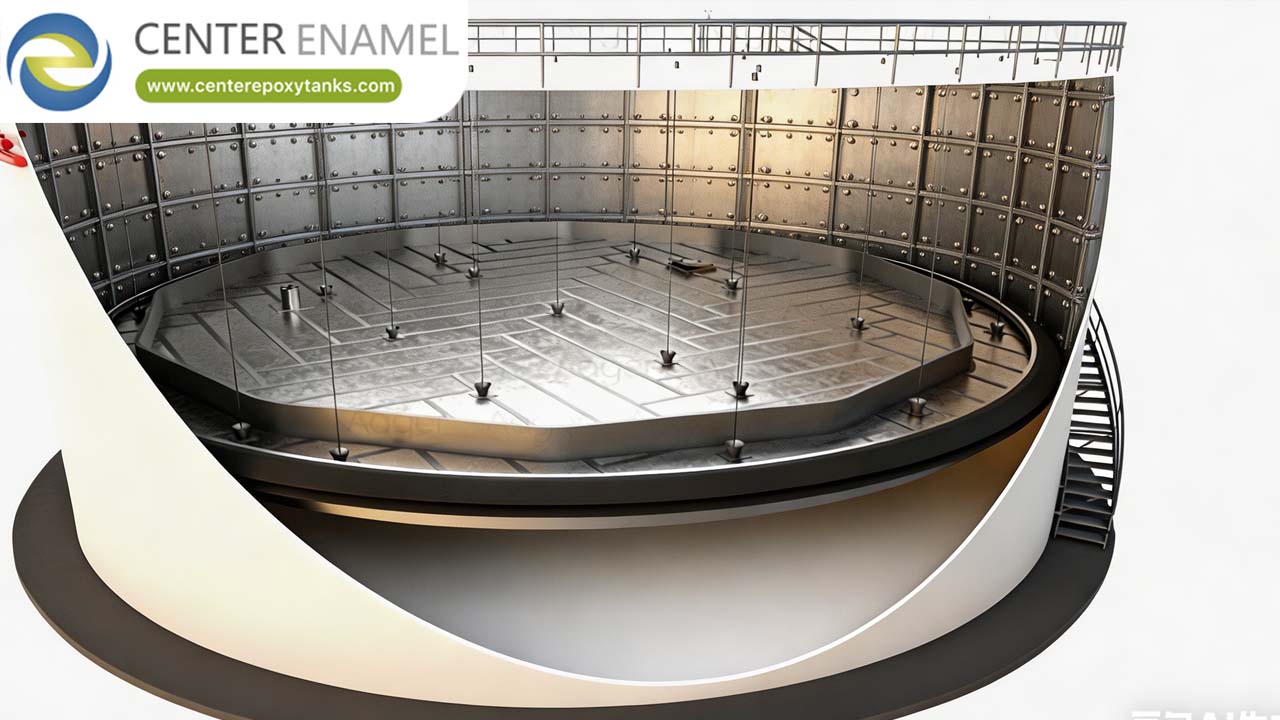
Internal Floating Roof Oil Tanks - Deck Types, Seals and Safe Operation
Choosing an internal floating roof is easy; choosing the right one is not. Pan decks are cheap but sink if they lose buoyancy. Skin-and-pontoon decks are robust and widely used. Aluminium sandwich panels give full contact with the liquid and excellent loss control but cost more. Each has a different failure mode, a different inspection regime and a different total cost, and the right answer depends on the product and the owner's tolerance for internal work.
The safest way to choose is to compare failure modes rather than prices. Engineered by Shijiazhuang Zhengzhong Technology Co., Ltd. (Center Enamel), an internal floating roof is specified to API 650 Appendix H with the deck type, seal system, grounding and venting matched to the product and the tank rather than selected from a catalogue.
1. Which Deck Type Suits Which Duty?
Pan decks suit mild, low-value service where the sinking risk is acceptable; skin-and-pontoon is the general-purpose workhorse; sandwich panel decks suit high-value volatile products where maximum contact and minimum vapour space matter.
· Pan Deck: A single deck plate with a shallow rim; economical, but it can sink if it loses buoyancy through a rim breach.
· Skin-and-Pontoon: A rim of buoyant pontoons around a centre membrane; robust, well proven, and the general default for refinery service.
· Sandwich Panel Deck: Aluminium honeycomb or buoyant-block panels in full contact with the liquid; excellent loss control and rigidity at higher cost.
· Buoyancy Reserve: Whichever type is chosen, reserve buoyancy is calculated and documented for the specified damage case.
· Material: Aluminium is common for refined products, carbon steel for heavier streams, and stainless where purity demands it.
2. How Is the Deck Grounded and Bonded?
Through dedicated shunts from the deck to the shell, plus bonding across every hinged or pivoting component. A floating deck that is not properly bonded can accumulate static charge during filling, which is an ignition risk in a vapour space.
· Shunts: Multiple flexible shunts connect the deck to the shell so resistance stays low as the deck travels.
· Bonding Across Fittings: Hatches, gauge poles, ladders and any pivoting part are individually bonded.
· Continuity Testing: Bonding resistance is measured and recorded at commissioning and at inspection.
· Seal Conductivity: Seal materials are selected with static behaviour in mind, particularly for low-conductivity products.
· Earthing Philosophy: The deck grounding is integrated with the tank's overall earthing and lightning protection.
3. What Are the Operating Rules for an IFR Tank?
Three rules dominate: never exceed the design filling and emptying rates, never let the deck land on product unless it is designed to, and never enter the roof space without gas testing. Most IFR incidents trace back to one of the three.
· Filling Rate Limits: High velocity can disturb the deck and, for low-conductivity products, generate static; limits are specified for the product.
· Landing Discipline: The deck is designed to land on its legs; landing on product or on sediment causes tilting and seal damage.
· Gas Testing: The roof space is confined; entry requires testing and a permit.
· Vent Maintenance: Vents and flame arresters are inspected so the roof space cannot pressurise or accumulate vapour.
· Seal Gap Monitoring: Seal condition is checked and recorded so deterioration is visible before it becomes an emission problem.
Evaluation Criterion | Pan Deck | Skin-and-Pontoon Deck | Sandwich Panel Deck |
Buoyancy after damage | Poor - can sink | Good - compartmented pontoons | Very good |
Loss control | Moderate | Good | Very good - full liquid contact |
Initial cost | Lowest | Moderate | Highest |
Rigidity | Low | Moderate | High |
Typical duty | Low-value, low-volatility | General refinery service | High-value volatile product |
Engineering Assurance and Project Support
Every welded oil tank delivered by Shijiazhuang Zhengzhong Technology Co., Ltd. (Center Enamel) is designed to API 650 with shell courses sized by the one-foot method and checked for wind, seismic and hydrostatic load cases, or to EN 14015 and the Eurocodes where the site is European. Shell plate is shot-blasted to Sa 2.5 and coated to a documented dry film thickness, longitudinal and annular plate welds are examined by radiography or ultrasonic testing to the acceptance level written into the purchase order, and every tank is hydrostatically tested and dimensionally surveyed before hand-over. We supply the deck, seals, shunts, fittings and support legs with buoyancy calculations, continuity test records and an operating manual that states the filling rate limits and the landing and entry rules.
Frequently Asked Questions (FAQ)
Which internal floating roof deck type is best?
It depends on the product and the risk you are willing to carry. Pan decks are the cheapest but can sink if the rim is breached. Skin-and-pontoon decks are compartmented, robust and the general refinery default. Sandwich panel decks sit in full contact with the liquid and give the best loss control at the highest cost. For high-value volatile product, the sandwich deck usually pays back.
Why is deck grounding so important?
A floating deck is electrically isolated from the shell by the rim seal, so without dedicated shunts it can accumulate static charge during filling. In a vapour space that is an ignition risk. Multiple flexible shunts connect the deck to the shell, every hinged or pivoting component is individually bonded, and bonding resistance is measured and recorded.
How often should an internal floating roof be inspected?
In-service checks of seal condition, vent condition and deck position are done from outside without emptying the tank. Internal examination requires the tank to be cleaned and gas-freed, is planned on the API 653 interval for the tank, and is the point at which deck, seal, shunts and support legs are examined properly.
Can the deck be customised for our tanks?
Yes. Deck type and material, buoyancy reserve, seal specification, shunts and grounding, fittings, support leg landing height and the fixed-roof venting arrangement are all engineered to your tank, product and operating pattern.


