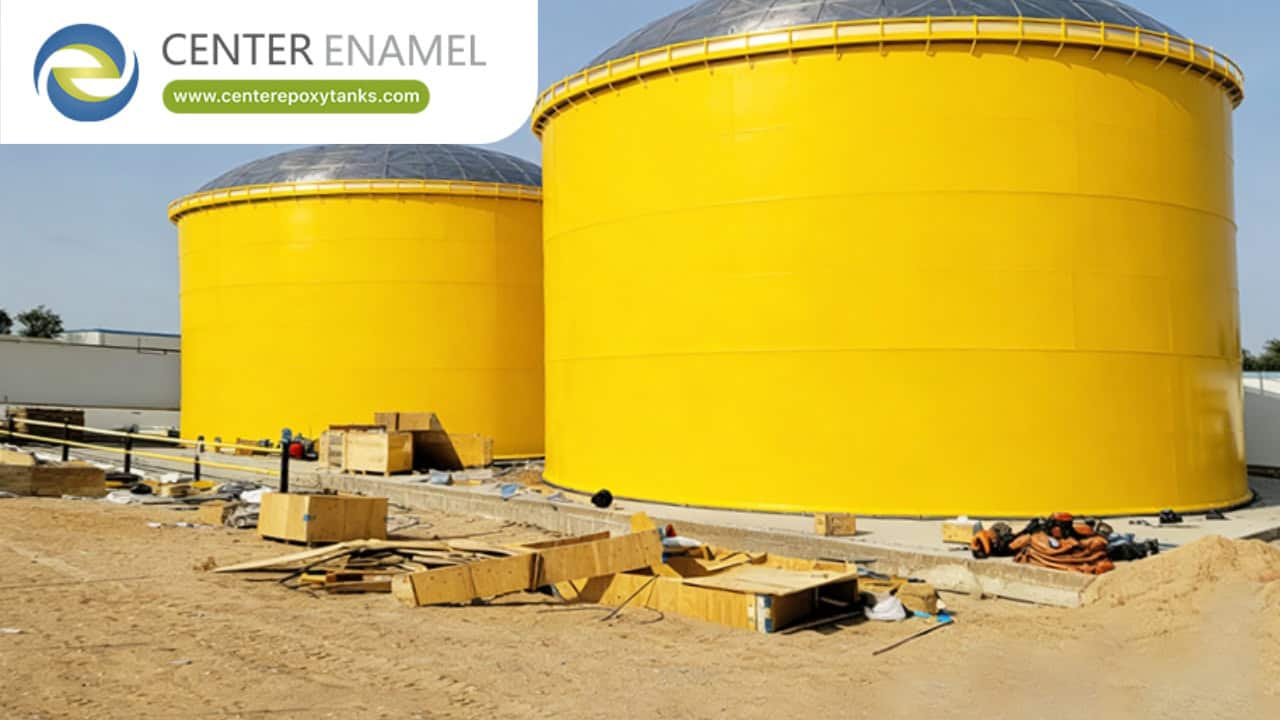
Industrial Purity Oil Tanks - Protecting Specification From Filling to Draw-Off
For transformer oil, white oil, process oils and other specification-critical streams, storage is part of the manufacturing process. A tank that admits moisture, sheds corrosion product or cannot be cleaned to a verified standard will take a product that met specification on dispatch and hand back one that does not. Dielectric strength, particle counts and water content are all measurable, and all of them can be lost in storage.
Purity is therefore a design requirement, not a housekeeping matter. Engineered by Shijiazhuang Zhengzhong Technology Co., Ltd. (Center Enamel), industrial purity oil tanks are built with the material, surface finish, sealing and blanketing provisions that keep the oil within specification from filling to draw-off.
1. What Does Purity Mean in Oil Storage?
It means the oil leaves the tank at the same specification it entered: water content, particle count and - for dielectric fluids - breakdown voltage all unchanged. Every design decision is made against those measurable limits.
· Water Content: Measured in parts per million and directly degraded by condensation and breathing.
· Particle Count: Controlled by surface finish, filtration and cleaning, and reported against a cleanliness standard.
· Dielectric Strength: For transformer oil, breakdown voltage is the parameter most sensitive to moisture.
· Oxidative Stability: Contact with air and with catalytic metals accelerates oxidation.
· Cleanability: The tank must be cleanable to a verifiable standard between campaigns.
2. How Is Moisture Kept Out?
By eliminating the breathing path. A sealed tank with nitrogen blanketing, a desiccant breather on any remaining vent, and no cool surface on which condensation can form will hold moisture far below an open-vented tank.
· Nitrogen Blanketing: A dry nitrogen pad excludes atmospheric moisture entirely where the specification requires it.
· Desiccant Breathers: Any vent path is fitted with a desiccant so incoming air is dried.
· Condensation Control: Insulation and a floating or sealed cover remove the cool surface where condensation forms.
· Dry Commissioning: The tank is dried and verified before first fill - moisture introduced at start-up is hard to remove later.
· Monitoring: Headspace humidity and oil water content are monitored rather than assumed.
3. Which Materials Suit Purity-Critical Service?
Stainless steel is the usual answer, with coated carbon steel where the specification permits. Surface finish, weld quality and the compatibility of every gasket and seal matter as much as the base metal.
· Stainless Steel: 304L or 316L with a specified internal surface finish; the standard for purity-critical oil service.
· Coated Carbon Steel: Used where the specification permits, with a coating compatible with the oil and verified after application.
· Weld Quality: Internal welds are smooth and crevice-free so they can be cleaned and cannot trap product.
· Gasket and Seal Compatibility: Every elastomer is selected for the oil and for the cleaning regime.
· Galvanic and Catalytic Review: Contact metals are reviewed because some catalyse oil oxidation.
Evaluation Criterion | Purity-Critical Tank | Standard Oil Storage Tank |
Headspace control | Nitrogen blanketing or desiccant breather | Open vent |
Condensation surface | Removed by cover or insulation | Present |
Internal material | Stainless or approved coating | Carbon steel |
Cleanability | Smooth welds, verified finish | Standard |
Verification | Water and particle testing | Visual |
Engineering Assurance and Project Support
Every welded oil tank delivered by Shijiazhuang Zhengzhong Technology Co., Ltd. (Center Enamel) is designed to API 650 with shell courses sized by the one-foot method and checked for wind, seismic and hydrostatic load cases, or to EN 14015 and the Eurocodes where the site is European. Shell plate is shot-blasted to Sa 2.5 and coated to a documented dry film thickness, longitudinal and annular plate welds are examined by radiography or ultrasonic testing to the acceptance level written into the purchase order, and every tank is hydrostatically tested and dimensionally surveyed before hand-over. Purity tanks are supplied with specified surface finish, weld maps, passivation records, blanketing and breather arrangements, dry commissioning procedures and the instrumentation needed to verify water content and cleanliness.
Frequently Asked Questions (FAQ)
Why does transformer oil need special storage?
Because its dielectric strength is extremely sensitive to moisture. Oil that meets specification on dispatch can fail breakdown voltage testing after storage in a tank that breathes moist air and condenses it back into the product. A sealed headspace, a desiccant breather and verified dry commissioning are what prevent that.
Is nitrogen blanketing always necessary?
It is the strongest control and is used where the specification is tightest. Where it is not justified, a desiccant breather on the vent path plus insulation and a sealed or floating cover achieves most of the benefit. The right choice depends on the oil's moisture limit and on how long it will be stored.
Should purity oil tanks be stainless?
Usually. 304L or 316L with a specified internal surface finish is the standard for purity-critical service because it does not shed corrosion product and can be cleaned to a verified standard. Coated carbon steel is used where the specification permits, with the coating selected for compatibility and verified after application.
Can the tank be customised for our specification?
Yes. Material and surface finish, weld finish and passivation, headspace control and blanketing, breather specification, insulation, outlet and sampling arrangements, cleaning access and instrumentation are all engineered to your oil specification and cleanliness requirements.


