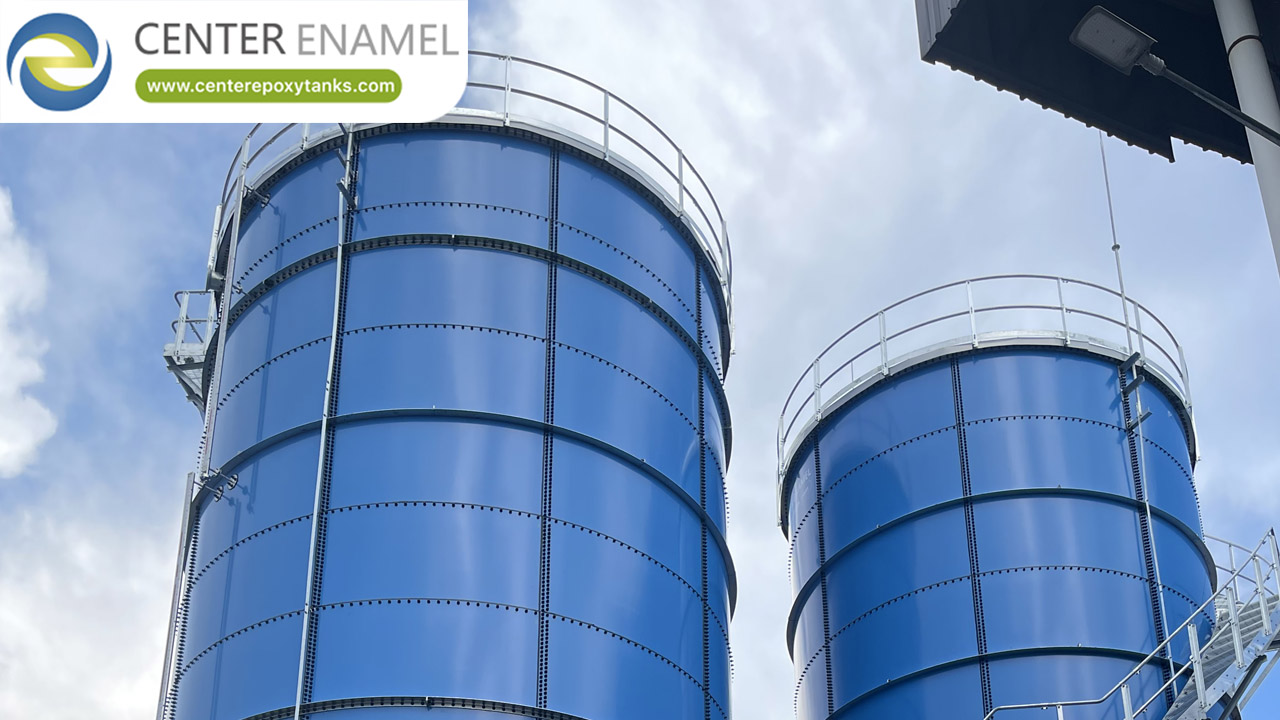
Industrial Boiler Feedwater Tanks - Storage That Protects the Boiler, Not Just the Water
Boiler feedwater storage is not water storage - it is corrosion control for the boiler. Water that arrives at the boiler carrying dissolved oxygen will pit tube metal, and water carrying hardness will scale it. Both failures happen inside equipment that is expensive, pressurised and difficult to repair, which is why the feedwater tank is designed as a process vessel rather than as a reservoir.
Engineered by Shijiazhuang Zhengzhong Technology Co., Ltd. (Center Enamel), industrial boiler feedwater tanks are built to support deaeration and chemical dosing, with the capacity, material and connections that keep dissolved oxygen low from the tank onward.
1. What Does a Feedwater Tank Actually Do?
It stores treated water, gives deaeration and dosing somewhere to work, and provides a buffer so the boiler is never starved. Every one of those functions protects downstream equipment.
· Storage Buffer: Provides reserve so demand peaks and supply interruptions do not reach the boiler.
· Deaeration Support: Where thermal deaeration is used, the tank receives and holds the deaerated water.
· Chemical Dosing Point: Oxygen scavenger and conditioning chemicals are dosed and mixed here.
· Temperature Retention: Keeping the water hot helps hold dissolved gases out.
· Steady Supply: A stable suction condition protects the feed pump from cavitation.
2. Why Is Dissolved Oxygen So Damaging?
Because it causes localised pitting rather than uniform corrosion, and pitting penetrates tube walls long before any overall metal loss would suggest. A small oxygen concentration sustained over time is enough to fail tubes.
· Pitting Mechanism: Oxygen attack is local, so damage is deep rather than spread.
· Temperature Acceleration: Oxygen corrosion accelerates sharply at feedwater temperature.
· Downstream Cost: The damage appears in the boiler and the condensate system, not in the tank.
· Control Points: Thermal deaeration, chemical scavenging and exclusion of air at the tank all contribute.
· Verification: Dissolved oxygen is measured rather than assumed.
3. What Capacity and Material Are Required?
Capacity follows boiler demand and the reserve the operator needs; material follows water chemistry and temperature. Stainless is common where treated water quality must be protected; coated carbon steel is used where the chemistry permits.
· Capacity Basis: Sized from boiler demand, condensate return rate and the required reserve period.
· Material: Stainless where water purity is critical; coated carbon steel where chemistry permits.
· Temperature Rating: The tank and its coating must suit hot, treated water.
· Connections: Return, make-up, dosing, vent, overflow, drain and pump suction are arranged to avoid short-circuiting.
· Cleaning and Inspection: Access is provided so the tank can be inspected and cleaned on schedule.
Evaluation Criterion | Purpose-Built Feedwater Tank | General Water Storage Tank |
Design intent | Boiler protection | Volume storage |
Temperature capability | Hot treated water | Ambient |
Deaeration and dosing provision | Designed in | Absent |
Material | Stainless or approved coating | Carbon steel |
Instrumentation | Level, temperature, dissolved oxygen | Level only |
Engineering Assurance and Project Support
Every welded oil tank delivered by Shijiazhuang Zhengzhong Technology Co., Ltd. (Center Enamel) is designed to API 650 with shell courses sized by the one-foot method and checked for wind, seismic and hydrostatic load cases, or to EN 14015 and the Eurocodes where the site is European. Shell plate is shot-blasted to Sa 2.5 and coated to a documented dry film thickness, longitudinal and annular plate welds are examined by radiography or ultrasonic testing to the acceptance level written into the purchase order, and every tank is hydrostatically tested and dimensionally surveyed before hand-over. Feedwater tanks are supplied with capacity sized from your boiler demand, material matched to water chemistry, connections arranged to avoid short-circuiting, insulation, instrumentation and access for inspection and cleaning.
Frequently Asked Questions (FAQ)
How large should a boiler feedwater tank be?
It is sized from boiler demand, the rate and reliability of condensate return, and the reserve period the operator needs to ride through a supply interruption. Undersizing risks starving the boiler and cavitating the feed pump; oversizing wastes space and heat. The calculation starts from your actual demand profile rather than from a rule of thumb.
Should a feedwater tank be stainless or carbon steel?
Stainless where treated water purity must be protected and where the chemistry or temperature demands it. Coated carbon steel is used where the water chemistry permits, with the coating selected for hot treated water and applied over verified surface preparation. The tank's coating or alloy must suit the temperature, not just the chemistry.
How is dissolved oxygen controlled?
In layers: thermal deaeration upstream where it is installed, chemical oxygen scavenger dosed and mixed in the tank, and exclusion of air at the tank itself through a properly vented but protected headspace. Dissolved oxygen is measured at the tank outlet so the control is verified rather than assumed.
Can the tank be customised for our boiler house?
Yes. Capacity and geometry, material and coating, insulation and cladding, connection schedule arranged to avoid short-circuiting, dosing and sampling points, instrumentation, access and cleaning provision are all engineered to your water chemistry, temperature and demand profile.


