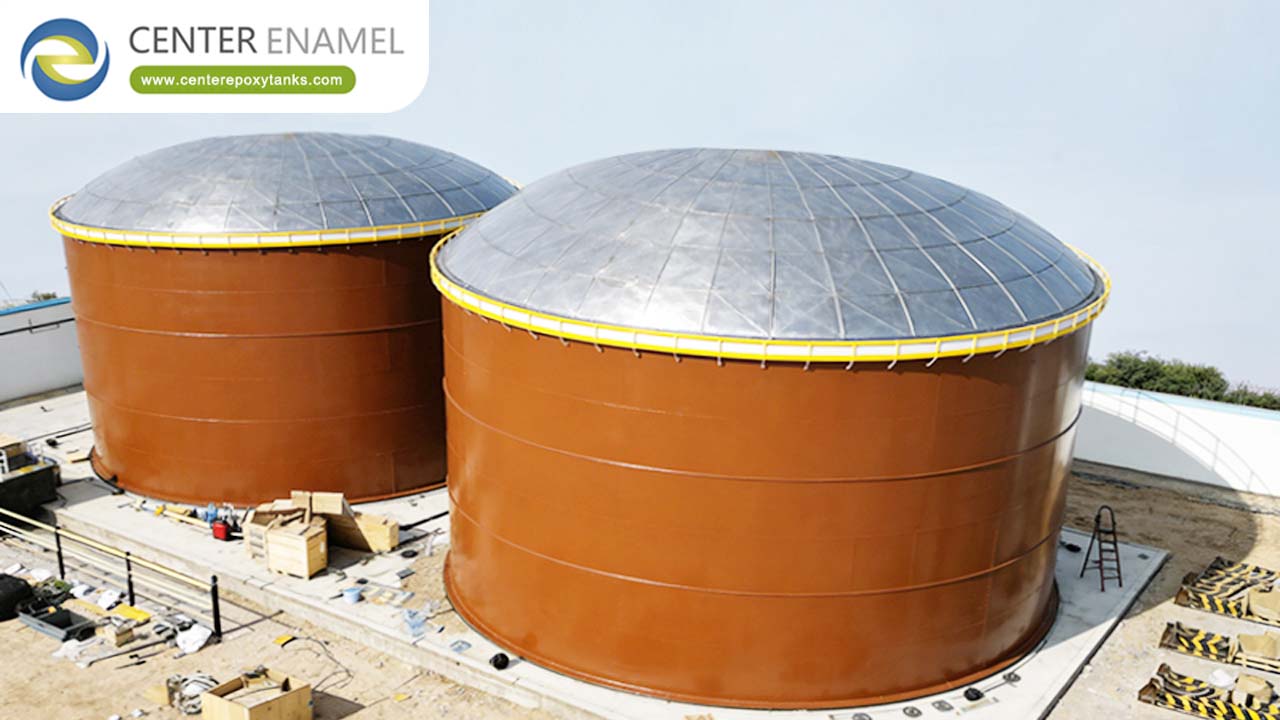
GFS Lubricant Oil Tanks - Inert Storage for Base Oils and Finished Lubricants
Lubricants are specification products. A base oil or finished lubricant that picks up rust particles, water or residue from a previous batch loses the properties it was blended to achieve, and the loss often shows up only after the product has been blended, packed and dispatched. Storage is therefore a quality step, and the tank surface is the part that decides whether it protects or degrades the product.
Engineered by Shijiazhuang Zhengzhong Technology Co., Ltd. (Center Enamel), glass-fused-to-steel tanks give a hard, inert, non-reactive surface that does not shed corrosion product, is smooth enough to clean reliably, and is economically viable at volumes where stainless becomes prohibitive.
1. Why Store Lubricants in a GFS Tank?
Because the surface is inert and cleanable, and because the economics work at volume. The glass layer is fused to the steel at 820-930 degrees Celsius, so it cannot flake the way a paint or a loose lining can, and it does not react with hydrocarbon product.
· Inert Contact Surface: Fused glass does not react with base oils or finished lubricant formulations.
· No Corrosion Product: Unlike bare steel, the tank cannot contribute rust particles to the product.
· Smooth and Cleanable: The fired surface releases residue, supporting campaign changeover.
· Economics at Volume: Glass-fused-to-steel is substantially cheaper than stainless at large capacities.
· Long Service Life: A properly specified GFS tank gives decades of service with minimal maintenance.
2. Is the Glass Surface Compatible With Oil?
Yes. Fused glass is inert to hydrocarbons and to lubricant additives in normal service. The compatibility question on a bolted oil tank is not the glass - it is the joint sealant, which must be selected for hydrocarbon service.
· Glass Inertness: The fused surface is chemically inert to oils and to typical additive packages.
· Sealant Selection: Joint sealant is specified for hydrocarbon immersion, not for water service.
· Gasket Compatibility: Nozzle and manway gaskets are selected for oil and operating temperature.
· Temperature Consideration: Heated lubricant storage is accommodated within the system's design envelope.
· Written Compatibility: The sealant and gasket schedule is documented for the product.
3. How Are Lubricant Tanks Cleaned and Maintained?
With compatible cleaning agents, complete drainage and verified drying before refilling. Because the surface is smooth and inert, cleaning is more reliable than on a coated steel tank, but the procedure still matters.
· Complete Drainage: The floor is arranged so product and cleaning fluid drain fully.
· Compatible Cleaning Agents: Selected for the product and for the glass surface.
· Drying Before Refill: Moisture is the main contaminant risk, so the tank is dried before returning to service.
· Inspection: The interior is inspected visually at internal examination; the fused surface does not need recoating.
· Sparking Test Baseline: The delivered surface is holiday tested, giving a baseline for condition.
Evaluation Criterion | Glass-Fused-to-Steel | Stainless Steel | Coated Carbon Steel |
Surface reactivity with oil | Inert | Inert | Depends on coating |
Corrosion product risk | None | None | Present if coating fails |
Cost at large capacity | Moderate | High | Low |
Cleanability | Good | Excellent | Good while coating is sound |
Recoating requirement | Never | Never | Periodic |
Engineering Assurance and Project Support
Every welded oil tank delivered by Shijiazhuang Zhengzhong Technology Co., Ltd. (Center Enamel) is designed to API 650 with shell courses sized by the one-foot method and checked for wind, seismic and hydrostatic load cases, or to EN 14015 and the Eurocodes where the site is European. Shell plate is shot-blasted to Sa 2.5 and coated to a documented dry film thickness, longitudinal and annular plate welds are examined by radiography or ultrasonic testing to the acceptance level written into the purchase order, and every tank is hydrostatically tested and dimensionally surveyed before hand-over. GFS lubricant tanks are supplied with the panels fired and holiday tested, a hydrocarbon-compatible sealant and gasket schedule, complete drainage, heating and insulation where required, and cleaning access sized for campaign changeover.
Frequently Asked Questions (FAQ)
Why use glass-fused-to-steel instead of stainless for lubricants?
Economics at capacity. Stainless gives an excellent surface but becomes expensive at large volumes, while glass-fused-to-steel provides an inert, smooth, non-shedding surface at a substantially lower cost and with no recoating requirement. For large base oil and finished lubricant storage, that difference usually decides it.
Does the bolted joint leak with oil inside?
Not when the sealant is specified for hydrocarbon service. This is the key detail on a bolted oil tank: the fused glass panels are inert to oil, so the compatibility question belongs to the joint sealant and the gaskets. We specify a hydrocarbon-compatible sealant and document the sealant and gasket schedule for the product.
Can GFS tanks store heated lubricants?
Within the system's design envelope, yes. Heavier base oils and some finished products are stored warm to stay pumpable, so heating and insulation are provided where needed and the operating temperature is confirmed against the tank design before the order is placed.
Can the tank be customised for our product?
Yes. Capacity and geometry, roof type, sealant and gasket schedule matched to your product, heating and insulation, complete drainage, nozzle and manway arrangement, blanketing provision, instrumentation and cleaning access are all engineered to your lubricant grades and process.


