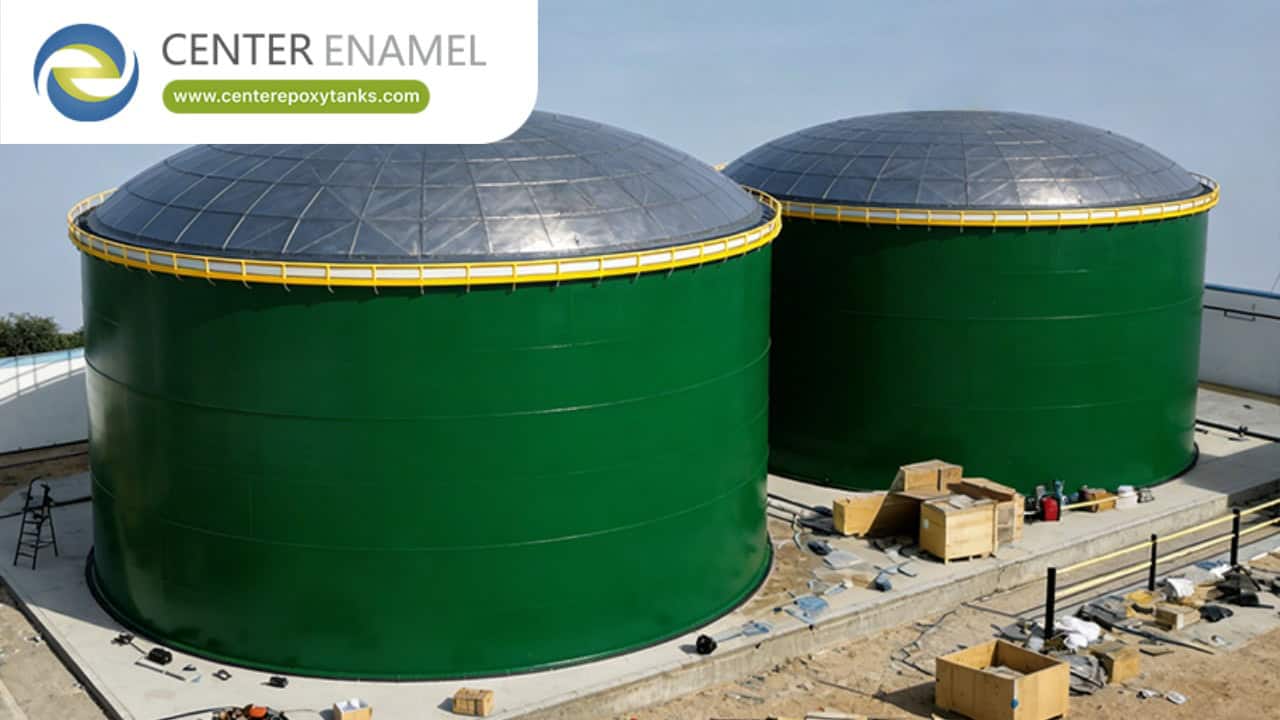
Large-Scale Unrefined Oil Storage - Engineering Very Large Crude Tanks
Above roughly fifty thousand cubic metres, the engineering of a crude tank stops being about the steel and starts being about the ground. Shell plate thickness is governed by hydrostatic head, annular ring stresses rise sharply, and differential settlement - a millimetre-scale problem on a small tank - becomes the parameter that decides whether a floating roof will still travel freely in twenty years. Construction sequence, welding distortion and hydrotest procedure all become first-order concerns.
Engineered by Shijiazhuang Zhengzhong Technology Co., Ltd. (Center Enamel), large-scale unrefined oil storage is designed with the foundation, the shell and the roof treated as one system, and with a construction and testing plan that controls the variables which dominate at that scale.
1. What Changes When Tanks Get Very Large?
The governing constraint shifts from plate supply to foundation behaviour and construction control. The loads are larger, the tolerances are tighter relative to diameter, and the consequences of distortion are much more serious.
· Annular Ring Demand: The shell-to-bottom junction carries the highest stress and needs higher-strength material and careful detailing.
· Settlement Sensitivity: A floating roof needs a shell that stays round; differential settlement destroys that.
· Welding Distortion: Large volumes of field welding introduce distortion that has to be managed by sequence.
· Wind and Seismic: Larger diameter and height raise environmental load demand.
· Outage Consequence: A very large tank out of service represents a large share of terminal capacity.
2. Why Does Foundation Settlement Dominate?
Because geometry governs operability. Uniform settlement is largely tolerable; differential settlement distorts the shell, opens floating roof seal gaps, and can bind the deck so it cannot travel.
· Differential vs Uniform: Differential movement is the damaging form and is what the foundation design controls.
· Roof Travel: A distorted shell means a floating roof binds or leaves a variable seal gap.
· Shell Stress: Out-of-round geometry introduces stresses the shell was not designed for.
· Monitoring: Settlement is monitored during hydrotest and periodically thereafter.
· Baseline Survey: Elevations and roundness are recorded at handover for future comparison.
3. How Are Very Large Tanks Built and Tested?
With a controlled sequence: foundation prepared and surveyed, bottom laid and seam-tested, shell courses erected and welded in a planned order, roof installed, then hydrostatic testing with settlement monitoring throughout.
· Foundation Preparation: Compacted pad or piled foundation designed for the load and the soil conditions.
· Bottom Construction: Plates are laid, welded and seam-tested before shell erection begins.
· Shell Erection: Courses are erected and welded in a sequence that controls distortion.
· Roof Installation: Floating roofs are usually built on the tank floor and lifted or assembled as the shell rises.
· Hydrostatic Testing: Filled in stages with settlement and shell behaviour monitored at each stage.
Evaluation Criterion | Very Large Crude Tank | Medium Crude Tank |
Governing constraint | Foundation settlement and geometry | Plate thickness and cost |
Annular ring material | Higher strength, carefully detailed | Standard |
Construction control | Sequenced welding, distortion management | Standard practice |
Hydrotest approach | Staged with settlement monitoring | Standard fill and hold |
Outage consequence | Large share of terminal capacity | Manageable |
Engineering Assurance and Project Support
Every welded oil tank delivered by Shijiazhuang Zhengzhong Technology Co., Ltd. (Center Enamel) is designed to API 650 with shell courses sized by the one-foot method and checked for wind, seismic and hydrostatic load cases, or to EN 14015 and the Eurocodes where the site is European. Shell plate is shot-blasted to Sa 2.5 and coated to a documented dry film thickness, longitudinal and annular plate welds are examined by radiography or ultrasonic testing to the acceptance level written into the purchase order, and every tank is hydrostatically tested and dimensionally surveyed before hand-over. Very large tanks are delivered with foundation loading data, settlement monitoring during staged hydrotesting, weld maps and examination records, and a dimensional survey baseline for the roof and shell.
Frequently Asked Questions (FAQ)
How large can a crude oil storage tank be built?
Very large crude tanks of well over one hundred thousand cubic metres are built and operated routinely, with diameters in the range of eighty to one hundred metres. The practical limits are not the steel but the foundation's ability to carry the load without differential settlement, transport access for plate, and the construction method available on site.
Why is settlement monitoring so important during hydrotesting?
Because the hydrotest is the first time the foundation sees full load, and it is the last opportunity to observe behaviour before the tank enters service. Filling in stages with settlement monitored at each stage confirms the foundation is behaving as designed and gives the data needed to predict long-term performance.
What is an annular ring and why does it matter?
It is the ring of bottom plate directly beneath the shell, which carries the highest stress in the tank because it transfers the shell load into the foundation. On very large tanks it is made from higher-strength material and detailed carefully, because a failure there is a failure of the whole tank.
Can the tank be customised for our terminal?
Yes. Diameter and height, shell and annular ring material, roof type, foundation loading data, construction method, heating and insulation, instrumentation, containment and access are all engineered to your capacity, soil conditions and site constraints.


