Internal Floating Roof Vapor Emission Control: What Actually Works
An internal floating roof reduces vapour loss by removing the large vapour space above the product, but the reduction is not automatic. Emissions occur through four identifiable paths, and the condition of the seals and fittings decides how much the roof actually achieves. This article explains the mechanism and the control hierarchy that follows from it.
Why the Vapour Space Shrinks
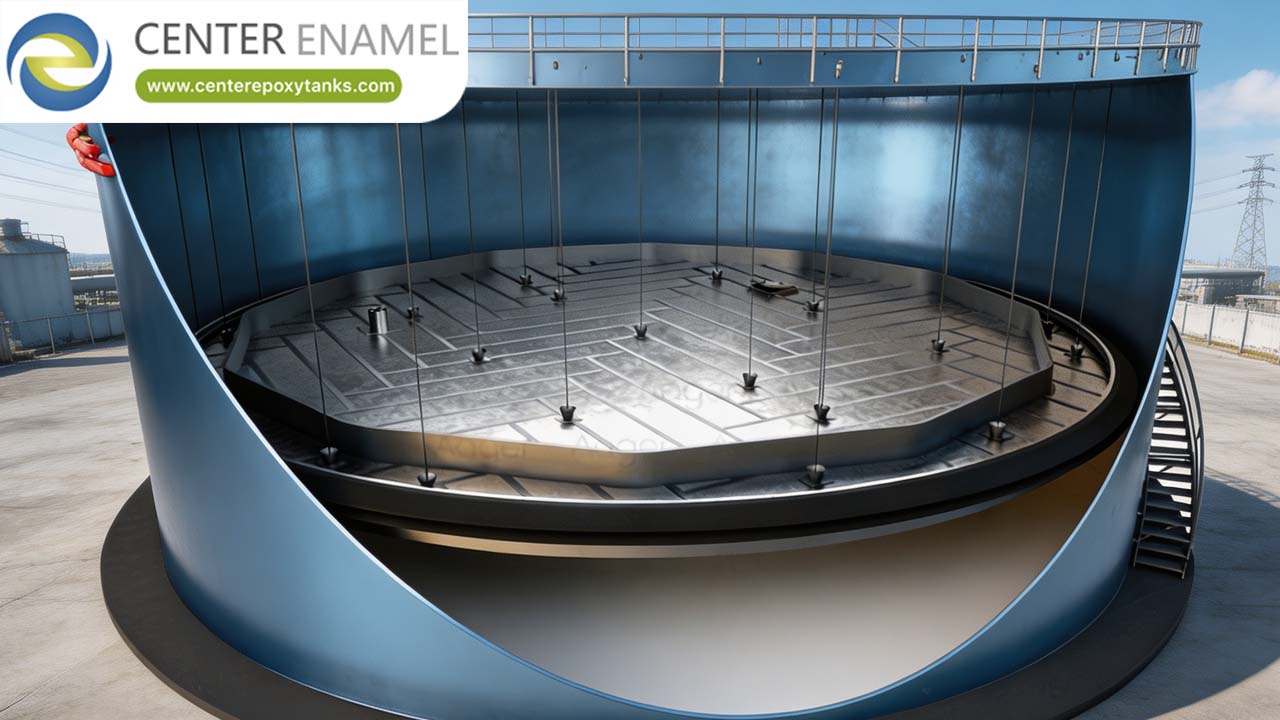
A fixed-roof tank has a vapour space that grows as the liquid level falls, and evaporation continues until that space approaches saturation. An internal floating roof floats on the liquid, so the space above the product is reduced to a small volume just above the deck that stays roughly constant as the level changes.
That is the primary mechanism, and it is why a floating roof is a recognised control for volatile liquids. The reduction is physical, not a matter of adding a chemical or operating at a different pressure.
The result still depends on how well the remaining small space is isolated. A deck with a poor seal or open fittings gives the vapour a route out and loses much of the benefit.
The Four AP-42 Paths
AP-42 Chapter 7 Section 7.1 breaks emissions from floating roof tanks into rim seal, withdrawal, deck fittings and deck seam. Rim seal loss is wind driven and, for an external roof, is usually the largest component. Withdrawal loss comes from liquid film clinging to the shell as the level falls. Deck fittings leak around hatches, wells, vents and legs, and deck seam loss applies to bolted decks.
A technical summary of the methodology explains that the vapour function P* derives from Raoult's law and approaches unity as the product's true vapour pressure approaches atmospheric pressure, while most refined products and crudes operate in a lower range. That is a formal way of saying that product volatility sets the ceiling on what any roof can achieve.
Use the four paths as an investigation tool. If a tank is still losing product, decide which path is responsible before spending money on a different deck.
Seals and Fittings as Control Points
A technical discussion citing AP-42 methodology states that secondary seals cut rim loss by roughly sixty to eighty percent versus a primary-only arrangement, and that a rim-mounted secondary is the most common form. That is a supplier-side technical summary, so confirm the basis before adopting the number, but the direction is clear.
Fittings deserve equal attention. The same summary lists fitting factors and notes that an open slotted gauge well can equal twenty gasketed access hatches in loss, making gasketed wells one of the quickest emission improvements available.
Under 40 CFR 60.112b, sample wells must have a fabric cover over at least ninety percent of the opening, and access hatches and gauge float wells must be bolted except when in use. These are not ceremonial requirements; they close specific paths in the AP-42 inventory.
What the US Rules Require
The Federal Register discussion of Subpart Kb and Subpart WW describes these standards as combinations of design, equipment, work-practice and operational requirements. They require a rim seal around the circumference, gasketed covers on deck fittings kept closed except in use, and visual inspections for defects such as holes, tears or covers that no longer close properly.
The same source notes that Subpart WW applies to storage vessels containing organic materials and that inspections under both rules occur within defined timeframes. It also explains that, where visual access exists, inspection may be conducted from the top side of the floating roof while the tank remains in service.
State rules add their own requirements. The Louisiana implementation plan referenced here sets seal and penetration rules that should be checked where that jurisdiction applies.
Making a Credible Reduction Claim
Suppliers often quote a single percentage, such as up to ninety-eight percent reduction. That figure can be meaningful, but only with the product vapour pressure, deck architecture, seal arrangement and estimation method stated. Without those, the number is marketing.
Build the claim from the AP-42 paths for your product and configuration, then verify the seal and fitting condition in service. A deck that was compliant on paper can drift out of compliance as a seal wears.
Where a regulator or client requires a specific method, use that method and keep the calculation with the inspection records. No internal floating roof project is held in the verified project library, so no measured reduction is claimed here.
A Practical Control Hierarchy
Start with the right deck architecture for the product volatility. Add a primary seal suited to the shell condition and product, and a secondary where the emission target or jurisdiction calls for it. Then close every fitting: hatches, wells, vents, legs and penetrations. Finally, set an inspection frequency that will catch wear before it becomes a reportable defect.
This order reflects the AP-42 paths and the rule requirements, and it is usually cheaper than trying to compensate for a poor seal with a more expensive deck.
Document the basis of each decision, because the next inspection or audit will ask why the roof was specified as it was.
Internal Versus External Roof Paths
The AP-42 paths are the same in principle for internal and external roofs, but their weight differs. An external roof has a large rim-seal term driven by wind and direct weather; an internal roof sits under a fixed cover, so weather loading is removed and fitting and seal condition dominate.
That difference changes where effort pays off. On an external roof, a weather shield and rim seal may be the priority; on an internal roof, the gauge wells, sample ports and column sleeves deserve equal attention.
Use the correct configuration when estimating losses. Applying an external-roof assumption to an internal roof will misstate the result.
Verifying the Result in Service
A designed reduction is an estimate until the roof is inspected. Verify seal contact, fitting closure and deck freedom at the frequencies set by the applicable rule, and keep the records where the original basis can be compared with the observed condition.
Where a client or regulator asks for a percentage, state the product, method and configuration behind it. A number without that context is not a defensible claim.
No internal floating roof project is held in the verified project library, so no measured emission result is claimed here.
Fitting inventories
Make a complete inventory of deck fittings for each tank and treat each item as a potential emission path. Hatches, gauge wells, sample ports, bleeder and rim vents, legs and stub drains all appear in the regulatory and AP-42 discussions cited here.
An inventory turns a vague intention to check fittings into a task with a defined count and a defined result.
When a percentage is not enough
A regulator or client may ask for a guaranteed reduction. State what can and cannot be supported: an estimate from an accepted method with stated assumptions is defensible; an unconditional guarantee for an unknown product and seal condition is not.
No internal floating roof project is held in the verified project library, so no measured reduction is claimed here.
Keeping the Basis Current
Emission estimates age as the product, seal and operating pattern change. Revisit the basis after any service change, seal replacement or significant repair, and record the revised estimate.
A calculation kept from commissioning may no longer describe the tank, and a compliance claim based on it would be misleading.
AP-42 Emission Paths
Path | Driver | Primary control |
Rim seal | Wind and vapour pressure | Seal type and condition |
Withdrawal | Liquid film on shell | Operating practice |
Deck fittings | Open or worn covers | Gaskets and closed lids |
Deck seam | Bolted seam length | Joint integrity |
The four paths below are the AP-42 framework. Use them to decide where a control will actually reduce loss on this tank.
Evidence note: this emission-control guide is an engineering explanation, not a project record. The verified project library contains no internal floating roof delivery, so no measured emission reduction is claimed from our work. Figures and requirements are attributed to the named public sources.
Conclusion
Internal floating roof emission control is a system result: a suitable deck, a primary and often secondary seal, closed and gasketed fittings, and disciplined inspection. Use the AP-42 paths to decide where effort pays off, state the basis of any percentage claim, and meet the applicable rule rather than assuming that a deck alone is compliance.
Frequently Asked Questions
Q: How does an IFR reduce vapour loss?
A: It floats on the product so the volume above the liquid is reduced to a small space above the deck, rather than a tank-sized space that grows as the tank empties.
Q: What are the AP-42 emission paths?
A: Rim seal, withdrawal, deck fittings and deck seam. Each has its own estimation method, and their relative importance differs between internal and external roofs.
Q: Why do deck fittings matter so much?
A: Each hatch, gauge well, vent and leg is a potential leak path. An open slotted gauge well can equal many gasketed access hatches in loss.
Q: What does a secondary seal do?
A: It adds a second closure above the primary, reducing vapour that bypasses the first. A technical summary puts rim-loss reduction at roughly sixty to eighty percent against primary-only.
Q: What rules apply in the United States?
A: 40 CFR 60 Subpart Kb and 40 CFR 63 Subpart WW set design, equipment, work-practice and inspection requirements for floating roof tanks above defined thresholds.
Q: Can I quote a single percentage reduction?
A: Only with its basis. Percentages depend on product vapour pressure, deck type, seal arrangement and the method used; state those assumptions.
Work With Center Enamel
Center Enamel is the trading name of Shijiazhuang Zhengzhong Technology Co., Ltd, established in 2008 and based in Shijiazhuang, Hebei Province, China. The company manufactures glass-fused-to-steel bolted tanks, fusion-bonded epoxy coated tanks, stainless steel and welded steel tanks, pressure vessels, aluminium geodesic dome roofs and floating roof systems. Aluminium dome design work is carried out against AWWA D108, API 650, ADM 2015, ASCE 7-10 and IBC 2012, and the broader product range is covered by ISO 9001, NSF/ANSI 61, CE/EN 1090, ISO 28765, WRAS and FM approvals. The company reports 30,000 installed projects and an annual output of 300,000 enamel steel plates, with technical support delivered through an international distributor network and a stated 24-hour response commitment.
If your project involves tank roofs, floating decks or the shells that carry them, send the tank diameter, shell height, product, operating temperature and site design loads. We will return a preliminary structural concept, the applicable design code basis, and a written scope that separates what is included from what the site contractor must provide.


