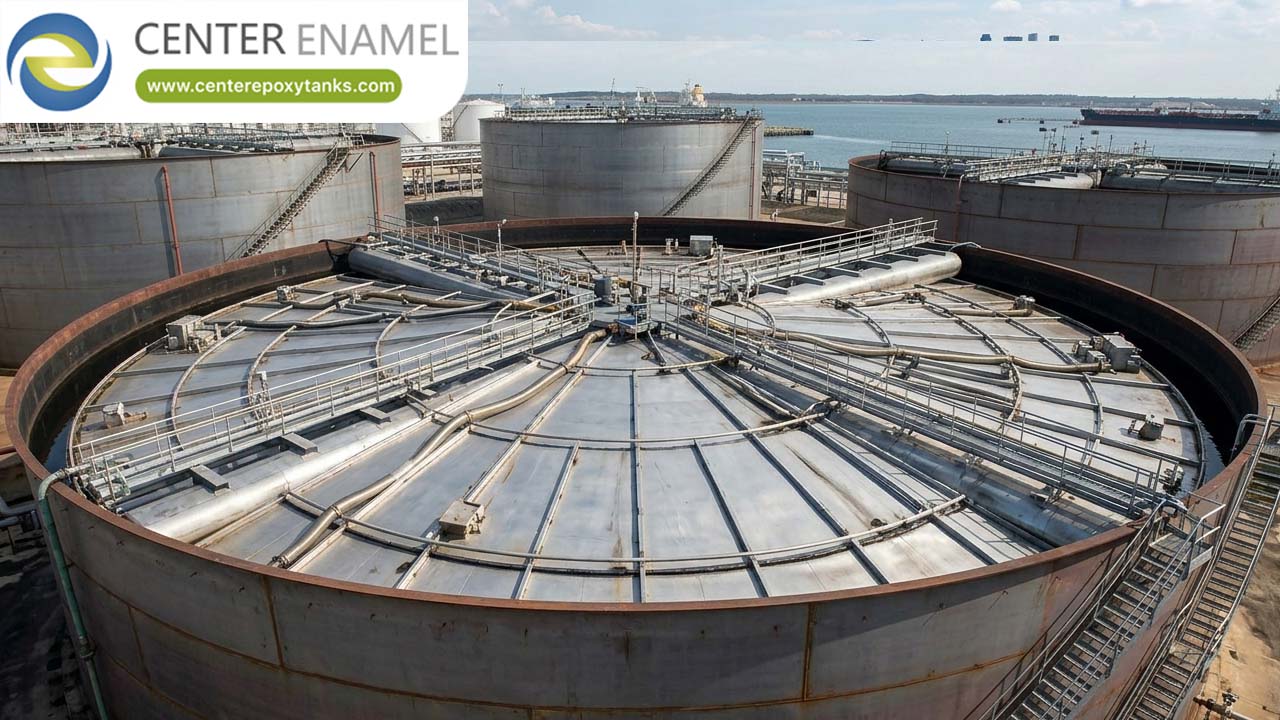
Aluminum Internal Floating Roof Cost: What Drives the Number
There is no honest single number for an aluminium internal floating roof cost. The price is driven by deck area, pontoon and seal configuration, tank geometry, the product's chemistry and the scope of installation and inspection. This article explains those drivers so you can read a quotation and compare bids on the same basis. It deliberately gives no price of our own, because the verified project library contains no IFR cost record.
Why There Is No Universal Number
A search for an aluminium internal floating roof cost usually wants a figure, but the honest answer is a structure. The same roof design costs differently at ten metres and forty metres diameter, with a simple seal and with a dual-seal system, in a clean new tank and in a retrofit with internal columns. Any single number quoted without those inputs is not a usable budget.
This article therefore treats cost as a function of scope. It explains what belongs in the scope and how each item moves the number, so that a buyer can build a comparison that means something. It does not invent a price, because the verified project library contains no internal floating roof and no associated cost record.
The discipline matters commercially. Two bids that look far apart may be quoting different seal systems or different documentation; two bids that look similar may be assuming different tank conditions. The first job is to make the scopes identical.
Diameter and Deck Area Set the Base
Cost driver | Why it moves the number | Input to provide |
Tank diameter | Sets deck area, panels and pontoons | Diameter and shell height |
Seal system | Different constructions and elastomers | Product and required seal type |
Material choice | Aluminium versus stainless compatibility | Product and cleaning regime |
Installation access | Manway size and internal obstructions | Manway and obstruction survey |
Documentation | Tests, records and as-built package | Required deliverables list |
Tank diameter is the first driver because it determines the deck area, the panel count and the number of pontoons required to keep the roof buoyant and level. A published aluminium roof specification describes a skin material and pontoon tubing sized for that purpose; the quantity of each scales with area, and so does the fabrication and handling effort.
Large diameters add effects beyond area. Panels must be transported and passed through a manway, the deck must be rigid enough to stay level across a wide span, and the load on the supporting structure rises. Published comparisons note that internal roofs are often lightweight to reduce shell load, while very large tanks sometimes favour external roofs for structural economy.
For budgeting, record diameter, shell height, manway size and internal obstructions before requesting a price. Those four inputs alone eliminate much of the variation between apparently similar quotations.
Seal and Material Choices Are Separate Line Items
The perimeter seal is a distinct cost element and one of the most variable. A liquid-mounted seal, a mechanical-shoe seal and a stacked dual-seal arrangement are different systems, and the elastomer grade must suit the product. Published rules such as Louisiana's require specific seal arrangements in named parishes, so the permit can decide this item for you.
Deck material is the next variable. Aluminium is commonly used and light; a supplier specification gives one such material set. Stainless is selected where the product or cleaning regime justifies it. The right comparison is the life-cycle cost of each in the actual service, not the price per square metre in isolation.
Fittings and hardware belong in the same review. Gauge wells, bleeder vents, drains, grounding and column sleeves are all part of a functioning roof, and a quotation that omits them is not cheaper, it is incomplete.
Installation, Testing and Outage Time
The supplied price is not the installed cost. Access through the manway, assembly inside the tank, torque control, seal fitting against the real shell and a documented float test all require site time. A manufacturer installation guide describes these phases; each is a real cost, and each is easy to miss in a budget built from a deck price.
Outage time is the larger hidden item. If the tank must be taken out of service, cleaned and gas-freed before work can start, the production or logistics cost can exceed the hardware. A buyer should state who provides the tank, the cleaning and the access, so the comparison is complete.
Inspection obligations continue after installation. A roof that is harder to inspect, such as one behind a fixed roof with limited access, carries a future cost in outage planning. Include it in the comparison where the site's inspection regime is demanding.
Compare on Life-Cycle Cost, Not Purchase Price
The reason to install a floating roof is to reduce standing vapour loss over many years. Published terminal guidance indicates that floating roofs substantially reduce standing losses compared with an uncontrolled fixed roof, while noting that recovery may still be needed depending on the permit and loading operation. That means the useful comparison includes both the roof cost and any remaining recovery cost.
For a high-value product in a high-throughput tank, the avoided product loss may justify a higher-specification roof and seal. For a low-volatility product in a seldom-used tank, the same spending may never pay back. Throughput and product value decide the economics, not the roof design alone.
Include maintenance and seal renewal in the life-cycle model. A cheaper seal that must be replaced more often, or that is incompatible with the cleaning regime, can cost more over the roof's life than a better initial specification.
How to Request a Comparable Quotation
Send the same package to every bidder: tank diameter and height, product and vapour pressure, jurisdiction and permit basis, seal requirement, internal obstructions, manway size, required tests and documentation deliverables. Ask each bidder to price that package and to identify any exclusions explicitly.
Ask for alternatives as separate lines, not mixed into one total. An option for a different seal or a stainless deck should be priced so you can accept or decline it with a clear understanding of what changes.
Finally, keep the evidence boundary in view. No internal floating roof cost exists in our verified library, and this article gives none. The value here is a method that turns an unanswerable question — what does it cost? — into a comparable set of scoped bids.
The Cost of Product Loss and Lost Availability
A quotation covers hardware; it does not cover the product the roof is meant to save. For a high-value volatile product, standing and working losses over a year can outweigh a difference in roof price, which is why the loss estimate belongs beside the bid. Use the applicable emission method and the site's actual throughput rather than a generic percentage.
Availability is the other hidden line. If a cheaper roof needs more frequent seal renewal or cannot be inspected without a long outage, the production cost can exceed the saving. Ask how each offered design will be inspected and how long a seal change takes, then price the outage that follows.
Put both into a simple life-cycle comparison: purchase, installation, inspection, seal renewal and estimated product loss over the same period for each option. A comparison that stops at purchase price is not a comparison of the roofs, only of the invoices.
How Seal Choice Reshapes the Whole Quote
The seal is small in mass and large in consequence. Changing from a simple liquid-mounted arrangement to a dual-seal system alters material, fitting and inspection scope, and it can decide whether the tank meets its permit without extra recovery equipment. Treat the seal as a design decision before treating it as a line item.
Elastomer grade moves the price in a different way. A fluorocarbon or PTFE-faced system suited to aromatics costs more than a nitrile face, but specifying nitrile for a product that attacks it produces a roof with a short and expensive life. The compatibility matrix should settle the grade before the bid is requested.
Ask each bidder to price the same seal basis and then to price the alternative separately. That way the comparison shows what a better seal costs rather than leaving each supplier to guess which one the buyer intended.
Evidence disclosure for this cost article: the verified project library contains no internal floating roof and no cost record for one, so no price, budget, saving or payback figure is claimed from our own work. Any cost relationships described are structural drivers only and are attributed to the named public sources where a figure is quoted.
Conclusion
Read an aluminium internal floating roof quotation as a set of drivers: diameter and deck area, pontoon and seal configuration, material compatibility, installation access and inspection scope. Compare bids only on identical inputs and with the same documentation deliverables. Do not accept a single price as meaningful without those boundaries, and do not expect a figure from our library that does not exist.
Frequently Asked Questions
Q: Why is there no typical price in this article?
A: Because cost depends on diameter, seal specification, material and scope, and our verified project library holds no internal floating roof quotation. Inventing a number would violate the evidence boundary.
Q: What is the biggest driver of deck cost?
A: Tank diameter, because it sets the deck area and the number of panels and pontoons. Large diameters also change structural and handling requirements.
Q: How much does the seal choice affect cost?
A: Significantly. A liquid-mounted, mechanical-shoe or dual-seal arrangement, and the elastomer grade, are separate line items and can differ substantially between bids.
Q: Is aluminium cheaper than stainless?
A: Aluminium is generally lighter and often less expensive for a given deck, but the right choice depends on product compatibility and cleaning regime. Compare on life-cycle basis, not material price alone.
Q: What installation costs are easy to miss?
A: Access and manway constraints, internal obstructions, float testing, torque records, and any outage time needed for commissioning or inspection.
Q: Does a floating roof remove other costs?
A: It can reduce standing product loss, but it does not necessarily remove vapour recovery, which depends on the permit and the loading operation.
Work With Center Enamel
Center Enamel is the trading name of Shijiazhuang Zhengzhong Technology Co., Ltd, established in 2008 and based in Shijiazhuang, Hebei Province, China. The company manufactures glass-fused-to-steel bolted tanks, fusion-bonded epoxy coated tanks, stainless steel and welded steel tanks, pressure vessels, aluminium geodesic dome roofs and floating roof systems. Aluminium dome design work is carried out against AWWA D108, API 650, ADM 2015, ASCE 7-10 and IBC 2012, and the broader product range is covered by ISO 9001, NSF/ANSI 61, CE/EN 1090, ISO 28765, WRAS and FM approvals. The company reports 30,000 installed projects and an annual output of 300,000 enamel steel plates, with technical support delivered through an international distributor network and a stated 24-hour response commitment.
If your project involves tank roofs, floating decks or the shells that carry them, send the tank diameter, shell height, product, operating temperature and site design loads. We will return a preliminary structural concept, the applicable design code basis, and a written scope that separates what is included from what the site contractor must provide.


