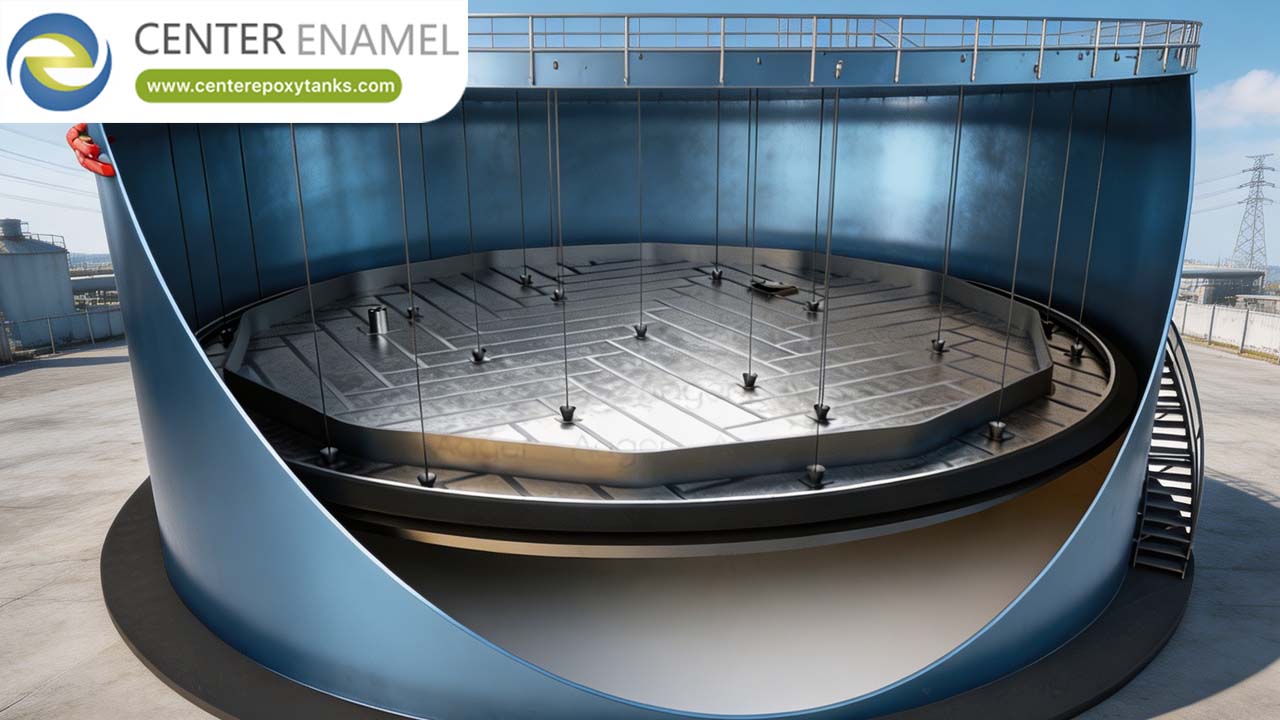
Internal Floating Roof Tank Manufacturer: How to Qualify Capability
Choosing an internal floating roof tank manufacturer is not a matter of comparing brochures. The roof is a moving safety-and-emission component inside a live tank, and the differences that matter sit in design capability, material control, testing and documentation. This article gives a technical qualification framework you can apply before a supplier is shortlisted, and it states plainly which claims cannot be verified from our own project library.
Start With the Design Basis, Not the Brochure
The first qualification question is what standard and method the manufacturer actually designs to. For an internal floating roof the usual reference is API 650 Appendix H, and the applicable emissions rule should be named alongside it. Ask which edition was used and which clauses govern the deck, the seal and the fittings; a vague answer at this stage usually predicts weak documentation later.
A published manufacturer specification is a useful template for the questions to ask. It states the skin material, the pontoon construction, buoyancy margin, point-load capacity and test pressures. Those are the kinds of values that should appear in a bid, tied to the project's diameter and product rather than quoted as generic catalogue figures.
The design basis should also record the exclusions. If the tank has internal columns, unusual nozzles or a shell out of roundness, the supplier should say how the deck will clear them. Treating obstructions as the site's problem at tender stage is a common source of installation disputes.
Material Traceability Is Non-Negotiable
Qualification area | Evidence to request | Red flag |
Design basis | Named code, edition and clauses | Generic 'to API' with no detail |
Materials | Certificates and traceability | Grade stated only as 'aluminium' |
Testing | Method and sample record | Claim of '100% tested' with no record |
Documentation | As-built file list | No defined deliverables |
Site support | Installation and spares plan | No answer after handover |
Deck skin, pontoons, seal face, fasteners and gaskets are all chosen against the product. A qualification should require material certificates and a traceability route from certificate to installed component. Without it, a supplier's statement that the roof is aluminium or stainless cannot be verified, and one unsuitable gasket can defeat an otherwise correct design.
Published specifications name specific materials, such as a particular aluminium skin grade and aluminium pontoon tubing, while other suppliers offer stainless constructions. The point for a buyer is not that one is universally better, but that the offered material is stated precisely and can be checked against the product compatibility matrix.
Ask how substitutions are handled. A manufacturer that replaces a specified elastomer during production without a written deviation has failed the qualification regardless of the roof's eventual performance. The control system matters as much as the choice.
Ask for Test Methods and Records
A factory test is only as good as its record. For an internal floating roof, relevant tests include pontoon leak testing, seam and weld integrity checks, dimensional verification of panels, and any coating or holiday testing specified for the service. The qualification question is not whether the supplier tests, but how, to what acceptance criterion and with what record.
A public specification gives a concrete example by citing a leak-test pressure and a point-load rating. A buyer should ask for the equivalent values for the offered design and for a sample completed record, redacted if necessary. That single request separates a disciplined manufacturer from one that relies on verbal assurance.
For chemical or aggressive service, add compatibility confirmation to the test list. A seal that passed a water or air test can still be wrong for an aromatic product; the qualification must cover both mechanical integrity and chemical suitability.
Documentation Discipline Predicts Field Performance
A floating roof is installed inside a tank and then sealed up for years. Once it is in service, the only way to know how it was built is the documentation. Require a defined as-built package: general arrangement, panel and pontoon layout, material certificates, test records, torque logs, seal profile and material, vent settings and grounding details.
Installation guides from manufacturers emphasise torque control, float testing and commissioning records. Those are not optional extras; they are the evidence that the roof was assembled as designed. A supplier who treats them as paperwork to be skipped is showing you how the project will be run.
Ask also for the spare-parts logic. Identify which seal profile and elastomer were fitted and how a replacement can be ordered years later. A roof whose seal cannot be reproduced is a roof with a shortened service life.
Site Support and the Interface With the Tank
The roof does not arrive in isolation. It must pass a manway, clear internal columns and nozzles, and work with the fixed roof's vents and the tank's grounding system. A capable manufacturer will ask for the tank geometry early and will state what the site contractor must provide, rather than assuming a perfect shell.
Published installation guidance describes phased assembly and a water-float test before handover. Ask the supplier to confirm the test method and to state who signs it. The division of responsibility should be explicit in the scope so that commissioning is not left to whoever happens to be on site.
Where a retrofit is involved, the qualification should include a feasibility step. An existing tank may have obstructions or shell condition that a new-build design would never face; the supplier should demonstrate that they have considered this rather than quoting the same roof as for a new tank.
Keep the Evidence Boundary Clear
This article is a method, not a claim of our own track record. The verified project library contains no internal floating roof delivery, so nothing here should be read as evidence that we have manufactured, tested or installed one. Public specifications and selection guides are the sources for the practices described, and each is attributed in the metadata.
That honesty is useful to the buyer. It means the framework can be applied to any supplier, including us, without relying on an assumed project history. Ask the same questions of every bidder and judge the answers on documents.
The outcome of a good qualification is not a logo on a shortlist; it is a set of records that will still make sense when the roof needs inspection or a seal replacement years later.
Comparing Quotations on Equal Inputs
Two quotations cannot be compared unless the inputs are identical. Send every candidate the same tank diameter, product envelope, vapour pressure, jurisdiction, internal obstruction list and documentation requirements, and ask them to price precisely that scope. Differences in the returned price then reflect the offer rather than a different interpretation of the tank.
Ask for exclusions in writing. A supplier who omits the seal, the fittings, the float test or the as-built file has not submitted a cheaper roof; they have submitted an incomplete one. Making exclusions explicit at tender stage avoids the worst kind of negotiation, where the low bidder adds back the missing scope later.
Request alternatives as separate priced lines. A different seal arrangement or a stainless deck option should be visible as an addition or deduction, so the comparison can be made on the base design and the upgrade judged on its own technical merit.
Contractual Quality Gates and Warranty Evidence
A qualification is only useful if it survives into the contract. Write the critical evidence into the purchase order: material certificates tied to components, the named factory tests with acceptance criteria, the as-built document list and the commissioning hold points. What is not written down is unlikely to be delivered consistently.
Warranty language deserves the same precision. Ask what is covered, for how long and on what evidence, and how a defect is distinguished from a condition caused by the site or the product. A warranty with no definition of proof is difficult to use when a roof underperforms.
Finally, require a named point of contact for the operating life of the roof. Seals and fittings will be needed years after installation, and a manufacturer who cannot reproduce the original profile has effectively shortened the asset's service life regardless of what the initial contract promised.
Evidence disclosure for this manufacturer-qualification article: the verified project library contains no internal floating roof delivery, so no factory, production volume, installed base, test result or lead time is claimed as our own. Public manufacturer specifications and selection guides are cited where a capability is described, and every such statement is attributed to its source.
Conclusion
Qualify a manufacturer on evidence, not adjectives. Require a named design basis, material traceability, defined factory tests, a complete documentation set and realistic site support, and give every bidder identical inputs. Where a supplier cannot produce records, treat that as a qualification gap rather than filling it with an assumption.
Frequently Asked Questions
Q: What should a manufacturer qualification cover?
A: Design basis and calculations, material traceability, welding and sealing methods, factory testing, documentation discipline and the ability to support installation and spares.
Q: Which standards should appear in the design basis?
A: For an internal floating roof, API 650 Appendix H is the common reference, with the applicable emissions rule named separately. Ask which edition and which clauses were used.
Q: Why ask for material certificates?
A: Deck and pontoon material, seal face and fasteners must match the product. Certificates and traceability are how you verify that the quoted material was actually used.
Q: What factory tests matter?
A: Pontoon leak testing, seam and weld checks, dimensional verification and, where relevant, coating or holiday tests. Ask for the method and the record format, not just a claim of testing.
Q: How do I compare suppliers fairly?
A: Give each the same inputs: tank diameter, product, vapour pressure, jurisdiction, internal obstructions and inspection philosophy. Without identical inputs, quotations are not comparable.
Q: Can you show a delivered IFR project from your own library?
A: No. The verified project library contains no internal floating roof delivery, so this article is a qualification method, not a claim of our own installed base.
Work With Center Enamel
Center Enamel is the trading name of Shijiazhuang Zhengzhong Technology Co., Ltd, established in 2008 and based in Shijiazhuang, Hebei Province, China. The company manufactures glass-fused-to-steel bolted tanks, fusion-bonded epoxy coated tanks, stainless steel and welded steel tanks, pressure vessels, aluminium geodesic dome roofs and floating roof systems. Aluminium dome design work is carried out against AWWA D108, API 650, ADM 2015, ASCE 7-10 and IBC 2012, and the broader product range is covered by ISO 9001, NSF/ANSI 61, CE/EN 1090, ISO 28765, WRAS and FM approvals. The company reports 30,000 installed projects and an annual output of 300,000 enamel steel plates, with technical support delivered through an international distributor network and a stated 24-hour response commitment.
If your project involves tank roofs, floating decks or the shells that carry them, send the tank diameter, shell height, product, operating temperature and site design loads. We will return a preliminary structural concept, the applicable design code basis, and a written scope that separates what is included from what the site contractor must provide.


