Internal Floating Roof vs External Floating Roof: A Conditional Decision Guide
The choice between an internal and an external floating roof is not a matter of which is better in the abstract. It is a conditional decision driven by product purity, tank diameter, climate, fire safety and cost. This article sets out the decision criteria and the standards behind them, and it is explicit that on-site comparison articles from our own group are marketing material rather than an independent source.
The One Structural Difference That Drives the Rest
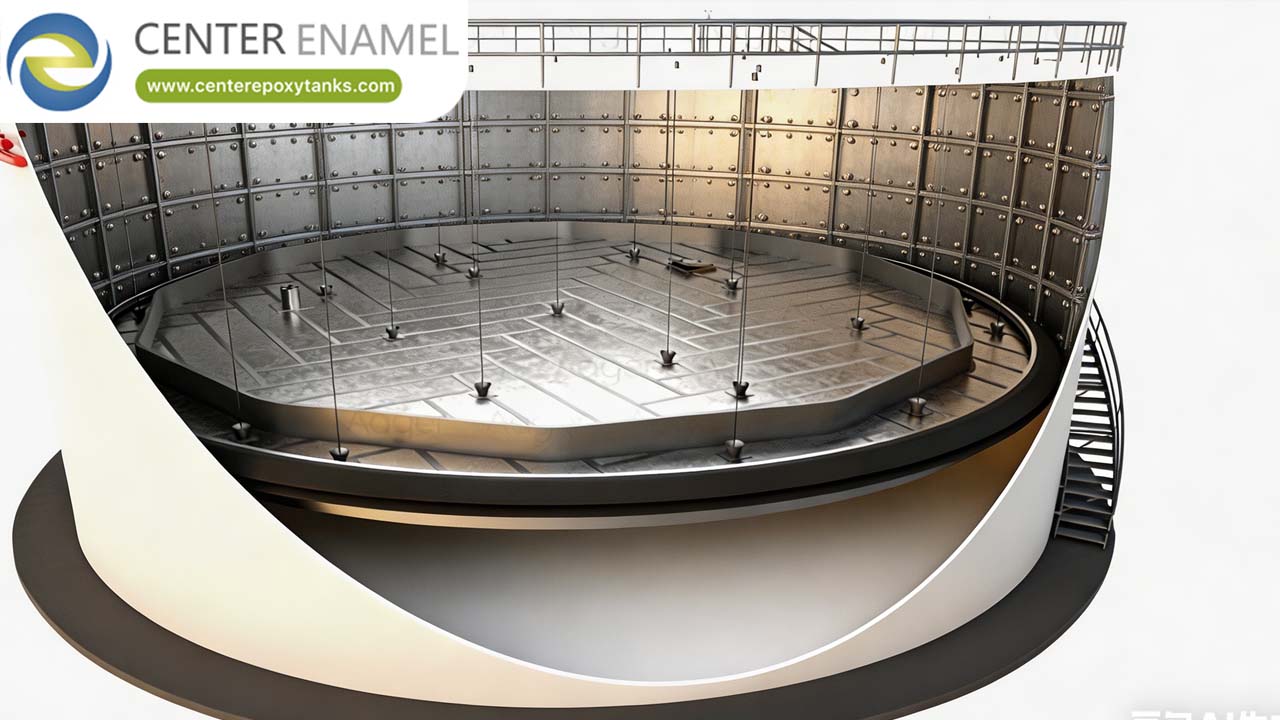
An internal floating roof operates inside a tank that already has a fixed roof; an external floating roof is the only cover and is exposed to the weather. Everything else follows from that single difference: exposure, product purity, drainage, fire safety, inspection access and structural load.
A general tank reference places internal roofs among solutions for volatile, contamination-sensitive liquids such as gasoline, naphtha and aviation fuel, and external roofs among options for large-volume volatile petroleum storage. That split is a practical summary of where each type tends to win, not a universal rule.
Both roofs work on the same principle: a buoyant deck on the liquid removes the standing vapour space. The comparison is therefore about the consequences of where that deck sits, not about whether floating roofs work at all — a mechanism covered in the how-it-works article in this batch.
Standards: Appendix H and Appendix C
Criterion | Internal floating roof | External floating roof |
Design basis | API 650 Appendix H | API 650 Appendix C |
Weather exposure | Shielded by fixed roof | Fully exposed |
Rainwater in product | Low risk | Drainage system required |
Large-diameter economy | Fixed roof adds cost | No fixed roof needed |
Inspection access | Harder; deck hidden | Easier topside access |
Fire consideration | Fixed roof limits rim fire | Rim-space fire risk managed actively |
Internal floating roofs are commonly designed to API 650 Appendix H, while external floating roofs are associated with API 650 Appendix C. Those references set the mechanical design basis; the air permit is a separate layer that can dictate seal arrangements and inspection frequencies regardless of roof type.
Louisiana's rule illustrates that separation. It defines an internal floating roof and an external floating roof separately, with different closure-seal expectations — the external roof requires a primary seal and a continuous secondary seal, with defined exceptions. A buyer should confirm which rule applies before assuming that the mechanical standard alone defines compliance.
Where the stored product is above the applicable vapour-pressure ceiling, neither roof type is the answer; the tank moves to pressure storage or vapour processing. That gate should be applied before the internal-versus-external comparison begins.
Product Purity and Climate Decide Many Cases
Where the product cannot tolerate water, an internal roof has a clear advantage. The fixed outer roof keeps rain and debris off the deck and out of the tank, removing the need for a complex roof drain that can fail. Aviation fuel and high-value refined products are the usual examples.
Climate reinforces that advantage. In regions with heavy rain or snowfall, an external deck must be designed for precipitation loads and equipped with drains that cannot be allowed to fail; an internal deck never sees that load. Comparisons of the two types consistently note this difference as a primary selection driver.
In a dry, mild climate with very large crude tanks, the balance shifts. The external roof avoids the cost of a fixed roof over a large diameter and gives easy access to the deck and seals, which can outweigh the drainage and weather concerns.
Diameter and Structural Economy
As tank diameter grows, a fixed roof becomes heavier and more expensive to support. That is the main reason very large crude tanks are often built with external roofs. Published comparisons note that an external roof eliminates the fixed roof cost and is typically chosen where tank diameters exceed a large threshold.
Internal roofs are often built from lightweight aluminium specifically to limit the load on the tank, which helps at mid-range diameters. Beyond that range the structural argument weakens, and the owner must weigh the protection of a fixed roof against its cost.
The diameter decision should also consider the fixed roof's own design. A clear-span aluminium dome over an internal deck removes internal columns that would obstruct the floating deck, which is one way the two systems are combined in practice.
Fire Safety and Inspection Trade-offs
Fire behaviour differs. An internal floating roof sits under a fixed roof, which limits direct lightning strike and rim-space fire exposure; an external roof has a rim space that requires active fire protection and foam systems. Comparisons treat this as a genuine advantage of the internal arrangement for volatile products.
Inspection cuts the other way. The internal deck is hidden under the fixed roof, so seal, pontoon and fitting inspection usually needs an emptying and confined-space access. The external deck is visible and reachable from the top, making condition monitoring simpler even though its components weather faster.
The right comparison includes both: the lower weather-driven maintenance of the internal deck and the easier inspection of the external one. Which dominates depends on the site's outage pattern and how strictly the permit treats seal condition.
Cost, Vendor Claims and an Honest Boundary
Capital cost is rarely one-directional. An internal roof adds a fixed roof and a protected deck; an external roof saves the fixed roof but needs drainage, weather-resistant seals and fire protection. Published comparisons note that the internal option carries a higher initial cost while the external option can be cheaper at very large diameters.
Our own group publishes comparison pages on group websites. Those pages are commercial material and are cited here only as stated positions, not as independent evidence. The technical criteria in this article are drawn from general tank references and regulations, and the metadata records every source.
The final boundary is the project library: it contains no floating roof of either type. This guide therefore offers a decision framework, not a claim that we have delivered one configuration or the other. Apply the criteria to your tank, confirm the permit, and choose the roof that fits the conditions.
Converting an External Roof to an Internal Arrangement
Some owners convert an external floating roof to an internal one by adding a fixed cover above the existing deck. The attraction is clear: the deck and seals are shielded from weather and rainwater no longer reaches the product. Published comparisons describe this as a retrofit path where product purity or emissions drive the change.
Feasibility depends on the existing structure. The tank shell must carry the new fixed roof, the vents and drainage must be redesigned, and internal columns under a dome can obstruct a deck that previously had a clear span. A conversion that ignores these interfaces is a specification on paper rather than a buildable project.
The business case must include the outage and the reinstated inspections. Once the deck is hidden, condition monitoring becomes harder even though weathering is reduced. Compare the conversion against simply maintaining the external roof with better drainage and seals before committing to the capital work.
A Step-by-Step Selection Workflow
Start by confirming that the product is a liquid within the vapour-pressure ceiling; if it is not, neither roof type applies. Then rank the decision criteria for the specific tank: product purity, diameter, climate, fire strategy, inspection practice and capital budget. The ranking matters because different tanks on the same site can legitimately reach different answers.
Apply the standards next. Use API 650 Appendix H for the internal option and Appendix C for the external one, and overlay the applicable emissions rule, which may prescribe seal arrangements regardless of roof type. Record the edition of every document relied upon so the decision can be checked later.
Finish by writing the trade-offs into the selection record. State what was gained and what was accepted — weather protection against inspection access, for example — so a future reviewer understands the reasoning. A conditional decision, documented honestly, is stronger than a claim that one roof is always superior.
Evidence disclosure for this comparison article: the verified project library contains no internal or external floating roof project, so no delivered comparison, cost differential or emission result is claimed from our own work. Comparison pages published on our own group's websites are treated as stated commercial positions, not as independent evidence; the technical criteria here are attributed to the named public sources.
Conclusion
Choose the roof type on conditions, not preference. Internal roofs suit volatile, purity-sensitive products and difficult weather; external roofs suit very large crude tanks where a fixed roof is uneconomic. Match the design basis to API 650 Appendix H or C as appropriate, confirm the emissions rule, and state the trade-offs openly rather than claiming one roof is universally superior.
Frequently Asked Questions
Q: What is the fundamental difference?
A: An internal floating roof sits inside a fixed-roof tank; an external floating roof is the tank's only roof and is exposed to the atmosphere. Both float on the liquid to reduce vapour space.
Q: Which standard covers each?
A: Internal floating roofs are commonly designed to API 650 Appendix H; external floating roofs to API 650 Appendix C. Confirm the edition and the applicable emissions rule separately.
Q: When is an internal roof preferred?
A: For volatile, contamination-sensitive products, in wet or snowy climates, and where the fixed roof can shield the deck and keep rainwater out of the product.
Q: When is an external roof more economical?
A: For very large diameter crude tanks where a fixed roof is heavy and costly, and where rim drainage and fire protection can be managed.
Q: Which has lower maintenance?
A: The internal deck is shielded from weather, which protects seals, but is harder to inspect. The external deck is easier to see but exposed to UV, rain and snow.
Q: Is there a comparative case in your library?
A: No. The verified project library contains no floating roof of either type, so this article claims no delivered comparison, cost or emission result from our own work.
Work With Center Enamel
Center Enamel is the trading name of Shijiazhuang Zhengzhong Technology Co., Ltd, established in 2008 and based in Shijiazhuang, Hebei Province, China. The company manufactures glass-fused-to-steel bolted tanks, fusion-bonded epoxy coated tanks, stainless steel and welded steel tanks, pressure vessels, aluminium geodesic dome roofs and floating roof systems. Aluminium dome design work is carried out against AWWA D108, API 650, ADM 2015, ASCE 7-10 and IBC 2012, and the broader product range is covered by ISO 9001, NSF/ANSI 61, CE/EN 1090, ISO 28765, WRAS and FM approvals. The company reports 30,000 installed projects and an annual output of 300,000 enamel steel plates, with technical support delivered through an international distributor network and a stated 24-hour response commitment.
If your project involves tank roofs, floating decks or the shells that carry them, send the tank diameter, shell height, product, operating temperature and site design loads. We will return a preliminary structural concept, the applicable design code basis, and a written scope that separates what is included from what the site contractor must provide.


