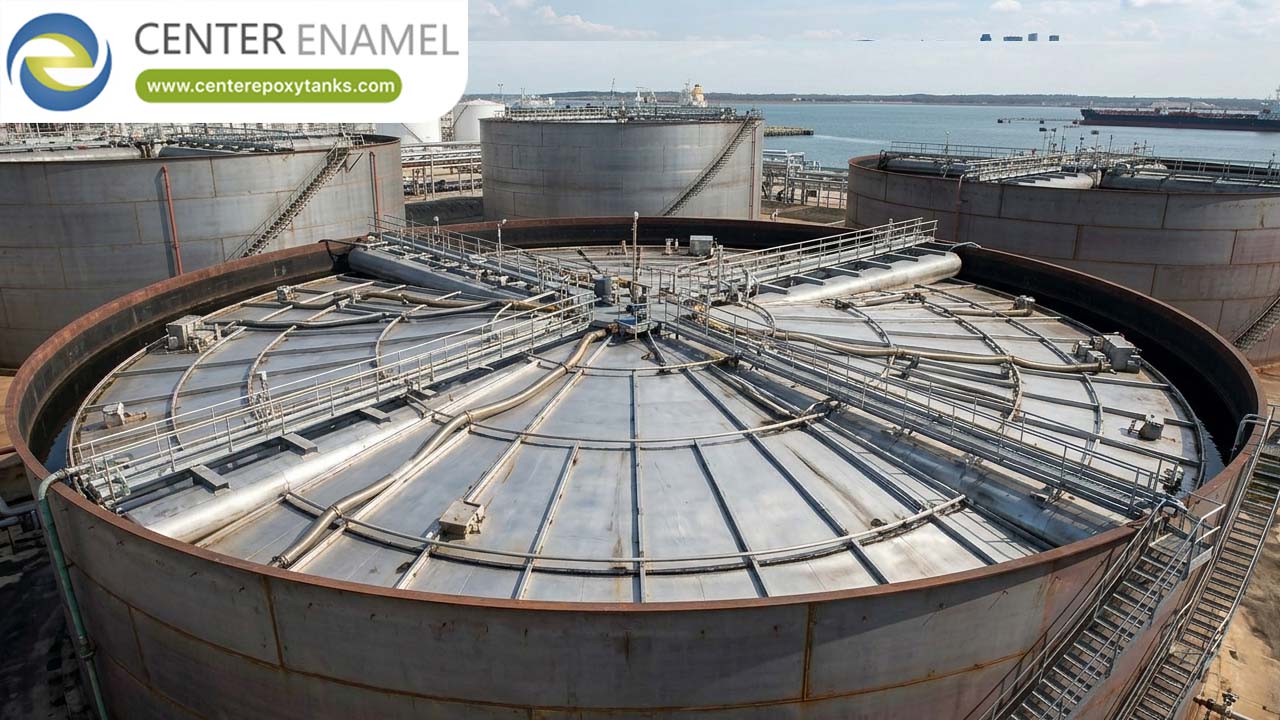
Internal Floating Roof Systems
The system is the seal and the deck, and the rest of the arrangement is detail. Choosing between them requires knowing what each one actually does, because the three seal families defined in the US EPA reference documentation differ in mechanism, in what they tolerate and in what they cost the operator to maintain. This article uses that taxonomy directly, adds the deck configuration dimension, and explains one consequence of seal design that is easy to miss: a secondary seal on an internal floating roof reduces the tank's usable capacity.
The Seal Is the System
Everything an internal floating roof does about emissions happens at the perimeter, in the millimetre-scale gap between a moving deck edge and a fixed tank shell that is never quite round and never quite smooth. The EPA reference material makes this clear by describing how the different seals accommodate exactly that reality. A resilient filled seal works because the expansion and contraction of a resilient material maintains contact with the tank shell while absorbing variations in the width of the annular rim space, and it allows the roof to move up and down freely without binding. A wiper seal works by flexing a continuous annular blade so that its elasticity provides a sealing pressure against the shell.
The mechanical shoe seal works differently again. It uses a light-gauge metallic band formed as a series of shoe sections joined into a ring and held against the tank shell by a mechanical device, and the bottoms of the shoes extend below the liquid surface to confine the rim vapour space between the shoe and the floating deck. The EPA material notes that for an external floating roof the shoes are normally three to five feet deep, and that they are often shorter when used on an internal floating roof.
The common feature of all three is that they are continuously maintained contact devices, not sealed joints. They wear, they are inspected, and they are adjusted. That maintenance requirement is the real differentiator between the options, and it should be weighed against the emission performance rather than treated as an afterthought.
The Three Seal Families Compared
Seal family | Mechanism | Principal strength | Principal limitation | Typical fit |
Mechanical shoe seal | A metallic band of shoe sections held against the shell by a mechanical device, normally extending below the liquid surface | Tolerates shell out-of-roundness and protruding details better than a flexible seal, because the metal band can conform and can be adjusted | Moving parts and springs or weighted levers require inspection and maintenance; a metallic band in a corrosive service has its own corrosion exposure | Tanks with shell irregularities, where a flexible blade would not hold consistent contact |
Resilient filled seal | A core of open-cell foam encapsulated in coated fabric, mounted on the deck perimeter, either liquid-mounted or vapour-mounted | Absorbs annular space variation continuously and allows the deck to move vertically without binding; the liquid-mounted arrangement removes the rim vapour space entirely | The resilient core degrades and has to be replaced on a defined interval; the mounting must be arranged to maintain contact as the shell distorts | Service where consistent contact matters more than absolute tolerance of shell irregularity |
Wiper seal | A continuous annular flexible blade fastened to a deck perimeter bracket, flexed so its elasticity presses it against the shell | Simple, compact and economical, with no moving mechanism; new tanks may be fitted with dual wipers mounted one above the other | A single blade must stay in substantial contact across the whole circumference, so shell distortion and debris are more significant; the blade wears at the contact line | Service with a well-behaved shell and a moderate emission requirement |
Two secondary points from the EPA material are worth carrying into any specification. The first is that the mounting arrangement of the resilient filled seal determines whether it is liquid-mounted or vapour-mounted, and that the liquid-mounted arrangement is used to eliminate the vapour space between the rim seal and the liquid surface, while the vapour-mounted arrangement deliberately retains that space. The second is that for emission control the attachment of the seal to the deck and the radial seal joints must be vapour-tight and the seal must be in substantial contact with the tank shell, and that the same requirement applies to the mounting, the circumference coverage and the radial joints of a wiper blade.
Deck Configuration Is the Second Decision
The seal is only half of the system, because the deck determines the volume of vapour space remaining beneath it and the mechanical robustness of the whole assembly. Three arrangements dominate. A pontoon deck uses buoyancy compartments around or distributed across the deck, so a vapour space remains between the deck skin and the product surface; it is mechanically robust, stable and widely used in heavier duty service. A double deck arrangement provides two decks, which adds buoyancy capacity and thermal insulation for the product beneath, and appears in regulatory definitions alongside the pontoon type.
A full contact deck rests directly on the product, so essentially no vapour pocket exists beneath it. Supplier literature in this field describes full contact roofs as built from panel sections that sit on the liquid surface, and identifies them with the honeycomb construction. The advantage is the lowest vapour space available; the cost is that the entire deck is in contact with the product and with whatever is in it.
The Louisiana implementation plan is a useful reference point for how the regulatory world treats these arrangements, because it accepts the pontoon type roof, the double deck type roof and the internal floating cover as the qualifying configurations, and then specifies the closure seal requirements that apply to all of them. That is a useful thing to know when writing a specification: the deck type establishes the qualification, and the seal establishes the performance within that qualification.
The Secondary Seal and the Capacity Penalty
A secondary seal is used to provide additional evaporative loss control over the primary seal, and the EPA reference describes secondary seals as being either flexible wiper seals or resilient filled seals. For an internal floating roof, the material is specific that the secondary seal is mounted to an extended vertical rim plate, above the primary seal.
The material also records a consequence that surprises people: for some floating roof tanks, using a secondary seal further limits the tank's operating capacity, because the seal has to be kept from interfering with fixed roof rafters, or has to be kept in contact with the tank shell when the tank is filled. That is a genuine engineering trade-off rather than a defect. A tank that needs to be filled to a high level to hold a full cargo may not be able to accommodate the extended rim plate that the secondary seal needs.
This is exactly the kind of interaction that has to be resolved in the enquiry rather than discovered during fabrication. The maximum filling level, the fixed roof internal arrangement and the intended seal hierarchy should be stated together, and the supplier should confirm in writing that the configuration does not reduce the usable capacity of the tank below the level the operator needs to operate.
What the Seal Choice Costs the Operator
Selection is not only about emission performance. A mechanical shoe seal introduces moving parts into the tank, which means inspection access, adjustment and replacement over the life of the system. A resilient filled seal has a defined replacement interval for the resilient core, which means a planned outage and a consumable cost. A wiper seal is simple and has no moving mechanism, but it depends on continuous blade contact, which means it is more exposed to shell distortion and to anything that ends up trapped against the shell.
The environmental and product conditions change all three of these. A corrosive headspace affects the metallic shoe and the coated fabric differently. A product that carries solids affects the seal contact line. A shell that has distorted over decades is a different problem from a new shell, and this is one of the cases where the new-build and retrofit answers genuinely differ.
The practical discipline is to write the inspection and replacement regime into the enquiry at the same time as the seal selection, so that the two can be assessed together. A seal specified without a stated inspection regime and without a stated replacement interval is a seal whose lifetime behaviour has not been considered.
The Selection Sequence That Works
A sequence that avoids most of the common mistakes runs like this. Start with the service: the product, its vapour pressure at working temperature, the headspace atmosphere, and whether the operating regime includes regular filling and emptying or long static periods. Then establish the regulatory position, because in many jurisdictions the seal hierarchy is prescribed rather than chosen, and the vapour pressure at which stricter requirements apply is a defined figure in regulation rather than a matter of preference.
Next establish the physical constraint: the tank diameter, the condition and roundness of the shell, the fixed roof internal arrangement, the maximum filling level and the deck's landing position. Only then choose the deck configuration, because it constrains the seal options, and then the seal, because the shell condition and the emission requirement together determine it. Finally, fix the inspection and replacement regime and confirm that the configuration does not reduce the usable capacity of the tank.
In parallel throughout, the maintenance access and the product management consequences have to be included in the assessment. Every configuration in this family needs periodic inspection, and the practical difference between the options is often the difference between an inspection that can be done during a scheduled outage and one that cannot.
Case evidence disclosure: seal and deck selection in this article is drawn from the United States EPA reference material on organic liquid storage tanks and from a state implementation plan for volatile organic compound storage, both cited in full in the source list. The verified Centre Enamel project library contains no internal floating roof delivery, so no installed seal arrangement, contact performance or seal life is evidenced by a project reference and none is stated. The article therefore teaches the selection method rather than reporting a result.
Conclusion
The system is the seal and the deck, and the decisions are interdependent. The mechanical shoe seal tolerates shell irregularity at the price of moving parts; the resilient filled seal absorbs annular variation and allows free vertical movement at the price of a defined replacement interval; the wiper seal is simple and economical at the price of depending on continuous blade contact. The deck configuration then determines what vapour space remains beneath it, and a secondary seal improves control while potentially reducing the tank's usable capacity. Specify the service, the regulatory position and the physical constraints first, then the deck, then the seal, then the inspection regime. Send us the tank data and we will work the selection with you.
Frequently Asked Questions
Q: What are the main types of internal floating roof seal?
A: Three families are defined in the US EPA reference material: a mechanical shoe seal using a metallic band held against the shell and extending below the liquid surface; a resilient filled seal using a foam core encapsulated in coated fabric, installed either liquid-mounted or vapour-mounted; and a wiper seal using a continuous annular flexible blade flexed against the shell. The choice depends on the shell condition, the emission requirement, the product and the maintenance regime the operator can support.
Q: Should an internal floating roof have a secondary seal?
A: It depends on the emission requirement and on a physical constraint that is easy to overlook. A secondary seal on an internal floating roof is mounted to an extended vertical rim plate above the primary seal, and the EPA material records that on some floating roof tanks this further limits the tank's operating capacity, because the seal must be kept clear of fixed roof rafters or kept in contact with the shell when the tank is filled. Confirm the usable capacity before specifying it.
Q: Is a full contact roof always better than a pontoon roof?
A: No. A full contact deck rests directly on the product and leaves essentially no vapour space beneath it, which makes it the aggressive choice for emission control. A pontoon deck keeps a vapour space under the skin but is mechanically more robust and is the common arrangement in heavier duty service. The right answer depends on the emission requirement, the product and the inspection burden the operator can carry, not on the emission figure alone.
Q: What is the difference between a liquid-mounted and a vapour-mounted seal?
A: It is whether a vapour space is deliberately retained between the rim seal and the liquid surface. The resilient filled seal can be mounted either way: liquid-mounted is used to eliminate that vapour space entirely, while vapour-mounted retains it. A mechanical shoe seal keeps the rim vapour space bounded by the shoe, the deck rim and the liquid surface, with the shoe extending below the liquid surface to confine it.
Q: How much does the seal choice affect tank capacity?
A: More than most people expect, in one specific way. The capacity effect comes from the secondary seal rather than from the primary, because the secondary seal's extended vertical rim plate has to clear the fixed roof rafters and has to remain in contact with the shell at the filling level. If your operation depends on filling the tank to a high level, that interaction must be confirmed in writing by the supplier before the configuration is fixed.
Q: What should be included in an internal floating roof system specification?
A: At minimum: the service and product data, the regulatory position and the seal hierarchy it requires, the deck configuration with its buoyancy and freeboard basis, the seal family and mounting arrangement, the penetration treatment itemised by fitting, the level envelope including the maximum filling level and the landing level, the vent and relief philosophy for the space above the deck, the inspection and replacement regime, and the documentation package with the design code list named.
Work With Center Enamel
Center Enamel is the trading name of Shijiazhuang Zhengzhong Technology Co., Ltd, established in 2008 and based in Shijiazhuang, Hebei Province, China. The company manufactures glass-fused-to-steel bolted tanks, fusion-bonded epoxy coated tanks, stainless steel and welded steel tanks, pressure vessels, aluminium geodesic dome roofs and floating roof systems. Aluminium dome design work is carried out against AWWA D108, API 650, ADM 2015, ASCE 7-10 and IBC 2012, and the broader product range is covered by ISO 9001, NSF/ANSI 61, CE/EN 1090, ISO 28765, WRAS and FM approvals. The company reports 30,000 installed projects and an annual output of 300,000 enamel steel plates, with technical support delivered through an international distributor network and a stated 24-hour response commitment.
If your project involves tank roofs, floating decks or the shells that carry them, send the tank diameter, shell height, product, operating temperature and site design loads. We will return a preliminary structural concept, the applicable design code basis, and a written scope that separates what is included from what the site contractor must provide.


