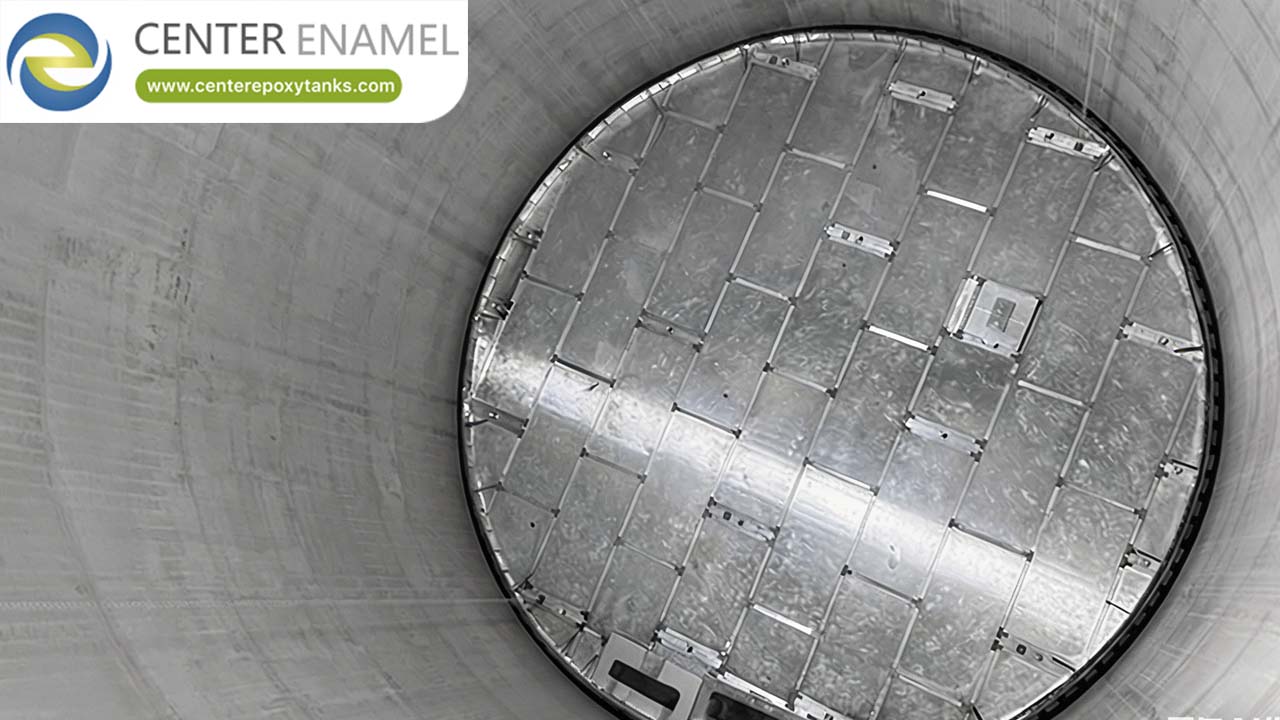
Internal Floating Roof Roof Drainage: Design and Failure Modes
Roof drainage is rarely the headline feature of an internal floating roof, yet a failed drain is one of the classic causes of a roof that tilts, jams or sinks. This article explains where water and liquid go on a floating deck, what the inspection requirements say and how to design and maintain a drainage path that will actually work when it is needed.
Where the Water Comes From
An internal floating roof sits under a fixed roof, so it is protected from rain in the way an external roof is not. That leads people to assume drainage is trivial. In practice, condensation on the fixed roof, wash water from cleaning, and product or water entering through a faulty fitting all find their way onto the deck.
Inspection specialists list the roof drain among the components that must be checked on floating roofs and describe a flexible hose or articulated piping system that carries liquid through the product to an external valve. The system has to move with the deck through its full travel without binding or tearing.
The consequence of getting it wrong is structural, not cosmetic. Standing liquid adds local weight, tilts the deck and can turn a small out-of-level condition into a jammed roof.
What the Integrity Rules Say
The API 653 material excerpt states that roof support systems, perimeter seal systems, appurtenances such as a rolling ladder and anti-rotation devices, water drain systems and venting systems shall be evaluated for needed repairs or replacements. Guidance for evaluating existing floating roofs is based on API 650 Annex C for external roofs and Annex H for internal roofs.
An inspection guidance page echoes this and calls out a blocked or failed drain as a classic cause of a sunk roof. It also notes that the drain is out of sight under the product, which is precisely why it is missed in a casual inspection.
Under the federal requirements cited earlier, deck drains appear among the fittings that must be managed, and stub drains are named among the openings subject to cover and projection rules. Drainage therefore touches both mechanical integrity and the emission compliance basis.
Common Failure Modes
A drain can fail by blockage, by leakage or by loss of flexibility. Blockage leaves water standing on the deck. A leaking hose can put product into the drainage line or water into the product. A hose that has stiffened or been trapped can tear as the deck moves, and the first sign may be a deck that no longer travels smoothly.
The integrity paper describes drainage repair as cleaning and replacing damaged hoses and piping, and stresses that proper slope must be maintained so liquid drains without backing up onto the roof.
External valves are part of the system too. A valve that is left closed, seized or inaccessible defeats an otherwise sound drain, so it belongs in the same inspection line as the sump and hose.
Designing for the Deck's Movement
The distinguishing feature of a floating roof drain is that one end moves with the deck while the other is fixed at the shell. Flexible hose, articulated pipe or a swivel arrangement bridges that movement, and its travel must cover the full operating level range plus the landed position on the legs.
Check the routing against internal columns and nozzles. A hose that rubs a column edge through every cycle will fail early, and that failure will occur inside the tank where it is expensive to reach.
Where the product can solidify or deposit wax, consider how the drain behaves at the lowest expected temperature. A path that drains cleanly in a light product may block in a waxy crude.
Inspection and Maintenance
Build drainage into the component schedule rather than waiting for a symptom. Check that the sump is clear, that liquid does not stand on the deck, that the hose or pipe is intact and free to move, and that the external valve operates. Record the condition so a slow deterioration is visible between visits.
After any repair, test the path with water where the product and site rules allow, and confirm that liquid leaves by the intended route. A repair that looks correct but does not flow is not a repair.
Training matters here. An operator who notices standing product on a deck after a fill should report it as a drainage concern, not simply as a minor housekeeping issue.
Evidence and Limits
No internal floating roof project is held in the verified project library, so this article offers no delivered drain arrangement or flow result. The design and inspection points are drawn from the named standard extracts and inspection guidance and should be confirmed against the licensed code and the actual tank.
Where drainage interacts with the emission requirements for your jurisdiction, involve the responsible inspector in the specification rather than treating the drain as a purely mechanical item.
Drainage in Waxy and Dirty Service
A crude or heavy product can deposit wax and solids in the drain sump, and produced water can add a separate phase. The path that drains cleanly at commissioning may block after a season of operation, so the inspection interval should reflect the service rather than a generic schedule.
Where deposits are expected, specify access for cleaning and a sump that can be inspected without dismantling the whole roof. A drain that cannot be reached is a drain that will be neglected.
After cleaning, test the path and record the result. A visual check that the sump looks clear does not prove that the hose and valve will flow.
Linking Drainage to Roof Stability
Standing liquid is a stability problem before it is a housekeeping problem. It adds weight at one location, tilts the deck, can cause binding at the guides and may overload a pontoon compartment. A drain that fails silently can therefore precede a much larger defect.
Train operators to report standing liquid on the deck after a fill or a heating cycle as a priority observation, and make the response a defined task in the maintenance plan.
No internal floating roof project is held in the verified project library, so no drain failure or flow figure is claimed here; the guidance is attributed to the named sources.
Drain testing after repair
After a drainage repair, test the complete path from sump to external valve, not just the section that was replaced. A restriction downstream will defeat a new hose just as effectively as a blocked sump.
Record the flow observation and the date so the next inspection can judge whether performance is holding.
Designing for inspection access
A drain that cannot be inspected is a drain that will fail unnoticed. Where a new roof is being specified, require that the sump and the external valve are reachable and that the hose route can be visually checked from a safe position.
This is a small design decision with a large maintenance consequence.
Drainage and the Compliance File
Where deck drain behaviour affects product contamination or emission compliance, keep the flow test and repair records with the compliance documents. A drain is a small component but it appears in the regulatory discussion of deck fittings.
Review the drain at every planned outage rather than only after a symptom. Its condition is difficult to see in service, so planned access is the only reliable way to know it still works.
Drainage Inspection Points
Item | Check | Failure sign |
Sump | Clear of deposits | Standing liquid on deck |
Hose or pipe | Condition and free movement | Stiff, torn or trapped |
Route | Clearance from columns | Rubbing or chafe marks |
External valve | Operation and position | Seized or left closed |
Flow | Discharge to intended point | Product or water in wrong place |
Work through this list in order during a drainage inspection. A clear sump is not proof that the downstream valve will flow.
Evidence note: this drainage guide is an engineering method, not a project record. The verified project library contains no internal floating roof delivery, so no installed drain, flow rate or failure incident is claimed here; the inspection points are drawn from the cited standard extracts.
Conclusion
Treat roof drainage as a safety-relevant system rather than plumbing. Give water a reliable path that accommodates deck travel, inspect the sump, hose and valve as a set, and act on standing liquid or a leaking path before it becomes a stability problem.
Frequently Asked Questions
Q: Does an internal floating roof need drainage?
A: Yes. Condensation, wash water and product ingress need a controlled path. The roof drain is a standard inspection item even though much of it is out of sight.
Q: How does a floating roof drain work?
A: Water collects at a low point or sump on the deck and leaves through a flexible hose or articulated pipe that runs to an external valve, accommodating the deck's vertical travel.
Q: Why is a blocked drain dangerous?
A: Standing liquid adds weight and can tilt the deck, and a leaking drain can put water into the product or product onto the roof.
Q: What do the codes say about drains?
A: API 653-based inspection guidance lists water drain systems among the components to evaluate for repair or replacement, and API 650 annexes provide evaluation criteria.
Q: Can a drain leak product into the tank?
A: Yes. That is why drainage systems are tested for leaks, and why a leak is a repair item rather than a nuisance.
Q: How should drainage be inspected?
A: Check for blockage, standing liquid, hose condition and flow, and confirm the external valve operates; record the result so trends are visible.
Work With Center Enamel
Center Enamel is the trading name of Shijiazhuang Zhengzhong Technology Co., Ltd, established in 2008 and based in Shijiazhuang, Hebei Province, China. The company manufactures glass-fused-to-steel bolted tanks, fusion-bonded epoxy coated tanks, stainless steel and welded steel tanks, pressure vessels, aluminium geodesic dome roofs and floating roof systems. Aluminium dome design work is carried out against AWWA D108, API 650, ADM 2015, ASCE 7-10 and IBC 2012, and the broader product range is covered by ISO 9001, NSF/ANSI 61, CE/EN 1090, ISO 28765, WRAS and FM approvals. The company reports 30,000 installed projects and an annual output of 300,000 enamel steel plates, with technical support delivered through an international distributor network and a stated 24-hour response commitment.
If your project involves tank roofs, floating decks or the shells that carry them, send the tank diameter, shell height, product, operating temperature and site design loads. We will return a preliminary structural concept, the applicable design code basis, and a written scope that separates what is included from what the site contractor must provide.


