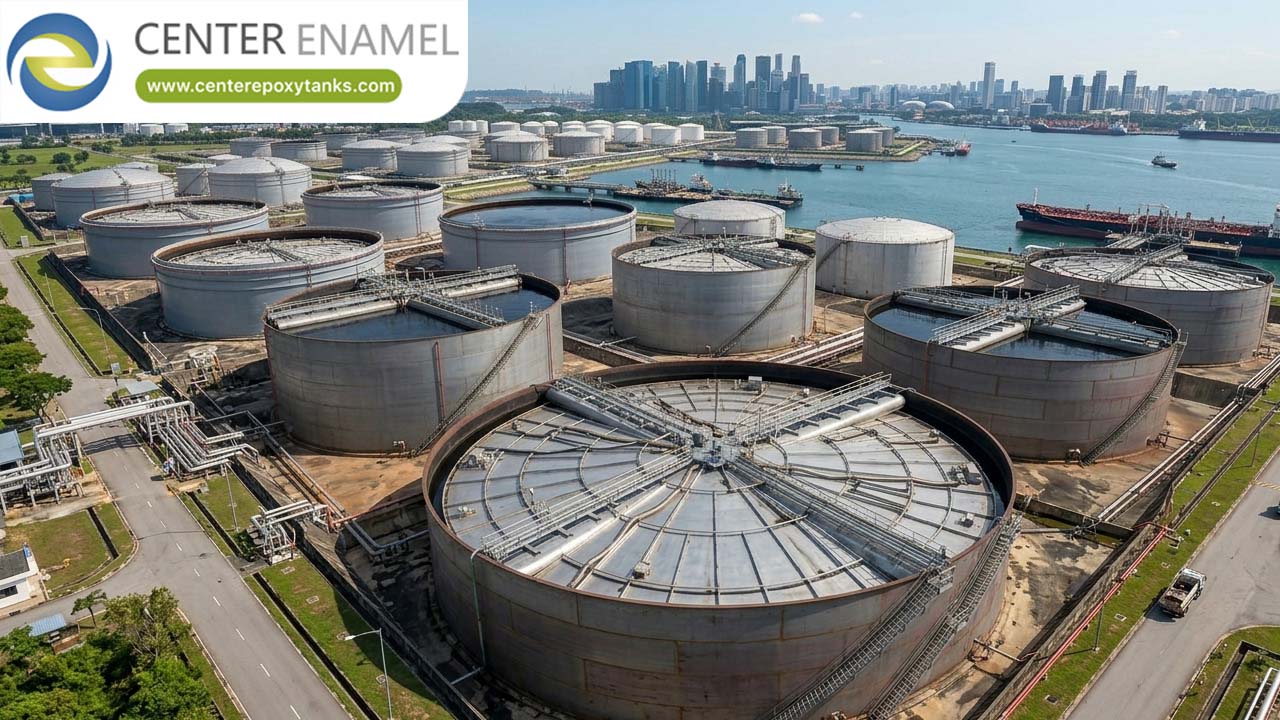
Internal Floating Roof Retrofit: Converting a Fixed-Roof Tank
A retrofit puts a floating deck inside a tank that was built with a fixed roof and no internal roof. It is one of the most effective ways to cut vapour loss without replacing the tank, but feasibility depends on details that are easy to miss in a desktop study. This article sets out what has to be checked and how the conversion is sequenced.
Feasibility Starts With the Existing Tank
A retrofit guide describes the first step as an assessment of the existing tank structure, including diameter, shell condition, roof type and foundation. That is the right order, because a floating roof cannot correct a tank that is no longer fit for service. Shell roundness matters twice: it determines whether the seal can maintain contact and whether the deck can travel without binding.
The same guide lists the elements of the system that must be accommodated: a floating deck, primary and secondary seals, support legs, ventilation and drainage. Each has to fit inside a tank that was not designed with it in mind.
Internal obstructions are the usual surprise. Heating coils, mixers, internal columns and nozzles all become either clearances or penetration details, and every one of them is a place where the deck can catch or leak.
The Access Constraint
The defining feature of a retrofit is that everything enters through an existing opening. A published honeycomb IFR description explains that modular designs are intended to fit through a twenty-four inch manway, with panels carried in and assembled inside the tank. That is why bolt-together construction matters so much in retrofit work.
Another manufacturer describes its modular, bolted aluminium roofs as designed to enter through standard manways without removing the fixed roof or performing site welding. That is a supplier claim, but it identifies the real comparison: a design that needs hot work inside a tank carries very different safety and shutdown consequences.
Measure the manway and the internal route before anything is ordered. The largest panel dimension must be compatible with the opening and with whatever handling is available inside the tank.
Sequencing the Shutdown
A retrofit process description sets out a recognisable sequence: tank preparation, deck installation, seal integration, and testing and commissioning. Preparation means cleaning, inspection and repair where needed, because a roof assembled over debris or sludge will be damaged before it floats.
One published installation timeline suggests one to three days for a hundred-foot diameter tank under favourable conditions, with flat-packed panels shipped in standard containers. Treat that as an illustration, not a promise: your figure depends on the survey, the manway and the number of internal penetrations.
Build the outage plan backwards from the point at which the tank must be back in service, and identify which activities can happen in parallel. Drawing approval and material release are usually on the critical path before the shutdown even begins.
Why the Vapour Case Matters
The reason for most retrofits is vapour control. Under the US rules cited earlier, an internal floating roof in a fixed-roof tank is a recognised control for volatile organic liquids above defined capacity and vapour-pressure thresholds, provided it has an acceptable closure device and complies with the opening and fitting requirements.
That means the retrofit is not complete when the deck floats. Covers must close, seals must contact the shell, vents must be gasketed and correctly set, and sample wells must have their fabric cover. The compliance case is made by those details, not by the presence of a deck.
If the tank falls outside the rule's thresholds, the business case may still be strong through product-loss reduction, but the specification should say which basis is being used so the acceptance test matches the objective.
Common Pitfalls
A supplier selection guide lists poor tank roundness, wrong seal material for the product, weak installation control and ignored columns or nozzles among the predictable causes of floating roof problems. A retrofit concentrates all four, because the existing tank sets the conditions and the new roof has to adapt.
Another recurring mistake is to treat the fixed roof as irrelevant. Its vents and supports determine the environment above the deck and the number of penetrations the deck must accommodate, so they belong in the survey.
Finally, do not assume that a successful installation means a successful retrofit. Commissioning has to show free movement across the full level range and a seal that follows the shell; a deck that merely floats on the first fill is not yet a control system.
Defining Scope and Evidence
State in the specification who performs the shell survey, who corrects any out-of-tolerance condition, who supplies and installs the seals, and who attends commissioning. These are the boundaries most likely to turn into variations on site.
No internal floating roof project is held in the verified project library, so this article describes a method rather than a delivered conversion. The figures quoted for access and installation are attributed to the named suppliers and must be confirmed against the actual tank.
Confirming the Business Case
A retrofit is justified by vapour loss, emission compliance or product quality, and the basis should be written down before work begins. For a regulated tank, identify the rule and the thresholds that apply; for an unregulated tank, estimate the annual product saving from the actual throughput and vapour pressure.
Use AP-42 methodology rather than a generic percentage. The result gives the project a measurable objective and provides a way to judge whether the installed roof is performing.
Record the assumed energy and operating costs as well. A retrofit that saves product but consumes significant shutdown time has a different economics from one that fits an existing turnaround.
Handover and First Year
The handover should include the geometry survey, as-built deck layout, seal specification, torque records, float-test observations and the commissioning criteria. It should also identify the inspection items that will apply in service.
During the first year, inspect the seal and deck movement more frequently than the eventual routine interval. Early wear reveals whether the shell condition or the installation method was misjudged, and it is much cheaper to correct then.
No internal floating roof project is held in the verified project library, so no retrofit duration or emission result is claimed here; the figures quoted are attributed to the named suppliers.
Regulatory basis and acceptance
Decide at the outset whether the retrofit is being done to meet a specific rule or to reduce product loss, because the acceptance criteria differ. A compliance-driven project needs evidence against the applicable seal, fitting and inspection requirements; a loss-driven project needs an agreed estimation method.
Write the acceptance test into the contract. A retrofit that is judged only by whether the deck floats has not been shown to deliver the reason it was funded.
Managing interfaces
A retrofit touches the fixed roof, the shell, the vents, thegrounding system and the operating procedure. Assign an owner to each interface so that no item is assumed to be somebody else's scope.
The most common gap is the operating document: the tank may be technically converted while the level range and approved products in the operating manual remain unchanged.
Retrofit Work Breakdown
Stage | Activity | Gate |
Survey | Shell, manway, internals | Access and roundness accepted |
Prepare | Clean, inspect, gas-free | Safe entry certified |
Assemble | Panels, seals, grounding | Torque and continuity logged |
Commission | Float test, fitting checks | Free travel and closed covers |
The stages below are a planning frame for a conversion. Confirm each gate against the actual shutdown window and the tank survey.
Evidence note: this retrofit guide is a feasibility and execution method, not a project record. The verified project library contains no internal floating roof delivery, so no converted tank, outage duration or emission result is claimed here. Process steps are attributed to the named public sources.
Conclusion
A successful retrofit starts with an honest feasibility study of the shell, internals and access, then a shutdown plan that sequences cleaning, assembly, sealing and commissioning. Confirm that the vapour and structural case justifies the work, and price access-related items as separate lines so the estimate stays comparable.
Frequently Asked Questions
Q: When is a fixed-roof tank a good retrofit candidate?
A: When the shell is sound and within roundness tolerance, the product is volatile enough to justify the work, and the tank can be taken out of service for the installation window.
Q: What is the biggest retrofit constraint?
A: Access. The roof must be carried through an existing manway, commonly around twenty-four inches, and assembled inside the tank without cutting shell plates.
Q: Can a retrofit be done while the tank is in service?
A: The deck is installed during a shutdown. Some final checks can be done in service, but the physical installation needs the tank emptied, cleaned and gas-free.
Q: Does the fixed roof have to be removed?
A: Usually not. The internal roof sits beneath it; removing the fixed roof defeats the purpose. Internal columns and nozzles become the details to manage.
Q: How long does a retrofit take?
A: A published supplier gives one to three days for a hundred-foot tank under ideal conditions. Your access, internal obstructions and shell condition will set the real figure.
Q: What compliance issue drives most retrofits?
A: Vapour loss and emissions rules. An internal floating roof removes most of the vapour space and is a recognised control under US air rules.
Work With Center Enamel
Center Enamel is the trading name of Shijiazhuang Zhengzhong Technology Co., Ltd, established in 2008 and based in Shijiazhuang, Hebei Province, China. The company manufactures glass-fused-to-steel bolted tanks, fusion-bonded epoxy coated tanks, stainless steel and welded steel tanks, pressure vessels, aluminium geodesic dome roofs and floating roof systems. Aluminium dome design work is carried out against AWWA D108, API 650, ADM 2015, ASCE 7-10 and IBC 2012, and the broader product range is covered by ISO 9001, NSF/ANSI 61, CE/EN 1090, ISO 28765, WRAS and FM approvals. The company reports 30,000 installed projects and an annual output of 300,000 enamel steel plates, with technical support delivered through an international distributor network and a stated 24-hour response commitment.
If your project involves tank roofs, floating decks or the shells that carry them, send the tank diameter, shell height, product, operating temperature and site design loads. We will return a preliminary structural concept, the applicable design code basis, and a written scope that separates what is included from what the site contractor must provide.


