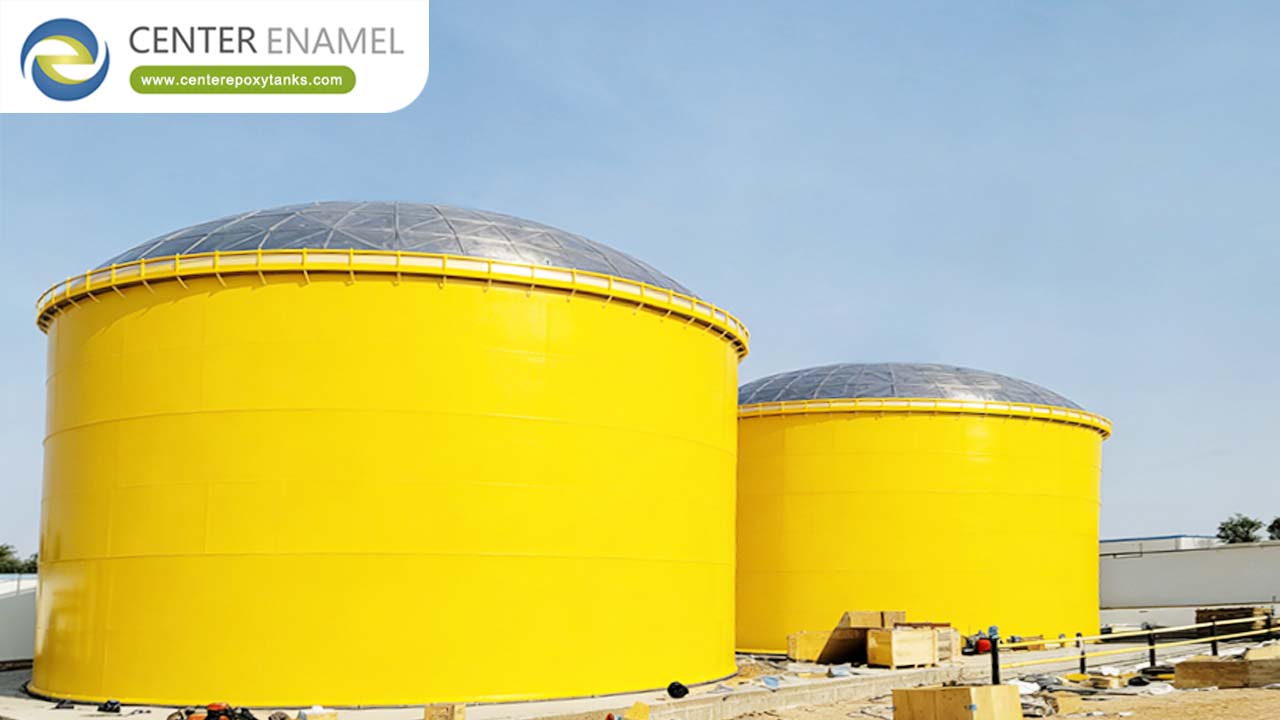
Internal Floating Roof (IFR) Tanks: Advanced Vapor Control and Storage Engineering
Internal Floating Roof (IFR) tanks are specialized vertical storage vessels designed to minimize evaporative losses and hazardous emissions of volatile organic compounds (VOCs). By utilizing a floating deck that rests on the liquid surface inside a fixed-roof tank, IFR systems eliminate the "vapor space" (ullage), reducing product loss by up to 98%. Engineered to API 650 Appendix H and NFPA 30 standards, Center Enamel’s IFR solutions—including Aluminum Geodesic Domes and Stainless Steel Full-Contact Pontoon Roofs—provide critical infrastructure for refineries, chemical plants, and terminal storage in 100+ countries.
1. Technical Specification & Performance Matrix
This matrix establishes the mechanical benchmarks for high-performance IFR systems.
Feature | Technical Specification (2026 Standard) | Strategic Industrial Value |
Design Standards | API 650 Appendix H, API 2000, NFPA 30 | Mandatory for global environmental and fire safety audits. |
Deck Types | Full-Contact Honeycomb / Pontoon / Bolted | Prevents vapor accumulation; optimized for buoyancy. |
Material Grades | Al 3003/6061, SS304/316L, Carbon Steel | Corrosion resistance against benzene, toluene, and xylenes. |
Seal Systems | Mechanical Shoe / Liquid-Mounted / Wiper | Maintains 99%+ seal efficiency against the tank shell. |
Emissions Reduction | 95% – 99% VOC Mitigation | Compliance with EPA (USA) and EU Clean Air directives. |
Ventilation | Circulation Vents / P-V Valves | Prevents internal vacuum and overpressure scenarios. |
2. The Physics of Vapor Mitigation: How IFR Systems Work
Eliminating the "Vapor Space"
Traditional fixed-roof tanks suffer from "breathing losses" caused by temperature fluctuations and "working losses" during filling. IFR tanks mitigate this through:
● The Piston Effect: The floating roof acts as a moving piston, rising and falling with the liquid level. By maintaining contact with the liquid (or staying within inches of it), the roof prevents the evaporation of high-vapor-pressure liquids like gasoline or light crude.
● Secondary Containment: The fixed outer roof protects the floating deck from external weather (rain, snow, wind). This prevents water contamination of the stored product and extends the service life of the internal seals.
● Fire Suppression Synergy: By eliminating the flammable vapor-air mixture in the headspace, IFR tanks significantly reduce the risk of internal lightning strikes or static-induced ignition.
3. Structural Variations of Internal Floating Roofs
● Full-Contact Honeycomb Decks: Provide maximum surface contact, eliminating the vapor zone entirely. Ideal for high-purity chemicals and volatile solvents.
● Pontoon-Type Floating Roofs: Feature high-buoyancy peripheral pontoons. These are cost-effective for large-diameter tanks storing crude oil or heavy fuels.
● Skin-and-Pontoon Bolted Roofs: Modular aluminum designs that can be "knocked down" and installed through existing manways without removing the tank roof.
4. Why Partner with Center Enamel for IFR Infrastructure?
As a global leader with over 30 years of specialization and 30,000+ successful installations, Center Enamel provides a unique technological advantage:
● Integrated Geodesic Dome Solutions: We are a pioneer in Aluminum Geodesic Domes. These self-supporting roofs provide the perfect clear-span environment for IFR systems, eliminating the need for internal support columns that can interfere with floating roof travel.
● Advanced Seal Engineering: Our mechanical shoe seals and secondary wiper seals are engineered for high-aromatic service, ensuring zero-gap contact with the tank shell even in slightly out-of-round tanks.
● FEA and Seismic Modeling: Every IFR system is subjected to Finite Element Analysis (FEA) to ensure structural stability during rapid filling/emptying cycles and seismic events per ASCE 7-22.
● Global Logistics & EPC Support: From Namibia to Qatar, Center Enamel manages the design, fabrication, and on-site supervision of large-scale storage projects, ensuring compliance with localized environmental safety codes.
5. Technical FAQ: IFR Tank Implementation
Q: Can a fixed-roof tank be retrofitted with an internal floating roof?
A: Yes. Center Enamel’s modular aluminum bolted IFRs are specifically designed for retrofitting. They can be transported in sections through standard 24-inch manways and assembled inside the tank without hot work.
Q: What is the maintenance interval for IFR seals?
A: We recommend a visual "in-service" inspection every 5 years and a full "out-of-service" seal replacement every 15–20 years, depending on the chemical aggressiveness of the stored product.
Q: How do IFR tanks contribute to Carbon Credit goals?
A: By preventing the release of methane and other hydrocarbons into the atmosphere, IFR tanks directly reduce a facility’s carbon footprint, qualifying for various green energy incentives and environmental tax credits.


