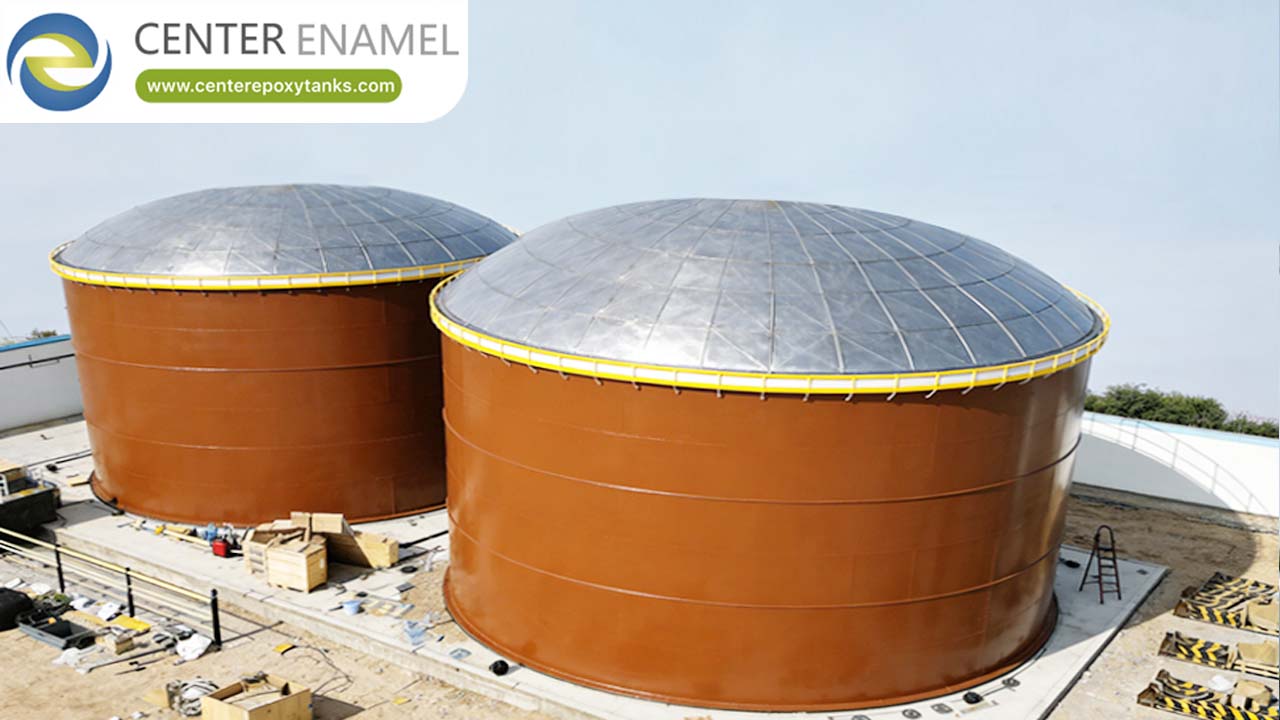
Double-Wall Oil Storage Tanks: Engineering Secondary Containment in Welded Steel
Double-wall oil storage tanks are the industry standard for preventing environmental contamination in high-stakes hydrocarbon storage. Engineered to UL 142, UL 58, and API 650 standards, these vessels feature a "tank-within-a-tank" design that provides 110% secondary containment. Center Enamel (Shijiazhuang Zhengzhong Technology Co., Ltd) specializes in site-constructed and shop-fabricated double-wall welded tanks, integrating interstitial leak detection and high-performance corrosion-resistant coatings. With a 30-year design life, Center Enamel systems ensure zero-leakage security for refineries, data centers, and global logistics hubs in 100+ countries.
1. Technical Specification & Compliance Matrix
This matrix establishes the mechanical benchmarks for Center Enamel’s double-wall engineering.
Feature | Technical Specification (2026 Standard) | Strategic Operational Value |
Design Standards | UL 142 (AST), UL 58 (UST), NFPA 30 | Mandatory for global refinery and municipal safety audits. |
Construction | Double-Wall (Coaxial) Welded Steel | Built-in secondary containment; eliminates concrete dikes. |
Leak Detection | Precision Interstitial Monitoring | Real-time electronic/vacuum sensors for 24/7 safety. |
Welding Protocol | Certified SAW / TIG (ASME IX) | X-ray quality monolithic seams; zero-porosity integrity. |
Testing Regimes | Pneumatic / Hydrostatic / Vacuum Testing | 100% verification of primary and secondary wall seals. |
Material Grade | ASTM A36, A516 Gr. 70, SS304L/316L | Optimized for tensile strength and ductility under load. |
2. The Physics of Coaxial Integrity: Double-Wall Mechanics
Interstitial Monitoring and Fail-Safe Engineering
The core of Center Enamel’s double-wall infrastructure is the interstitial space (the gap between the primary internal tank and the secondary outer shell).
● Secondary Containment: The outer shell is engineered to hold the full capacity of the primary tank plus a safety margin. This removes the legal requirement for expensive concrete "bund" walls or external dikes, significantly lowering site footprint and construction costs.
● Real-Time Leak Detection: We integrate precision electronic sensors or vacuum monitoring within the interstitial space. If the primary wall is breached, the secondary wall contains the oil while the system triggers an instant alarm—preventing any soil or groundwater contamination.
● Hydrostatic Stability: Utilizing Finite Element Analysis (FEA), we calculate the exact shell thickness required for both walls to resist the high specific gravity (SG) of crude and refined oils without structural deformation.
3. Advanced Corrosion Protection for Sub-Surface and Aboveground Service
Hydrocarbon tanks face aggressive internal and external environments. Center Enamel utilizes multi-stage protection to ensure decadal longevity.
● External (UST): For Underground Storage Tanks, we apply a thick, chemically bonded Fiberglass-Reinforced Plastic (FRP) jacket. This dielectric barrier isolates the steel from corrosive soil moisture and stray electrical currents.
● External (AST): Aboveground tanks are finished with UV-stable Aliphatic Polyurethane topcoats, resisting the chalking and fading caused by extreme solar exposure.
● Internal (Fuel Purity): To prevent "tank bottom water" corrosion, our tanks feature sloped floors and high-performance epoxy linings that facilitate water drainage and prevent internal oxidation.
4. High-Impact Applications in Global Energy Infrastructure
● Petrochemical Terminals: Large-scale site-constructed double-wall tanks for crude oil and refined products, ensuring compliance with API 650 Appendix S.
● Data Center Backup Power: Secure underground diesel storage for mission-critical facilities, ensuring uninterrupted power with zero environmental risk.
● Logistics & Fleet Refueling: High-throughput refueling hubs utilizing double-wall security to simplify environmental permitting in urban areas.
● Emergency Power for Hospitals: Reliable fuel containment for healthcare infrastructure, where safety and regulatory compliance are non-negotiable.
5. Why Partner with Center Enamel for Double-Wall EPC?
As a global leader with over 30 years of specialization and a pioneer in Chinese high-end tank technology, Center Enamel offers a unique technological advantage:
● Bespoke Structural FEA: Every tank is subjected to Finite Element Analysis (FEA) to simulate specific project-site conditions, including wind loads and seismic ground acceleration.
● Global Compliance Authority: Our engineering team adapts every design to localized safety and environmental codes (e.g., Eurocode, ASCE, AWWA) in 100+ countries.
● Quality Assurance (QA/QC): We implement rigorous on-site NDT (Non-Destructive Testing) protocols, including Radiographic Testing (RT) and Vacuum Box Testing, ensuring a zero-leakage start-up.
6. Technical FAQ: Double-Wall Implementation
Q: How does a double-wall tank simplify regulatory permitting?
A: Because the tank provides its own secondary containment, it often removes the legal requirement for external dikes. This simplifies the environmental impact assessment (EIA) and allows for faster project approval.
Q: Can double-wall tanks be used for volatile chemicals?
A: Yes. By utilizing 316L Stainless Steel for the primary wall and a carbon steel secondary wall, we provide high-integrity containment for a wide range of aggressive chemicals and volatile organic compounds (VOCs).
Q: What is the typical service life of a Center Enamel double-wall tank?
A: With our advanced coatings and cathodic protection systems, these tanks are designed for a 30-year service life, significantly lowering the total cost of ownership (TCO).


