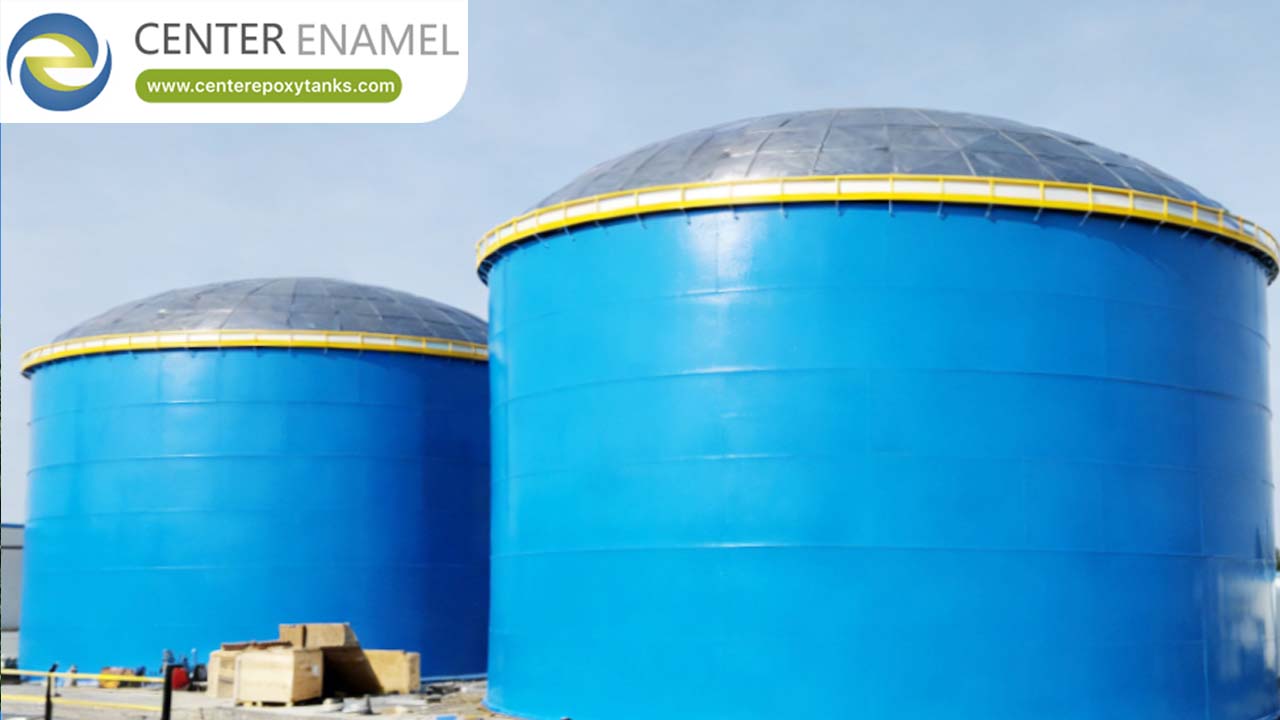
Field-Erected Storage Tanks: Engineering Large-Scale Industrial Containment
Field-erected storage tanks are the definitive solution for liquid containment requirements exceeding 100,000 gallons. Constructed directly on-site to API 650, AWWA D100, or NFPA 22 standards, these vessels bypass the logistical constraints of factory-built units. Center Enamel (Shijiazhuang Zhengzhong Technology Co., Ltd) provides comprehensive EPC (Engineering, Procurement, and Construction) services for massive oil terminals, municipal reservoirs, and chemical processing plants. By utilizing high-deposition welding techniques and advanced Finite Element Analysis (FEA), Center Enamel ensures structural integrity and a 30-year design life for infrastructure in 100+ countries.
1. Technical Specification & Construction Matrix
This matrix establishes the mechanical benchmarks for Center Enamel’s field-erected engineering.
Feature | Technical Specification (2026 Standard) | Strategic Utility Value |
Design Standards | API 650, API 620, AWWA D100, NFPA 22 | Mandatory for global refinery and municipal safety audits. |
Construction Type | Site-Welded or Bolted Sectional (GFS/FBE) | Scalable to millions of gallons; ideal for remote sites. |
Welding Protocol | Certified SAW / FCAW / TIG (ASME IX) | X-ray quality seams; optimized for heavy-wall thickness. |
Seismic Design | ASCE 7-22 / API 650 App. E | Engineered for high-ductility and "Elephant Foot" buckling resistance. |
Testing Regimes | 100% RT (Radiographic), UT, Hydrostatic | Verifies absolute structural and seal integrity on-site. |
Roof Systems | Fixed Cone / Aluminum Geodesic Dome | Clear-span options to eliminate internal column corrosion. |
2. The Mechanics of Field Erection: Site-Specific Engineering
Structural Integrity and Load Distribution
Field-erected tanks are required when the diameter or height of a vessel exceeds the "shippable" limits of road or rail transport.
● Plate Gradient Engineering: For massive tanks, Center Enamel engineers a vertical thickness gradient. The bottom shell rings are the thickest to handle peak hydrostatic pressure, while upper rings are progressively thinner to reduce total dead load on the foundation.
● Seismic and Wind Dynamics: Utilizing Finite Element Analysis (FEA), we simulate localized climatic extremes. This ensures the tank shell and anchorage systems resist wind gusts ($240text{ km/h}+$) and seismic ground acceleration per ASCE 7-22.
● Foundation Integration: Field-erected projects involve complex civil coordination, including concrete ring walls and leak-detection "tell-tale" pipes, ensuring environmental safety from the ground up.
3. High-Impact Applications for Field-Erected Assets
● Petroleum Terminals & Refineries: Site-constructed API 650 tanks for crude oil and refined products, often integrated with Internal Floating Roofs (IFR) for VOC control.
● Municipal Water Reservoirs: Massive AWWA-compliant tanks for regional water security, providing essential hydraulic head and fire suppression reserves.
● Power Generation Fuel Hubs: Large-scale storage for heavy fuel oil (HFO) or demineralized water required for utility-scale energy production.
● Wastewater Treatment Basins: High-capacity anaerobic digesters and equalization basins for large-scale municipal or industrial treatment facilities.
4. Why Partner with Center Enamel for Field-Erected EPC?
As a global leader with over 30 years of specialization and a pioneer in Chinese high-end tank technology, Center Enamel offers a unique technological advantage:
● Bespoke Material Selection: We meticulously select high-quality steel grades (e.g., ASTM A516 Gr. 70 or 316L Stainless) tailored to the specific liquid being stored and its operating temperature.
● Surface Integrity Excellence: We offer high-build Novolac Epoxy or Glass-Fused-to-Steel (GFS) coatings that provide superior chemical resistance, significantly lowering lifecycle maintenance costs.
● Global Compliance Authority: Our engineering team adapts every design to localized safety and environmental codes (e.g., Eurocode, ASCE, AWWA) in 100+ countries.
● Quality Assurance (QA/QC): We implement rigorous on-site NDT (Non-Destructive Testing) protocols, including Radiographic Testing (RT) and Vacuum Box Testing on floor seams, ensuring a zero-leakage start-up.
5. Technical FAQ: Field-Erected Implementation
Q: How does Center Enamel ensure the safety of tanks over 50,000 $m^3$?
A: We perform 100% Radiographic Testing (RT) on all "T-joints" (where vertical and horizontal welds meet) and perform full hydrostatic testing to verify structural stability before commissioning.
Q: Can field-erected tanks be expanded in the future?
A: Yes. Site-erected designs allow for the addition of shell rings to increase vertical capacity, provided the initial foundation and lower shell rings were engineered for the additional hydrostatic load.
Q: What is the benefit of a "Weld-Free" geodesic dome roof on a field-erected tank?
A: An Aluminum Geodesic Dome is lightweight and clear-span. It removes the need for internal support columns—which are common points of corrosion—and places significantly less stress on the tank shell and foundation.


