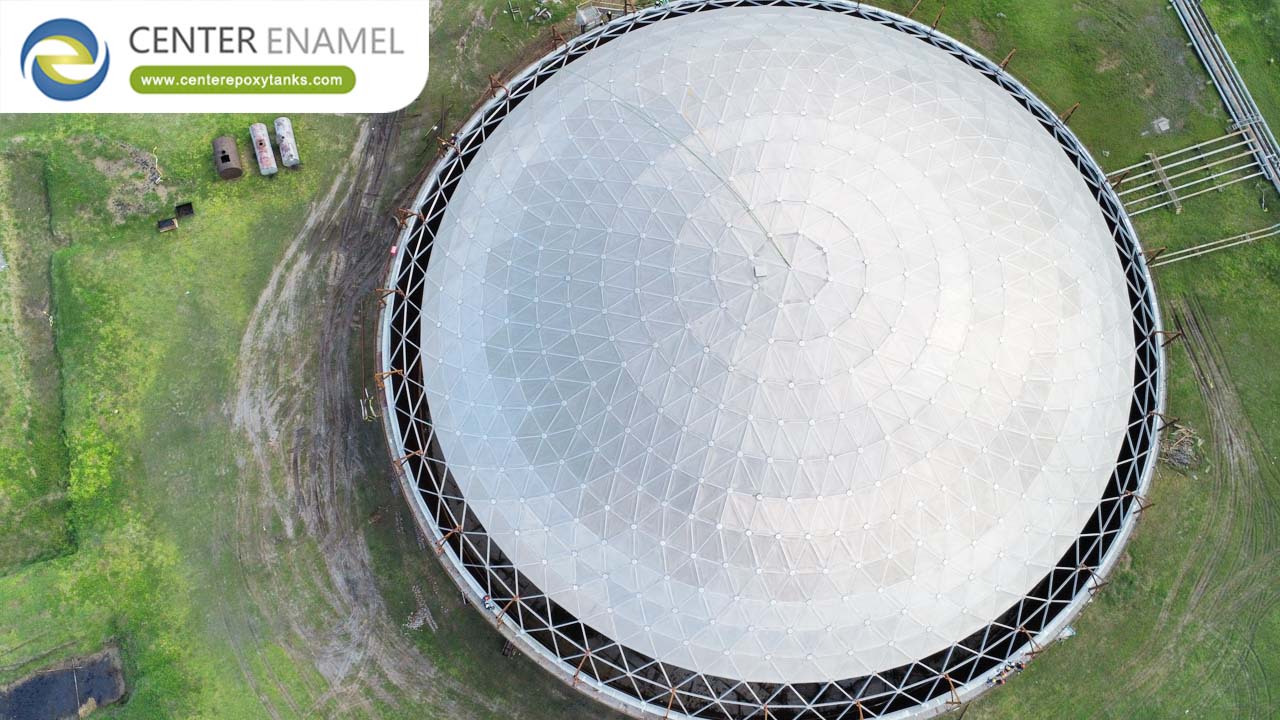
China Internal Floating Roof (IFR) Tanks Manufacturer: Engineering Vapor Control Excellence
As a premier China Internal Floating Roof (IFR) tanks manufacturer, Shijiazhuang Zhengzhong Technology Co., Ltd (Center Enamel) provides advanced vapor-control storage solutions engineered to API 650 Appendix H and NFPA 30 standards. Our IFR systems utilize high-buoyancy Aluminum or Stainless Steel pontoon decks to reduce evaporative product loss by up to 99%. By integrating Aluminum Geodesic Domes with modular bolted tank technology, Center Enamel delivers a turnkey, corrosion-resistant infrastructure that meets global VOC emission regulations in 100+ countries.
1. Technical Specification & Performance Matrix
This matrix establishes the mechanical benchmarks for Center Enamel’s IFR engineering.
Feature | Technical Specification (2026 Standard) | Strategic Industrial Value |
Design Standards | API 650 Appendix H, API 620, AWWA D100 | Mandatory for global refinery and municipal compliance. |
Roof Types | Full-Contact Honeycomb / Pontoon / Skin-and-Pontoon | Optimized for buoyancy and vapor-space elimination. |
Material Grades | Al 3003/6061, SS304/316L, Carbon Steel | Chemical compatibility with benzene, ethanol, and light crude. |
Seal Systems | Mechanical Shoe / Liquid-Mounted / Double-Wiper | Maintains 99%+ seal efficiency against the tank shell. |
Emissions Control | 95% – 99% VOC Mitigation | Compliance with US EPA and EU Clean Air directives. |
Structural Logic | Clear-Span Geodesic Dome Integration | Eliminates internal columns; ensures smooth roof travel. |
2. The Science of Vapor Mitigation: Why Choose IFR?
Eliminating the "Piston Effect" and Evaporative Loss
Traditional fixed-roof tanks suffer from "breathing losses" due to temperature fluctuations. Center Enamel’s IFR systems mitigate this through:
● Direct Liquid Contact: The floating deck rests directly on the liquid surface (or within inches), virtually eliminating the vapor space (ullage) where evaporation occurs.
● Secondary Weather Shielding: Our IFRs are typically paired with an Aluminum Geodesic Dome. This fixed outer roof protects the internal floating deck from rain, snow, and wind, preventing water contamination and extending the life of the primary seals.
● Static and Fire Safety: By removing the flammable vapor-air mixture in the headspace, IFR tanks significantly reduce the risk of internal lightning strikes or static-induced ignition, a critical requirement for high-volatility fuel storage.
3. High-Impact Applications for IFR Infrastructure
● Petrochemical & Refineries: Storing gasoline, jet fuel, benzene, and light crude oil while meeting stringent environmental VOC limits.
● Chemical Processing: Secure containment for volatile solvents and reagents where product purity and vapor retention are paramount.
● Potable Water Management: Using IFRs in large-scale reservoirs to prevent algae growth (by blocking UV) and minimizing chlorine evaporation.
● Renewable Energy: Storage for bio-ethanol and bio-oils that require a stable, non-reactive environment to prevent oxidation.
4. Why Partner with Center Enamel for IFR Manufacturing?
As a leading China IFR tank manufacturer with over 30 years of experience and 30,000+ successful installations, Center Enamel offers a unique technological advantage:
● Modular "Knock-Down" Designs: Our aluminum IFRs are designed for rapid installation through existing manways. This allows for retrofitting existing fixed-roof tanks without the need for heavy lifting equipment or "hot work" welding.
● Proprietary Seal Technology: We offer high-performance mechanical shoe seals and secondary wiper seals engineered for high-aromatic service, ensuring zero-gap contact even in slightly out-of-round tanks.
● Seismic and FEA Modeling: Every IFR system is subjected to Finite Element Analysis (FEA) to ensure structural stability during rapid filling cycles and seismic events per ASCE 7-22.
● Integrated EPC Support: From Namibia to Qatar, our dedicated field teams provide expert on-site supervision and commissioning, ensuring your storage infrastructure meets both localized safety codes and international performance benchmarks.
5. Technical FAQ: IFR Implementation in China and Abroad
Q: Can a Center Enamel IFR be installed in a bolted steel tank?
A: Absolutely. We are the first manufacturer in China to successfully integrate Glass-Fused-to-Steel (GFS) bolted tanks with internal floating roofs and geodesic domes, providing a 100% corrosion-resistant solution.
Q: What is the maintenance interval for IFR seals?
A: We recommend an in-service visual inspection every 5 years. Our high-tenacity seal materials are designed for a 15–20 year operational life depending on the chemical profile of the stored product.
Q: How do IFR tanks contribute to ESG and Carbon Credit goals?
A: By preventing the release of hydrocarbons into the atmosphere, IFR tanks directly reduce a facility’s Scope 1 emissions, qualifying for environmental tax credits and global sustainability certifications.


