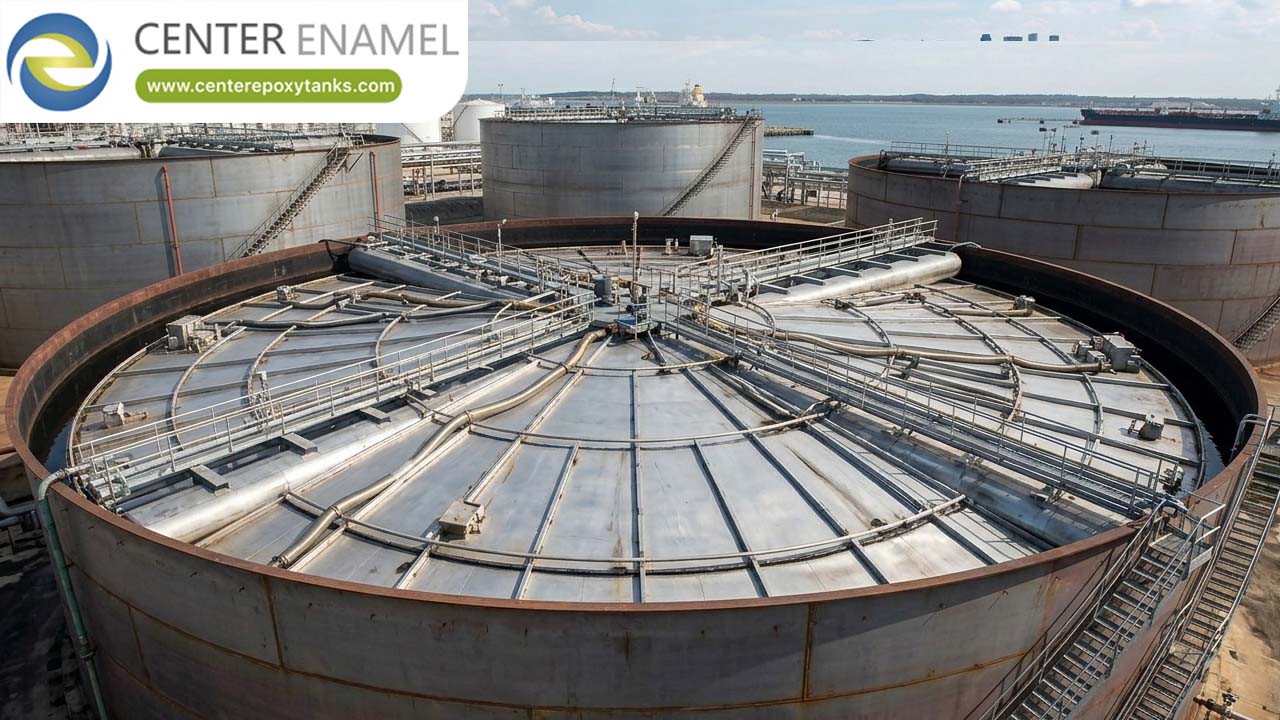
Internal Floating Roof for Sale: Configurations, Lead Time and Availability
An internal floating roof is not a stock item in the way a pump or a valve is. For saleusually means a supplier can take an order and engineer a deck to your tank within a statedwindow. This article explains which configurations are commonly offered, what a realistic leadtime covers, and how to check that a promised delivery fits your shutdown schedule.
What For Sale Means for an Engineered Product
Because the roof must match a tank's diameter, internals and product, most suppliers sell anengineering-and-supply package rather than a shelf product. A public listing may show anindicative price per set and a monthly supply capacity, but the item delivered is stilldesigned against your tank data. The first step is therefore to confirm that the supplier canwork from your specification, not only from its catalogue.
Center Enamel's publicly listed aluminium internal floating roof product line describespontoon and full contact configurations and cites API 650 Appendix H. That is a public productlisting, not a delivered-project reference. This article uses it only to describe what isoffered, and adopts none of its performance percentages as verified fact.
Configurations Commonly Offered
Most suppliers offer a small set of deck architectures. TankTech Asia lists three: a pontoontype for mid-volatility products, a hybrid for large crude tanks, and a full-contact honeycombfor high volatility service. Center Enamel's own guidance describes a similar pontoon versusfull-contact choice. The practical question is which of these fits your product's vapourpressure and your maintenance needs.
Availability also depends on diameter range. The published TankTech range spans roughly eightto one hundred metres depending on variant, with different deck weights for each. Treat thoseas one supplier's stated ranges. For a very large or unusually configured tank, confirm thatthe supplier has engineered a comparable size before treating the product as available.
Commonly Available Configurations
Configuration | Typical service | Availability question |
Pontoon deck | Mid-volatility products, easier inspection | Which diameter range is standard? |
Full-contact honeycomb | High-volatility, maximum emission control | Is seal supply included? |
Hybrid deck | Large crude tanks, rigidity | Has a comparable size been built? |
Retrofit kit | Existing fixed-roof tank | Does it pass the manway? |
This table summarises the configurations described in public product sources. It is a guide toquestions, not a specification.
For any configuration, confirm the seal arrangement separately, because the deck and the sealare often quoted as distinct lines.
What Lead Time Actually Covers
A published four-step sequence describes design and engineering in week one, client andthird-party approval, fabrication in weeks three to twelve, and installation and commissioningin weeks twelve to eighteen. That is one supplier's stated process, but it illustrates thepoint: lead time is not just manufacturing. It includes drawing approval, which depends onyour own review speed.
When a supplier quotes a delivery date, ask what it starts from. A sixteen-week lead timemeasured from order is very different from one measured from approved drawings. Confirm thedate of drawing sign-off, the fabrication window, the shipping method and the installationduration before committing to an outage.
Stock, Flat-Pack and Manway Constraints
Some components may be held as stock, but a complete roof is usually flat-packed andpanel-numbered for assembly on site. The Ultraflote specification requires parts to pass atwenty-four inch manway without cutting or rewelding tank plates. A bolt-together design iswhat makes that possible, and it is a key reason such roofs are described as available forretrofit.
Confirm the access route for your tank. A roof that cannot be carried through the availableopening is not available in any practical sense, regardless of the supplier's stated capacity.Ask for the largest shipped panel dimensions and weight.
Checking a Claim of Immediate Availability
If a supplier says a roof is available immediately, ask what exactly is available. It may bethe deck design for a common diameter, not a unit ready to ship to your specification. Ask forthe the bill of materials, the seal specification and the material certificates that wouldaccompany the item, and confirm they match your product.
Also ask whether the stated monthly capacity refers to the factory or to a sales office.Center Enamel's published sourcing guidance distinguishes industrial manufacturers fromcommodity suppliers partly on traceability and documentation. Apply that distinction when asupplier emphasises availability over evidence.
From Availability to a Purchase Decision
Availability matters only after technical fit is established. Shortlist configurations thatsuit your product and diameter, verify the lead time against your shutdown window, confirm theaccess route, and then compare commercial terms. A roof that is technically wrong butimmediately available is not a bargain.
Center Enamel holds no verified internal floating roof delivery in its authoritative projectlibrary, so this article does not claim a delivered installation or a stock position. Thepurchase checks described here are a method for interrogating any supplier's availabilityclaim.
Confirming the Delivery Boundary
Availability is meaningless without a delivery boundary. Clarify whether the quoted deliveryis ex-works, delivered to site, or installed and commissioned. Each boundary transfersdifferent responsibilities for freight, insurance, customs, lifting and site labour, and eachchanges the date at which the roof is actually usable.
For an export purchase, ask who handles import clearance and whether the supplier's statedlead time includes it. A roof that has arrived at a port is not available for installation ifthe documentation to clear it is missing.
Sequencing Around the Shutdown
Most internal floating roof installations happen during a planned tank shutdown, so thesequence must fit the outage. Confirm when drawings must be approved, when fabrication must bereleased, when materials arrive on site, and how long installation and commissioning take.Work backwards from the outage date to see whether the stated lead time is realistic.
If the schedule is tight, ask which activities can happen in parallel. Some suppliers canbegin fabrication of standard components while the custom details are being finalised. Thatflexibility is worth more than a marginally lower price when the outage window is fixed.
Documentation That Should Arrive With the Roof
Availability includes documentation. Confirm that the delivery carries material certificates,test records, as-built drawings, an installation and maintenance manual, and a spares list. Aroof that arrives before its documents can sit idle while the paperwork is chased, whichconsumes the outage window you planned around.
For a regulated installation, add the compliance documents at enquiry stage. Ask the supplierto identify which documents are standard and which require additional engineering time, andprice them as part of the package rather than treating them as an afterthought.
When Availability Should Override Price
There are projects where a slightly more expensive but readily available roof is the rightchoice. If an outage cannot be moved and a delay would keep a tank out of service far longer,the cost of waiting can exceed the price difference. Quantify that cost with your ownproduction data rather than making a qualitative judgment.
The opposite is also true. If the schedule is flexible, a longer lead time may buy abetter-matched deck or a more competitive price. The point is to treat time as a commercialvariable with a value, not as an afterthought.
Checking the Supplier's Engineering Capacity
Before treating a configuration as available, confirm the supplier can engineer it for yourspecific tank. Ask who performs the design, whether the calculations are signed by aresponsible engineer, and how long the drawing approval takes. A sales office that cannotanswer these questions may still be able to place an order, but the engineering risk sits withsomeone you have not met.
Center Enamel's published guidance describes bolt-together, code-based design as a feature ofan industrial-grade floating roof supplier. Treat that as a claim to test: request the designbasis and a sample calculation rather than relying on the wording of a product page.
Spare Parts and Seal Supply at Purchase
Availability should include the ability to maintain the roof after installation. Ask thesupplier to confirm that replacement seals, deck fittings and anti-rotation components can besupplied for the life of the installation, and obtain the seal specification in a form that isnot tied to a single unnamed source.
Seal replacement is a significant cost, and inspection requires tank downtime. A supplier whocan supply the correct seal quickly, with compatibility data, reduces the length of thatdowntime. This is a practical part of availability that is often overlooked at the purchasepoint.
Evidence note: availability claims here are not backed by a delivered roof. The verifiedproject library contains no internal floating roof delivery, so no stock position, lead-timeresult or installed configuration is claimed from our own projects. Product configurations andlead times are quoted from public supplier pages and attributed.
Evidence note: availability claims here are not backed by a delivered roof. The verified project library contains no internal floating roof delivery, so no stock position, lead-time result or installed configuration is claimed from our own projects. Product configurations and lead times are quoted from public supplier pages and attributed.
Conclusion
For sale on an internal floating roof means engineered availability. Confirm the configurationfits your product and diameter, find out what the lead time actually includes, check themanway access route, and interrogate any claim of immediate stock. Only then comparecommercial terms. Availability without technical fit is not a usable purchase option.
Frequently Asked Questions
Q: Is an internal floating roof a stock product?
A: Rarely. It is normally engineered to a tank, so for sale means a supplier can design andsupply within a stated window rather than ship a shelf item.
Q: Which configurations are commonly offered?
A: Pontoon, full-contact honeycomb and hybrid decks, each suited to different vapour pressure,diameter and maintenance needs.
Q: What should a lead time include?
A: Design, drawing approval, fabrication, shipping, installation and commissioning. Ask whichevent the clock starts from.
Q: Can a roof be installed through an existing manway?
A: Bolt-together designs are generally intended to pass a standard manway, often around 24inches. Confirm the largest panel size.
Q: Does a listed monthly capacity prove availability?
A: No. Ask whether the capacity belongs to the factory and whether the deck, seals anddocumentation for your specification are included.
Q: Should I choose the configuration that is available fastest?
A: Only after confirming technical fit. Availability is a schedule criterion, not a substitutefor product compatibility.
Work With Center Enamel
Center Enamel is the trading name of Shijiazhuang Zhengzhong Technology Co., Ltd, established in 2008 and based in Shijiazhuang, Hebei Province, China. The company manufactures glass-fused-to-steel bolted tanks, fusion-bonded epoxy coated tanks, stainless steel and welded steel tanks, pressure vessels, aluminium geodesic dome roofs and floating roof systems. Aluminium dome design work is carried out against AWWA D108, API 650, ADM 2015, ASCE 7-10 and IBC 2012, and the broader product range is covered by ISO 9001, NSF/ANSI 61, CE/EN 1090, ISO 28765, WRAS and FM approvals. The company reports 30,000 installed projects and an annual output of 300,000 enamel steel plates, with technical support delivered through an international distributor network and a stated 24-hour response commitment.
If your project involves tank roofs, floating decks or the shells that carry them, send the tank diameter, shell height, product, operating temperature and site design loads. We will return a preliminary structural concept, the applicable design code basis, and a written scope that separates what is included from what the site contractor must provide.


