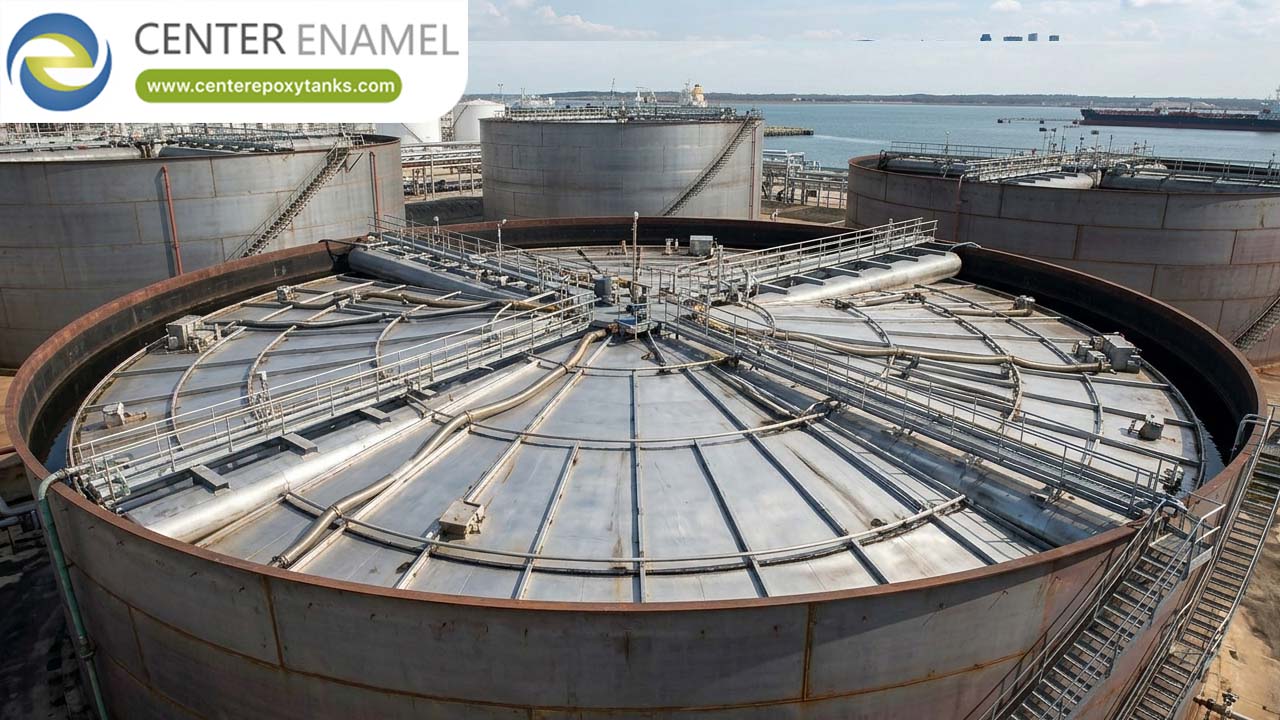
Internal Floating Roof for Crude Oil Tanks: Wax, Density and Vapour
Crude oil is a difficult service for a floating roof: it is dense, can deposit wax, carries varying quantities of light ends, and often arrives with water and solids. A design that works in a refined product can underperform in crude unless these properties are addressed explicitly. This article sets out the issues that matter and how they feed into design and inspection.
Density Is a Design Input
Buoyancy calculations are made against a stated product density, often with a minimum expected value. Crude is denser than many refined products, which helps flotation in simple terms, but blends, temperature and light-end content change the figure. A deck designed for one crude should not be assumed suitable for another without checking.
A published IFR specification expresses the buoyancy basis at the lowest expected specific gravity, showing how the design ties flotation to a defined product condition. Use the same discipline for crude and record the range in the specification.
Where the tank receives multiple crudes, define the lightest case for buoyancy and the heaviest or most viscous case for drainage.
Wax, Solids and Deck Loading
Crude can carry wax, asphaltenes and solids that settle where flow is slow. On a floating deck, that means low points, sumps and the area around penetrations. Deposits add weight where the deck can least tolerate it and can block the drainage path that is meant to remove liquid.
A storage-equipment selection guide lists the potential for sludge, wax, solids or polymer formation among the questions to ask before choosing an IFR. That is a direct prompt for crude service.
Inspection should therefore include a visual and measured check of deposit thickness at known collection points, with a trend recorded between campaigns.
Water and Corrosion
Produced water often accompanies crude and can separate inside the tank. Water collecting on a deck or in a pontoon compartment accelerates local corrosion and adds load. The corrosion guidance in this series points to deck low points, pontoon welds and compartments as the locations where degradation concentrates.
An API 653-based inspection programme evaluates plate pitting against the next internal inspection, and inspectors are advised to check every pontoon compartment rather than a sample. In crude service those instructions are not excessive.
Drainage design should assume that water will be present, not that the crude will stay clean.
Vapour and Deck Architecture
Crude contains light ends that create a real vapour-loss and emissions case. A published product range describes a hybrid deck for large crude tanks, recommended where rigidity and walkability under operator loading matter, and a full-contact honeycomb variant for high-volatility service. These are supplier assignments, but they illustrate that crude tanks often need a stiffness-conscious choice.
Use AP-42 methodology to estimate emissions with the actual true vapour pressure rather than a generic crude value. The result sets the required seal and fitting performance.
Where the emission target is tight, specify the secondary seal and the fitting controls explicitly instead of relying on a headline deck percentage.
Seal and Material Compatibility
Crude chemistry varies widely, including sulphur content and proportions of aromatics. Seal compounds and metals should be checked against the specific crude and the operating temperature, not against a generic hydrocarbon category. A seal that swells in an aromatic-rich crude may be stable in a paraffinic one.
An integrity paper notes that aggressive chemical service can force specialised materials and that compatibility failures are a persistent challenge. Treat crude variation as a compatibility question that must be revisited when the supply changes.
Record the assay basis at specification and keep it with the material certificates.
Operational Controls
Heating, mixing and recirculation all change the deck environment in crude tanks. Higher temperature changes vapour pressure and can soften some seal compounds; mixing can.create surface turbulence that tests the deck's stability.
Document the permitted operating envelope, including heating temperature and mixing schedules, and relate it to the design basis. A deck that is fine under quiet conditions may behave differently during a heating cycle.
No internal floating roof project is held in the verified project library, so no crude-service outcome is claimed here; these are design and inspection considerations drawn from the named sources.
Managing Crude Variation
Crude assays change with supply, and a tank that receives blends from several sources sees a moving design condition. Keep a simple record of the density, sulphur and light-end range actually received, and compare it with the basis on which the roof was specified.
When a new crude falls outside the recorded range, review buoyancy, seal compatibility and drainage before accepting it. The operating procedure should make that review a required step rather than a discretionary one.
This is particularly important where a roof was specified for a narrow crude slate and the terminal later broadens its supply.
Inspection Records for Crude Tanks
Record deposit thickness at the same marked points each campaign, note water in any pontoon compartment, and trend seal gaps by sector. Those three measurements capture most of the crude-specific degradation mechanisms.
An API 653-based evaluation judges pitting against the next internal inspection interval; deposit and water findings should be judged on the same forward-looking basis.
No internal floating roof project is held in the verified project library, so no crude-service result is claimed here; the guidance is attributed to the named sources.
Heating and mixing
Crude tanks are often heated to control viscosity, and heating changes vapour pressure, density and seal temperature. Record the operating temperature range and confirm that the material and seal choices remain valid across it.
Mixing and recirculation add surface movement. Where they are used, check deck stability under those conditions rather than only in a quiet tank.
Water draw-off coordination
Where a tank has water draw-off, coordinate it with the roof programme. Draw-off patterns affect where water collects and how the drainage system is used.
An undocumented operational change can undo a carefully designed drainage arrangement.
Deposits and the Inspection Interval
Where wax or solids accumulate quickly, a standard inspection interval may be too long to catch a blocked drain or a loaded deck. Use the first few campaigns to measure how fast deposits build, then set the interval from that evidence.
An adaptive interval based on observed condition is more defensible than a fixed number copied from another tank.
Crude and the Compliance Case
Crude tanks are frequently subject to vapour control requirements because of their light-end content. Establish whether your tank is above the applicable capacity and vapour-pressure thresholds, and keep the determination with the roof file.
Where it is not regulated, the product-loss case still benefits from a stated estimation method rather than an assumed saving.
No internal floating roof project is held in the verified project library; no crude emission result is claimed here.
First-Fill Checks
After a crude tank returns to service following roof work, confirm that the deck floats cleanly at the lowest and highest expected levels and that the drain discharges to the intended point. Wax or debris left from the outage can show up only when the tank fills.
Record the first-fill observations so later behaviour can be compared with a known baseline.
Final Review Before Crude Acceptance
For a crude tank, the essential question is whether the roof design basis still matches the crude actually being received. Review density, light-end content and deposit behaviour together before accepting a new supply.
No internal floating roof project is held in the verified project library; no crude-service outcome is claimed here.
Crude-Specific Review Points
Factor | Effect | Action |
Density range | Changes buoyancy margin | State minimum design density |
Wax deposition | Blocks sump and adds weight | Shorten drain inspection |
Produced water | Promotes local corrosion | Check compartments and low points |
Light ends | Raise vapour pressure | Set seal and fitting performance |
Crude varies by supply, so review each of these factors when the source or blend changes rather than assuming a fixed duty.
Evidence note: this crude-service guide is an engineering method, not a project record. The verified project library contains no internal floating roof delivery, so no crude tank, wax rate or emission result is claimed here. Design considerations are attributed to the named public sources.
Conclusion
Crude service rewards attention to density, deposits and vapour. State the design density, choose deck and seal against the actual crude, design drainage for wax and water, and inspect the parts where deposits collect. Treat each crude blend as a new service question rather than assuming all crudes behave alike.
Frequently Asked Questions
Q: Does crude density help or hurt buoyancy?
A: A higher density helps flotation for a given deck, but the design must state the minimum expected density because blends and temperature can change it.
Q: Why is wax a problem for a floating roof?
A: Wax and solids can deposit on the deck and in the drain sump, adding weight and blocking drainage, which can tilt the deck.
Q: What about water in crude?
A: Produced water can separate and collect at low points, accelerating corrosion and adding local load. Drainage and inspection should account for it.
Q: Which deck architecture suits crude?
A: Large crude tanks are often associated with hybrid or full-contact decks in published ranges, but the choice must follow the actual vapour pressure and diameter.
Q: Can an IFR reduce crude losses?
A: It removes most of the vapour space, which reduces losses of light ends. quoted percentages need the product and method stated.
Q: How should inspection be adjusted for crude?
A: Target pontoons, deck low points and drains, and compare results between campaigns to catch deposit build-up early.
Work With Center Enamel
Center Enamel is the trading name of Shijiazhuang Zhengzhong Technology Co., Ltd, established in 2008 and based in Shijiazhuang, Hebei Province, China. The company manufactures glass-fused-to-steel bolted tanks, fusion-bonded epoxy coated tanks, stainless steel and welded steel tanks, pressure vessels, aluminium geodesic dome roofs and floating roof systems. Aluminium dome design work is carried out against AWWA D108, API 650, ADM 2015, ASCE 7-10 and IBC 2012, and the broader product range is covered by ISO 9001, NSF/ANSI 61, CE/EN 1090, ISO 28765, WRAS and FM approvals. The company reports 30,000 installed projects and an annual output of 300,000 enamel steel plates, with technical support delivered through an international distributor network and a stated 24-hour response commitment.
If your project involves tank roofs, floating decks or the shells that carry them, send the tank diameter, shell height, product, operating temperature and site design loads. We will return a preliminary structural concept, the applicable design code basis, and a written scope that separates what is included from what the site contractor must provide.


