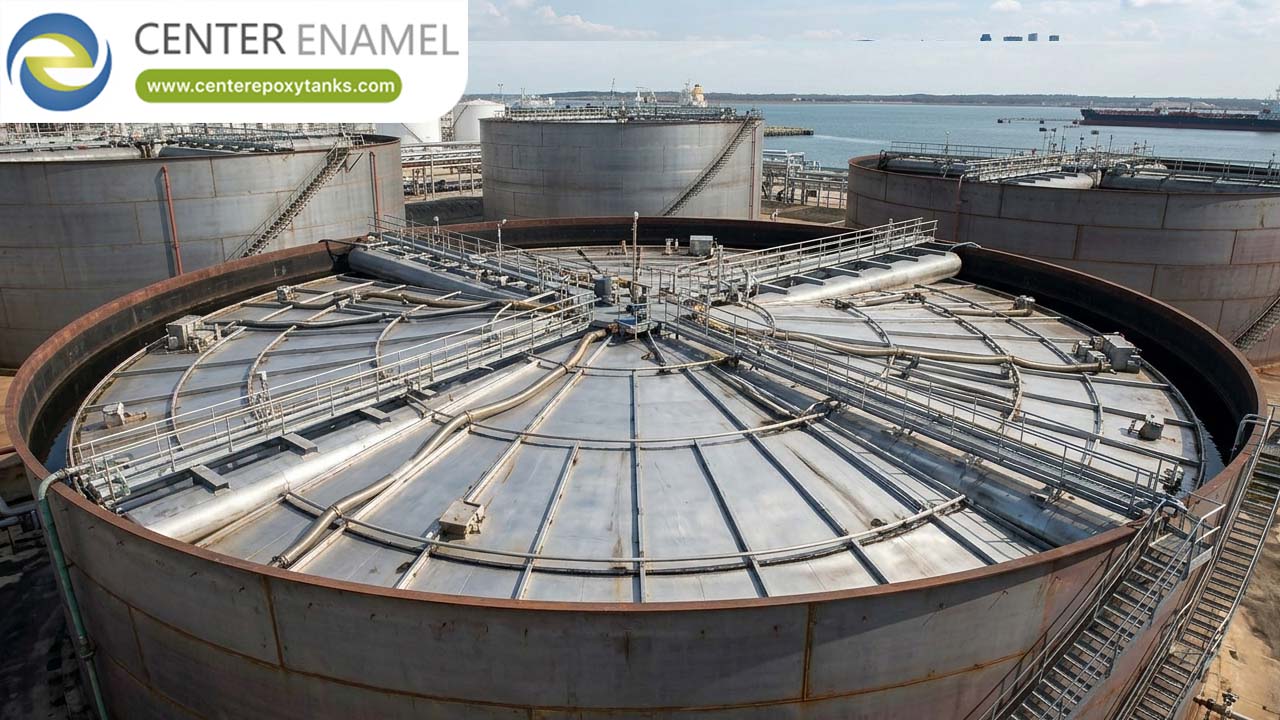
Internal Floating Roof for Oil Storage Tanks: Service Constraints
Oil storage is the classic application for an internal floating roof, but oil is not one product. A light distillate, a fuel oil and a crude each present a different vapour pressure, density and contamination risk. This article sets out the service constraints that decide whether and how an IFR should be applied to an oil tank.
Start With the Product, Not the Tank
The first input is the product's true vapour pressure and its density at operating temperature. Vapour pressure sets both the emission potential and, in the United States, whether a floating roof is a recognised control for a tank above the capacity thresholds in 40 CFR 60.112b. Density sets the buoyancy requirement the deck must satisfy.
A storage-equipment selection guide lists vapour pressure and volatility, compatibility with seal materials, and the potential for sludge, wax or solids among the first questions for an IFR. Those are service questions, not equipment questions.
State the design product and the allowable range in the specification. If the tank will handle more than one oil, define the worst case for each property.
Deck Architecture for Oil Service
A published product range associates its three deck variants with different services: a pontoon deck for mid-volatility products, a hybrid for large crude tanks and a full-contact honeycomb for high-volatility products. These are one supplier's assignments, but they show the correct logic - architecture follows vapour pressure and tank diameter.
For a large oil tank, stiffness and walkability during inspection matter as well as emission performance. The hybrid variant in that range is recommended for very large diameters where deflection under load is the governing concern.
Confirm the selected architecture against your own product and diameter rather than copying a supplier's default.
Seal Compatibility in Oil Service
Oil products differ chemically, and a seal compound that performs in one may swell, shrink or harden in another. A selection guide lists the wrong seal material for the product as a common cause of floating roof problems, and an API 653-based inspection guide stresses that seals must suit the stored material.
Ask for compatibility data against the specific product and temperature, and record the compound in the component register so a later replacement matches the original decision.
Seal condition should be a measured inspection item in oil service. A gap that grows at one sector may indicate shell distortion rather than simple wear.
Cycling, Drains and Deposits
Receiving and dispatch patterns change the load on a floating deck. Frequent cycling moves the roof repeatedly across its travel and gives any seal defect more opportunities to leak. The selection guide lists fill and empty frequency and the typical operating level range among the key operational inputs.
Deposits are the other oil-specific issue. Wax, sludge and solids can collect on a deck and in a drain sump, adding weight and blocking the drainage path. An inspection programme for an oil tank should therefore include the deck low points and the drain as explicit tasks.
Where a tank is taken out of service for long periods, document the landed condition of the deck and the state of the legs; a roof resting on its legs for months needs a careful restart check.
Compliance and Business Cases
For a regulated oil tank, the compliance case is built from the deck, the seal arrangement, closed fittings and the inspection record under the applicable air rule. For a tank outside those thresholds, the case usually rests on reduced product loss and lower vapour risk, which should be estimated from the actual operating profile.
AP-42 provides the recognised method for estimating storage tank emissions. Use it with the product vapour pressure and seal configuration rather than adopting a generic percentage from a product page.
No internal floating roof project is held in the verified project library, so no oil-service emission result is claimed here.
Inspection Priorities in Oil Tanks
Target inspection at the parts the service attacks: pontoon compartments for product ingress, deck low points for deposits and pitting, seals for contact and wear, and fittings for closed covers. An API 653-based programme judges pitting against the next scheduled internal inspection, which is a more useful test than appearance alone.
Compare each campaign with the last. A trend in seal gaps or pontoon leaks tells you more than a single pass result.
Keep the design product and the inspection findings in the same file, because a service change should trigger a review of both.
Different Oils, Different Priorities
A diesel tank and a gasoline tank in the same terminal do not have the same programme. The gasoline tank's case is dominated by vapour pressure and seal integrity; the diesel tank may be more concerned with deposits, drainage and product quality over long storage.
Group tanks by duty and assign inspection priorities accordingly. A single terminal-wide frequency is easy to administer but tends to over-serve the easy tanks and under-serve the difficult ones.
Review the grouping when the product slate changes, and record the reason for each group so the decision is defensible.
Documentation for Oil Service
Keep the design density, design vapour pressure, seal compound and deck architecture on file for every oil tank. Those four items explain most service problems when something goes wrong.
When a tank switches product, update the file before the change and compare the new product against the recorded basis. A review performed after a leak is a recovery exercise, not a control.
No internal floating roof project is held in the verified project library, so no oil-service outcome is claimed here.
Quality and contamination
In some oil services, reducing air contact can limit oxidation and water ingress, but the effect depends on the product and the seal condition. Treat any quality benefit as a secondary outcome to be verified, not a general promise.
Keep records of product quality before and after installation if that benefit is part of the business case.
Planning the first inspection
Set the first post-installation inspection earlier than the routine interval so that early seal wear or fitting problems are caught while they are still cheap to correct.
Use that first campaign to calibrate the interval for the actual service rather than an assumed one.
Reviewing After a Service Change
When an oil tank changes grade, compare the new product against the recorded design density, vapour pressure and seal compatibility before the change takes effect. A short review at that point prevents most of the problems that otherwise appear months later.
Record the decision in the tank file so the next operator knows the roof was assessed for the new service.
No internal floating roof project is held in the verified project library; this is an operating method, not a reported case.
Documentation Across the Tank Life
Keep the design basis, seal specification and inspection findings for the life of the tank. When a problem appears years later, that file is what distinguishes a material failure from an operating change.
For oil service in particular, record the products handled and any period of unusual cycling or heating. Those details often explain a defect that the metal alone cannot.
No internal floating roof project is held in the verified project library; this is a record-keeping method, not a delivered case.
Final Acceptance Check for Oil Service
Before any oil-service roof is accepted, confirm that the recorded design density, vapour pressure, seal compound and deck architecture match the product the tank will actually hold. That simple comparison closes the loop between selection and operation.
No internal floating roof project is held in the verified project library; this is an acceptance method, not a reported installation.
Oil Service Inputs
Input | Why it matters | Record |
True vapour pressure | Sets emission potential and rule status | Design basis |
Density | Sets buoyancy requirement | Minimum expected value |
Wax and solids | Affect drains and deck loading | Inspection priority |
Seal compatibility | Prevents swelling or hardening | Compound certificate |
Record these inputs for every oil tank. They explain most service problems when something changes or a defect appears.
Evidence note: this application guide is a service-based method, not a project record. The verified project library contains no internal floating roof delivery, so no oil tank, emission figure or service outcome is claimed here; the service inputs are drawn from the cited rules and guidance.
Conclusion
Apply an internal floating roof to oil storage by starting with the product: vapour pressure, density, temperature and solids. Match the deck architecture and seal to those conditions, design drainage for deposits, and set inspection around the actual service rather than a generic schedule.
Frequently Asked Questions
Q: Is an IFR suitable for all oil products?
A: It depends on vapour pressure, density, temperature and solids content. Light products benefit most from vapour control; heavy or waxy products can create deck and drain issues.
Q: What role does vapour pressure play?
A: It sets the emission potential and, under US rules, whether a floating roof is a required control above defined capacity thresholds.
Q: How does product density affect the deck?
A: Buoyancy is designed against a specified minimum density. A lighter product than assumed reduces the flotation margin, so the design basis must state it.
Q: Why are seals product-specific?
A: A compound compatible with one hydrocarbon may swell or harden in another. Compatibility data against the actual product and temperature is required.
Q: Do oils with wax or solids create problems?
A: Yes. Deposits can accumulate on the deck, block drains and interfere with movement, so inspection and drainage need a shorter interval.
Q: Can an IFR improve product quality?
A: By reducing the vapour space and air contact it can limit oxidation and contamination in some services, but the effect is product-specific and should not be promised generally.
Work With Center Enamel
Center Enamel is the trading name of Shijiazhuang Zhengzhong Technology Co., Ltd, established in 2008 and based in Shijiazhuang, Hebei Province, China. The company manufactures glass-fused-to-steel bolted tanks, fusion-bonded epoxy coated tanks, stainless steel and welded steel tanks, pressure vessels, aluminium geodesic dome roofs and floating roof systems. Aluminium dome design work is carried out against AWWA D108, API 650, ADM 2015, ASCE 7-10 and IBC 2012, and the broader product range is covered by ISO 9001, NSF/ANSI 61, CE/EN 1090, ISO 28765, WRAS and FM approvals. The company reports 30,000 installed projects and an annual output of 300,000 enamel steel plates, with technical support delivered through an international distributor network and a stated 24-hour response commitment.
If your project involves tank roofs, floating decks or the shells that carry them, send the tank diameter, shell height, product, operating temperature and site design loads. We will return a preliminary structural concept, the applicable design code basis, and a written scope that separates what is included from what the site contractor must provide.


