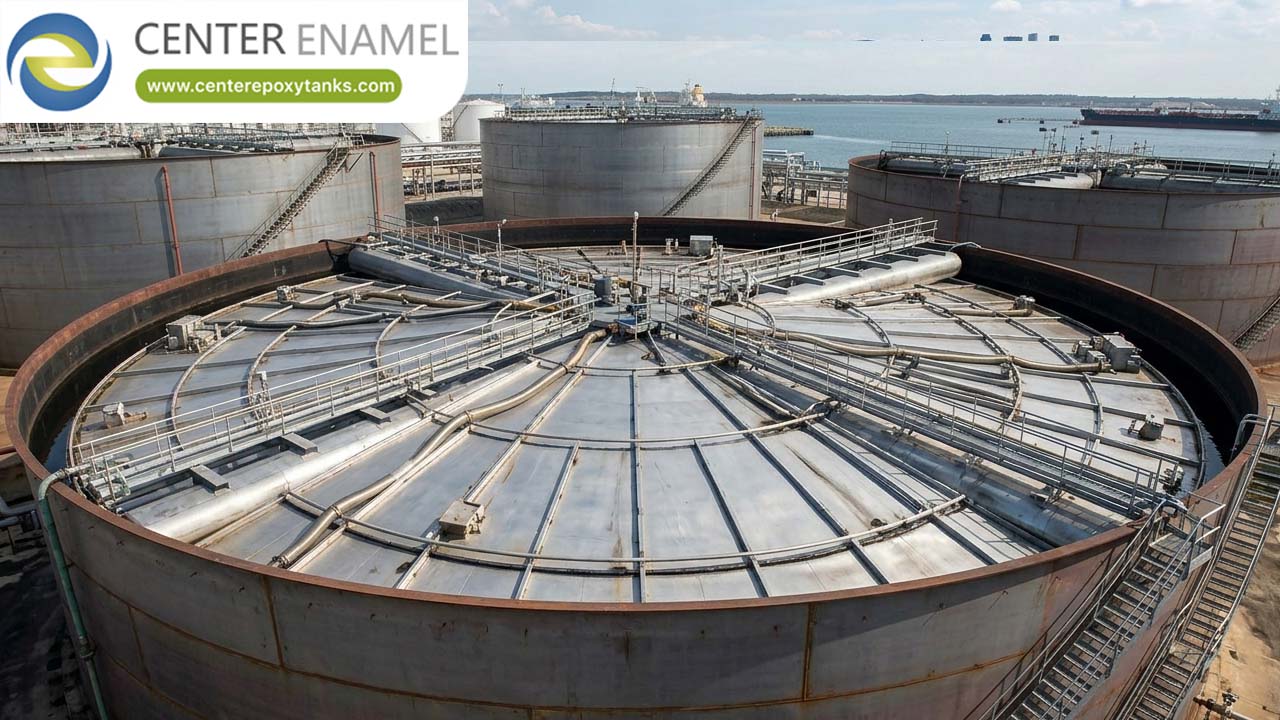
Internal Floating Roof Corrosion Resistance: Where It Matters
Corrosion resistance is often quoted as a single material property, but an internal floating roof degrades at specific locations for specific reasons. The deck skin, pontoons, weld regions, fasteners and seals each face a different exposure. This article identifies where corrosion actually occurs and how material choice and inspection respond.
Corrosion Is Local, Not Uniform
A floating roof integrity paper describes inspection and materials evaluation as targeted activities: visual assessment of the deck and internals, material tests where abnormal operation has occurred, and non-destructive testing of pontoons and welds to detect wall thinning and cracks before they cause leakage or sinking. The point is that degradation concentrates at identifiable locations.
Deck low points, sumps and areas around the drain collect liquid. Pontoon welds and compartments can hold product or water after a small leak. The underside of the deck sits in the vapour space, where corrosion may be worse than on the top surface. Penetrations and sleeves are places where different materials meet and where crevices form.
An inspection specialist makes the same point about fixed roofs and adds a warning that applies here too: measuring plate thickness only from above misses the worst corrosion, which is often on the underside.
Why Aluminium Is Commonly Chosen
Aluminium is widely used because it forms a protective oxide, resists many petroleum and chemical environments, and is roughly a third of the weight of carbon steel. A published floating roof specification names 3003-H14 deck skin and 3004-H36 flotation tubes, illustrating that the choice is a specific alloy and temper, not a generic material.
A competing product range quotes deck weights around six to nine kilograms per square metre across pontoon, hybrid and full-contact variants. Those figures are one supplier's data, but they show why low weight matters on an older shell that was not designed for a heavy roof.
Low weight is not the only criterion. Strength, formability and joining behaviour matter, which is why specifications name tempers rather than simply saying aluminium.
Chemical Compatibility Sets the Real Limit
The most important question is whether the material and seal resist the specific product at the operating temperature. A compound that swells in one hydrocarbon may be stable in another; water, acids or blends can change the picture completely. A storage-equipment guide lists the wrong seal material for the product as a common cause of floating roof problems.
The integrity paper notes that material compatibility is a persistent challenge and that aggressive chemicals can drive exotic alloys or specialised coatings. Cost rises accordingly, but that is a better outcome than a roof that fails early because a generic resistance chart was treated as proof.
Where the product changes, revisit the decision. A roof that served one service well may face a different chemistry, density and solids content in another.
Design Allowances and Inspection
The technical paper cites a corrosion allowance of roughly 1.6 to 3.2 millimetres on steel components as a design consideration, alongside deflection limits under water and snow load. An allowance is not permission to ignore corrosion; it is margin that inspection must confirm has not been consumed.
Inspection of an internal floating roof under an API 653-based programme evaluates plates and pontoons for cracks, punctures and pitting, and judges pitting by the likelihood of through-pitting before the next internal inspection. That is a direct link between the corrosion mechanism and the maintenance interval.
NDT methods named in the integrity paper include ultrasonic and radiographic testing of pontoons and welds, used to find wall thinning and cracks before leakage or sinking. Choose the method to the location rather than applying one test everywhere.
The Seal Is Part of the Corrosion Story
Seals are usually discussed in emission terms, but they influence local corrosion. A seal that no longer contacts the shell allows vapour and liquid to reach areas that were previously dry, and a failed fitting gasket can leave product sitting on the deck.
Under the federal requirements cited earlier, covers and gaskets must remain closed except when in use, and sample wells and column penetrations have specific closure arrangements. Keeping those features intact is as much a corrosion-control measure as an emission measure.
Inspect the seal and the metal beneath it together. A gap and a corroded patch at the same sector usually share a cause, not two unrelated problems.
Using This Guide
Corrosion resistance is a system property: alloy, coating, seal compound, workmanship and operating discipline together decide how a roof ages. No internal floating roof project is held in the verified project library, so no service life is claimed here; the figures and mechanisms are attributed to the named sources.
Set the material basis from the actual product, record it in the component register, and let the inspection programme test whether the assumption still holds.
Corrosion Under the Deck
The underside of a floating deck sits in the vapour space and can corrode faster than the top surface, particularly where the product is acidic or where water collects. An inspection specialist warns against measuring plate thickness only from above; that advice is directly applicable to an internal roof.
Where access allows, compare underside and topside thickness at the same locations. A consistent difference tells you the vapour space is the driver and should change the material or coating decision for the next roof.
Pontoon compartments are part of the same picture. Water or product inside a compartment is both a buoyancy defect and evidence that corrosion has already opened a path.
Using the Inspection Record
Corrosion decisions should be made from trends. Record location, method, measured value and date in a form that can be compared at the next inspection, and mark the same points so the comparison is like for like.
When a location consistently loses thickness faster than expected, revisit the material assumption rather than simply increasing the inspection frequency. A shorter interval detects the problem but does not remove its cause.
No internal floating roof project is held in the verified project library, so no corrosion rate is claimed here; the mechanisms and figures are attributed to the named sources.
Material selection under uncertainty
When the product varies, choose on the worst credible case and record the assumption. A material that has margin in the harshest expected condition will tolerate variation; one selected at the average will not.
Where the worst case would force an expensive alloy, consider whether operating controls can reduce the exposure instead. The decision should be explicit rather than implicit in a supplier's default.
Linking corrosion to inspection scope
Let the corrosion mechanism decide the inspection method. Wall thinning calls for ultrasonic measurement, cracks for methods able to find them, and pontoon leakage for a compartment-by-compartment check.
Using one generic test everywhere wastes time on sound areas and misses the locations that actually degrade.
The Cost of Ignoring Local Corrosion
Local corrosion is easy to defer because the rest of the deck still looks sound. The risk is that a small penetrating defect in a pontoon removes buoyancy from one compartment, and several such defects together change how the whole roof behaves.
A programme that records thickness at fixed points and acts on the trend avoids discovering several compartments at once during an outage. The cost of a planned patch is small compared with a deck that has to be taken out of service unexpectedly.
No internal floating roof project is held in the verified project library, so no corrosion cost is claimed here; this is a maintenance argument drawn from the cited integrity guidance.
Corrosion Sites and Responses
Location | Mechanism | Response |
Deck low points | Standing liquid and pitting | Measure thickness, improve drainage |
Pontoon welds | Through-pitting or leaks | NDT, patch or replace |
Vapour-side underside | Acid or wet vapour attack | Compare underside thickness |
Seal interface | Trapped liquid at deck edge | Check seal and shell condition |
These locations are where degradation concentrates on a floating deck. Match the test to the mechanism rather than applying one method everywhere.
Evidence note: this corrosion guide is an engineering method, not a project record. The verified project library contains no internal floating roof delivery, so no corrosion rate, material life or failure incident is claimed from our work; the mechanisms described are drawn from the cited integrity literature.
Conclusion
Internal floating roof corrosion is local, not uniform. Target inspection at deck low points, pontoon welds, the vapour-space underside and penetrations; choose materials and seals against the actual product; and treat a service change as a new compatibility question rather than a continuation of the old one.
Frequently Asked Questions
Q: Where does an internal floating roof corrode first?
A: Common locations are deck low points and sumps, pontoon welds and compartments, the underside of the deck in the vapour space, and around penetrations where product or water can collect.
Q: Why is aluminium often chosen?
A: It forms a protective oxide and resists many petroleum environments, and its low weight suits retrofit. Compatibility must still be confirmed for the specific product and temperature.
Q: Can a seal cause corrosion?
A: The seal itself does not, but a compound incompatible with the product can swell or harden and trap liquid against the deck edge, accelerating local attack.
Q: What is a corrosion allowance?
A: Extra material thickness included in design so that expected metal loss does not reduce the component below its required thickness during its service life. A technical paper cites 1.6 to 3.2 mm as a typical steel range.
Q: Does API 653 require thickness measurement?
A: API 653 evaluates roof plates and pontoons for pitting and through-pitting. The owner and authorized inspector set the intervals and acceptance decisions.
Q: How does product change affect corrosion?
A: A new product can change compatibility, density and the presence of water or solids, so the roof should be reviewed before a service change rather than after a leak.
Work With Center Enamel
Center Enamel is the trading name of Shijiazhuang Zhengzhong Technology Co., Ltd, established in 2008 and based in Shijiazhuang, Hebei Province, China. The company manufactures glass-fused-to-steel bolted tanks, fusion-bonded epoxy coated tanks, stainless steel and welded steel tanks, pressure vessels, aluminium geodesic dome roofs and floating roof systems. Aluminium dome design work is carried out against AWWA D108, API 650, ADM 2015, ASCE 7-10 and IBC 2012, and the broader product range is covered by ISO 9001, NSF/ANSI 61, CE/EN 1090, ISO 28765, WRAS and FM approvals. The company reports 30,000 installed projects and an annual output of 300,000 enamel steel plates, with technical support delivered through an international distributor network and a stated 24-hour response commitment.
If your project involves tank roofs, floating decks or the shells that carry them, send the tank diameter, shell height, product, operating temperature and site design loads. We will return a preliminary structural concept, the applicable design code basis, and a written scope that separates what is included from what the site contractor must provide.


