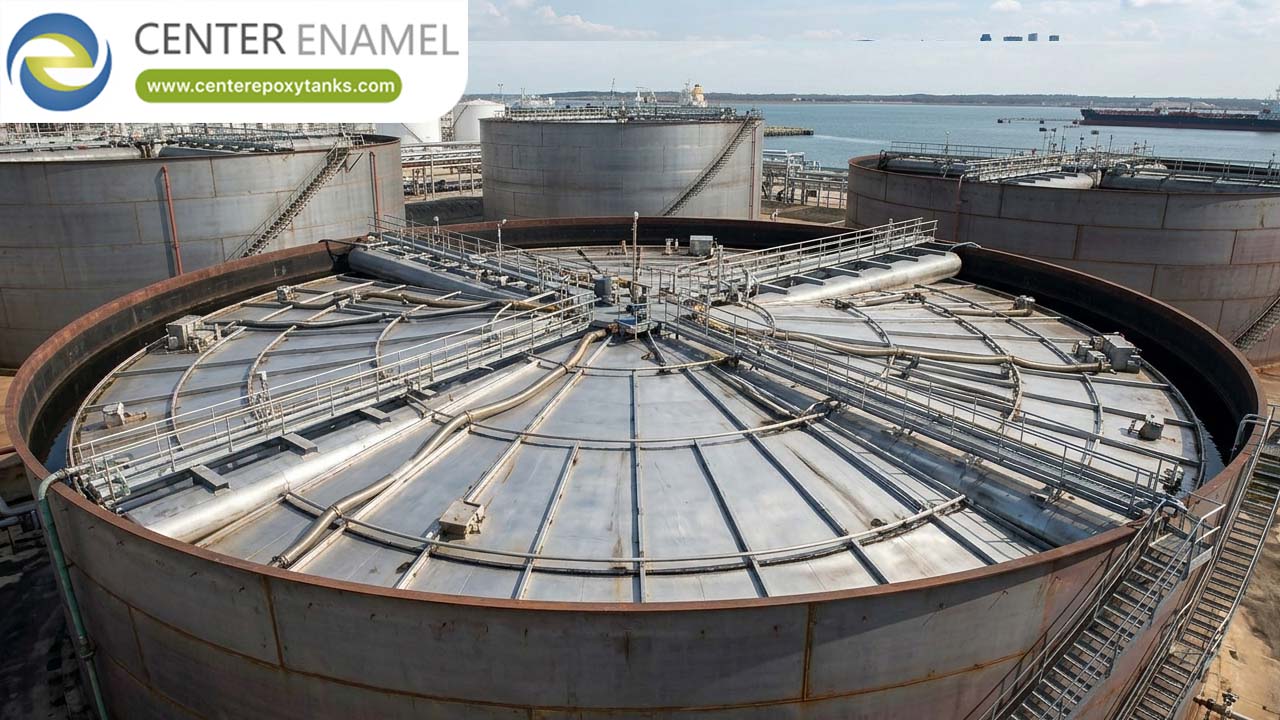
How Does a Floating Roof Tank Work? A Technical Overview
A Floating Roof Tank is an atmospheric storage vessel featuring a roof that rises and falls automatically with the level of the stored liquid. By maintaining constant surface contact (or near-contact) with the product, the roof acts as a floating piston that eliminates the "vapor space" above the liquid. This design is primarily used to prevent the evaporation of Volatile Organic Compounds (VOCs), thereby significantly reducing environmental emissions, minimizing product loss, and lowering fire hazards by preventing the accumulation of explosive vapor-air mixtures.
The Mechanism: Why Vapor Space is the Enemy
In a standard "fixed roof" tank, there is a large volume of air between the top of the liquid and the tank roof. As temperatures fluctuate or liquid levels change, the liquid evaporates into this air gap, creating hazardous, flammable, and polluting vapors.
Floating roof tanks utilize the principle of buoyancy to solve this. The roof floats directly on the liquid surface. Because there is no air gap, there is no room for vapors to form.
1. The Two Primary Configurations
While the basic working principle is identical, the application differs based on the environment:
External Floating Roof (EFR): The floating roof is open to the atmosphere. EFRs are typically used for very large diameter tanks (often storing crude oil) where constructing a fixed roof would be prohibitively expensive. They require robust drainage systems (to remove rainwater) and are prone to weather-related complications.
Internal Floating Roof (IFR): The tank has a fixed roof that shields the floating deck from the elements. This is the preferred design for storing refined, highly volatile products (like gasoline or jet fuel). The fixed roof provides a protective layer, making it safer and easier to maintain.
Critical Components for Functionality
The effectiveness of a floating roof tank relies on three key mechanical elements:
The Deck (The Buoyant Structure)
The deck provides the flotation. It can be constructed as a "pan" (rarely used due to sinking risks), a "single deck" with pontoons, or a "double deck" for maximum buoyancy. It must remain stable even if the tank is being filled or emptied rapidly.
The Perimeter Seal (The Vapor Barrier)
This is the most critical engineering component. Because the tank shell is rarely perfectly circular (due to thermal expansion/contraction or construction tolerances), there is a gap between the roof edge and the tank wall.
Primary Seal: The first line of defense, often a flexible wiper or mechanical shoe, that bridges the gap.
Secondary Seal: An additional, redundant seal mounted above the primary to ensure virtually zero vapor escape.
Support Legs
When the tank is drained completely, the roof cannot touch the bottom (as it would block suction lines or damage equipment). Adjustable support legs hold the roof at a precise height (the "landing position") when the tank is empty, ensuring maintenance crews can safely inspect the floor.
Why Is This System Used?
VOC Emission Control: These tanks can reduce evaporation loss by over 90% compared to fixed-roof tanks, which is essential for meeting modern environmental regulations.
Fire Prevention: By removing the air-vapor mixture, the tank eliminates the most common cause of storage fires: an explosive headspace.
Product Quality: Minimizing evaporation also protects the chemical composition of the stored product (preventing the "light ends" of fuel from evaporating off).
Frequently Asked Questions (FAQ)
Q: What is the difference between a primary and secondary seal?
A: The primary seal is the main, contact-based barrier that minimizes the bulk of vapor escape. The secondary seal acts as a backup, mounted above the primary, to catch any residual vapors that escape the primary seal, ensuring compliance with strict environmental standards.
Q: Do floating roof tanks ever sink?
A: Yes, this is an operational risk. If the perimeter seals leak, or if rainwater accumulates on an external floating roof (EFR) faster than the drain can remove it, the roof can lose buoyancy and tilt. This is why regular inspection of drains and seals is a critical part of facility maintenance.
Q: Why choose an Internal Floating Roof (IFR) over an External one?
A: IFR tanks are generally safer and easier to maintain because the fixed outer roof protects the floating deck from rain, snow, and wind. They are the industry standard for refined products. EFRs are usually only chosen for massive, large-diameter crude oil tanks where the cost of a fixed roof is too high.
Q: Can you store non-volatile liquids in a floating roof tank?
A: It is unnecessary. Floating roof tanks are expensive to build and maintain. If the liquid has very low volatility (like heavy fuel oil or lubricating oil), a standard fixed-roof tank is much more cost-effective.


