How Do Floating Roofs Work? The Mechanics of Vapor Containment
How does a floating roof function? A floating roof works by eliminating the air-filled "vapor space" inside a storage tank. Unlike a fixed roof, which is welded to the top of the tank, a floating roof rests directly on the surface of the liquid. It uses buoyancy to rise and fall with the liquid level, ensuring there is no room for the product to evaporate. By keeping the liquid in a liquid state, the roof prevents the formation of flammable air-vapor mixtures and reduces product loss by up to 98%.
1. The Principle of Buoyancy
The core of floating roof technology is Archimedes' Principle. The roof is engineered to be lighter than the volume of liquid it displaces, allowing it to "float" with total stability.
● Pontoon Systems: Most Internal Floating Roofs (IFR) utilize high-strength, airtight aluminum or stainless steel pontoons. These provide concentrated buoyancy. Even if a percentage of pontoons are compromised, the remaining units keep the deck level.
● Double-Deck Systems: Often used in External Floating Roofs (EFR), two layers of steel create a hollow, buoyant chamber across the entire surface. This provides superior structural rigidity and insulation against solar heat, further reducing evaporation.
2. The Rim Seal: The Critical Interface
The roof itself does not touch the tank walls; a small gap (the rim space) is necessary to prevent the roof from "binding" or jamming as it moves. To prevent vapors from escaping through this gap, a Rim Seal System is installed.
● Primary Seals: Typically a mechanical shoe seal or a foam-filled seal that maintains constant contact with the tank shell.
● Secondary Seals: Installed above the primary seal to provide a second layer of defense, catching any trace vapors that may have bypassed the first barrier.
● Vapor Suppression: This dual-seal configuration is what allows refineries and terminals to meet strict EPA and EU environmental compliance standards.
3. Operational Cycle: Filling and Emptying
How the roof behaves during a "working" cycle is what defines its efficiency:
1. Filling: As liquid enters the tank, the hydrostatic pressure pushes the roof upward. The anti-rotation system (usually a guide pole) ensures the roof does not spin, keeping the seals aligned.
2. Emptying: As the liquid level drops, the roof descends.
3. Landing: When the tank is nearly empty, the roof rests on support legs. This creates a temporary space beneath the roof to allow for maintenance or to prevent the roof from damaging the tank floor or internal heaters.
4. Engineering Standards: API 650 Compliance
At Center Enamel, our floating roofs are engineered in strict accordance with API 650. This ensures the system can handle:
● Rain and Snow Loads: EFR systems include "roof drains" to prevent water weight from sinking the roof.
● Seismic Sloshing: The structure is reinforced to remain stable during earthquake-induced liquid movement.
● Internal Pressure: The roof is designed to "breathe" through pressure-vacuum vents when it is resting on its legs.
5. Why Precision Manufacturing Matters
A floating roof is a dynamic machine. If the tank shell is out-of-round or the roof components are not precisely fabricated, the roof can tilt or jam—a catastrophic failure known as "binding."
Shijiazhuang Zhengzhong Technology Co., Ltd (Center Enamel) utilizes:
● CNC Fabrication: In our 150,000 m² facility, we ensure every pontoon and deck panel is perfectly uniform.
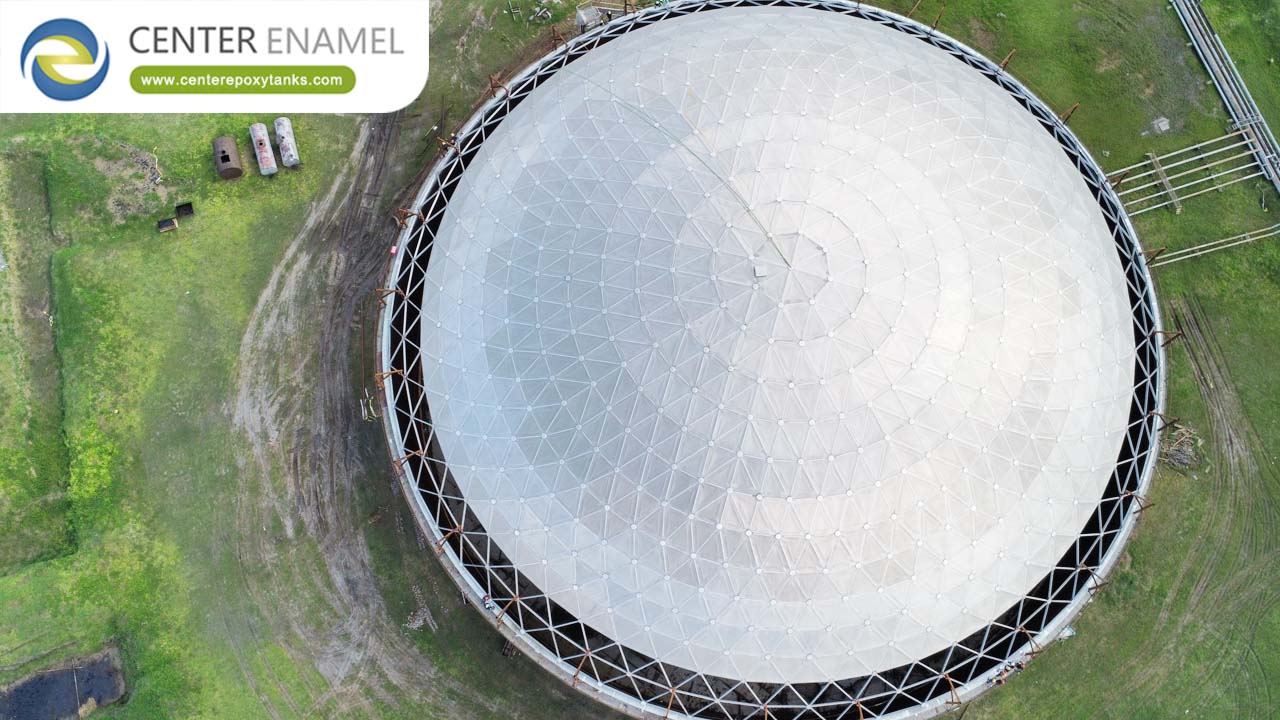
● Lightweight Materials: We specialize in Aluminum Geodesic Domes paired with internal decks, providing a maintenance-free, column-free interior that allows the roof to move with zero obstruction.
● Global Logistics: Our bolted designs are shipped to 100+ countries, allowing for rapid, weld-free assembly on-site.


