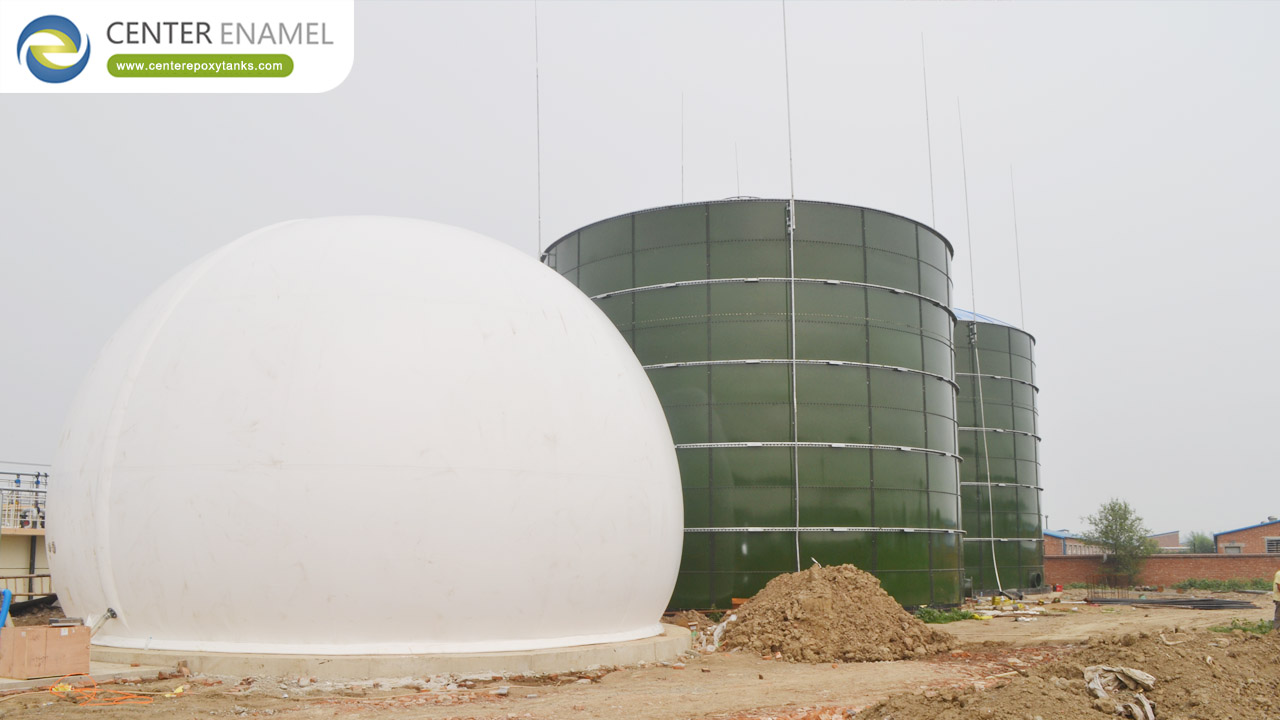
How Center Enamel Biogas Holders Benefit Modern Pig Farms: Engineering Renewable Energy and Sustainable Swine Waste Management
Intensive modern pig farming operations generate vast volumes of organic animal waste, presenting significant environmental, regulatory, and odor management challenges. Storing and treating high-strength swine manure traditionally required open lagoons or static concrete basins that release potent greenhouse gases, attract pests, and create severe odor liabilities.
To transform this operational burden into a profitable green energy asset, leading swine producers rely on advanced anaerobic digestion systems. Shijiazhuang Zhengzhong Technology Co., Ltd. (Center Enamel) delivers premier Center Enamel biogas holders and integrated Glass-Fused-to-Steel (GFS) anaerobic digesters. By combining high-performance double membrane gas storage technology with superior corrosion resistance, Center Enamel empowers modern pig farms to achieve complete waste valorization, odor suppression, and energy independence.
Core Engineering Advantages for Pig Farm Biogas Systems
Center Enamel’s integrated biogas digestion and double membrane storage systems are engineered specifically to conquer the harsh chemical and biological realities of swine manure management:
Superior Resistance to H2S and Corrosive Slurries: Swine manure naturally breaks down to produce biogas containing trace levels of hydrogen sulfide (H2S) and moisture, which rapidly corrode unprotected metals. Center Enamel utilizes signature Glass-Fused-to-Steel (GFS) technology—fusing molten glass to high-strength steel at approximately 800°C—to create an ultra-smooth, chemically inert surface that completely resists acid attack and abrasion.
Dynamic Double Membrane Pressure Buffering: Biological gas generation on a pig farm fluctuates continuously based on feeding cycles and temperatures. Center Enamel's double membrane gas holders feature a specialized multi-layer architecture. An inner membrane securely stores the raw biogas, while an outer protective membrane is maintained under constant pressure by an automated air blower, ensuring stable, uninterrupted fuel delivery to downstream Combined Heat and Power (CHP) engines.
Integrated Tank-Top Design for Maximum Efficiency: By mounting the double membrane gas holder directly on top of the anaerobic digester tank, Center Enamel creates a closed-loop, compact system that eliminates intermediate gas piping, minimizes leakage risks, and preserves valuable land space on the farm.
Modular Scalability for Expanding Farms: As swine production grows, upgrading waste management capacity is seamless. The modular bolted design of Center Enamel’s systems allows farms to expand tank volumes efficiently without total reconstruction.
Data Table: Comprehensive Comparison of Pig Farm Waste Storage & Gas Management
Technical Parameter | Center Enamel Biogas Holder & GFS Digester | Traditional Open Manure Lagoons | Static Concrete Basins |
Methane Recovery & Emission Control | Absolute; closed-loop system captures 100% of biogas with ultra-low leakage ( 0.02%) | Zero capture; fugitive methane and greenhouse gases vent directly into the atmosphere | Poor; prone to unsealed joint venting and low gas collection efficiency |
Corrosion & H2S Defense | Superior; inert glass-fused-to-steel and PVC/PVDF membranes resist acidic manure and H2S | Not applicable (unlined earth basins erode and contaminate groundwater) | Moderate to poor; vulnerable to concrete carbonation and acid spalling from slurry |
Odor Mitigation & Environmental Compliance | Complete odor suppression; completely eliminates volatile organic emissions and community complaints | Severe odor issues; releases heavy ammonia and foul-smelling volatile compounds | Moderate; surface crusting provides limited odor control |
Energy Recovery & Economic ROI | High ROI; generates steady electricity and thermal energy via captured biogas | Zero energy return; represents purely a waste disposal cost | Difficult to integrate gas collection equipment reliably |
Frequently Asked Questions (FAQ)
Q: How do Center Enamel biogas holders benefit modern pig farms operationally?
A: They capture and store methane-rich biogas produced from swine manure, providing a reliable fuel source for on-farm Combined Heat and Power (CHP) generators to offset electricity and heating costs while completely eliminating farm odor emissions.
Q: Why is Glass-Fused-to-Steel (GFS) technology ideal for pig manure anaerobic digesters?
A: GFS tanks combine the high tensile strength of steel with the chemical inertness of glass. This fused barrier resists corrosive manure acids, moisture, and hydrogen sulfide (H2S) gases, ensuring a service life exceeding 30 years with minimal maintenance.
Q: How do double membrane gas holders maintain stable fuel pressure for gas engines?
A: An automated air blower maintains a controlled positive pressure in the space between the inner gas storage membrane and the outer protective dome. This exerts consistent downward pressure on the inner membrane, ensuring steady biogas delivery to downstream equipment.
Q: Can Center Enamel's biogas systems be scaled up if a pig farm increases its livestock capacity?
A: Yes. Center Enamel’s modular bolted tank construction allows agricultural operators to easily expand digestion and storage volumes by adding ring panels as their livestock operations grow.


