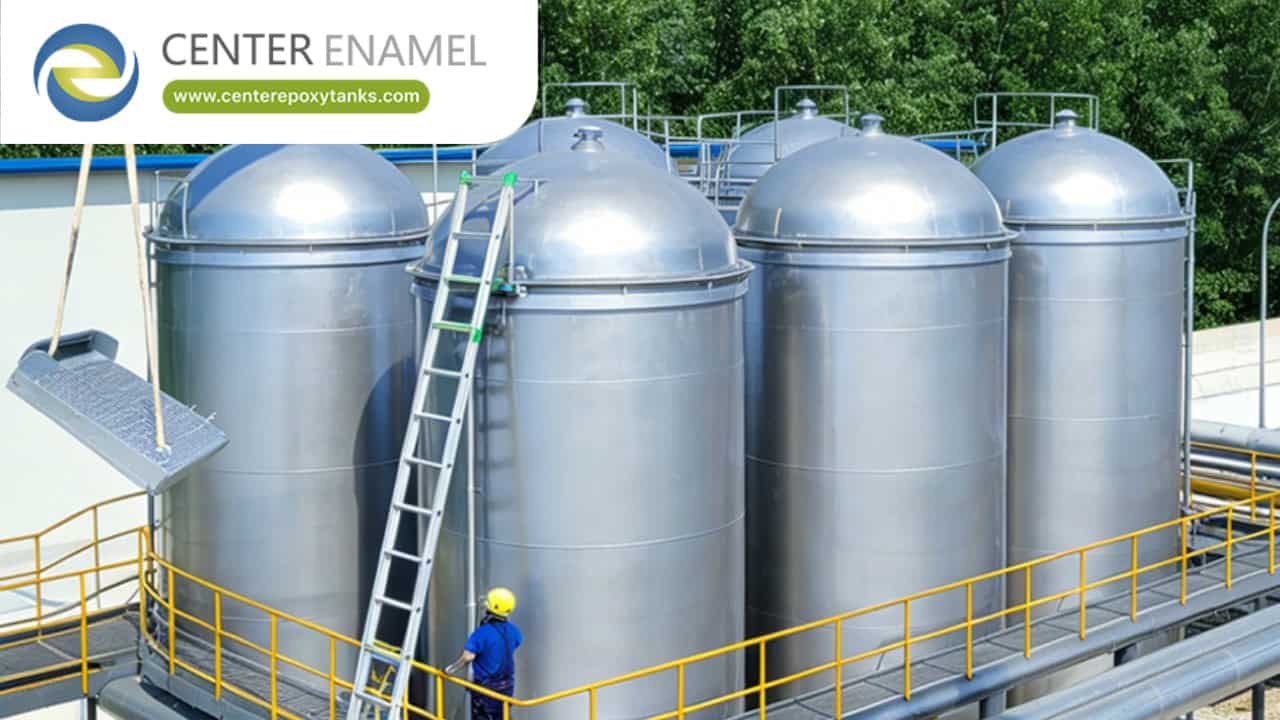
Guide to Hydrofluoric Acid Storage Tanks: Specifications and Critical Safety Requirements
Hydrofluoric acid (HF) is one of the most hazardous and corrosive chemicals utilized in heavy industry today. Commonly employed in oil refining (alkylation), aluminum production, and semiconductor manufacturing, its storage requires an entirely different engineering approach than standard industrial acids.
As a leading global manufacturer of industrial containment systems since 2008, Center Enamel (Shijiazhuang Zhengzhong Technology Co., Ltd.) provides advanced structural engineering for extreme chemical storage.
Below is the definitive guide to the precise material specifications, design standards, and safety requirements necessary for secure HF containment.
The "No Glass" Rule: Why HF is Unique
Before selecting a tank, facility managers must understand the most critical chemical property of hydrofluoric acid: it actively dissolves silicon dioxide (glass).
While Center Enamel is globally renowned for our signature Glass-Fused-to-Steel (GFS) technology—which is the ultimate solution for almost every other chemical and wastewater application—GFS panels are strictly forbidden for HF storage. The acid will rapidly strip the enamel frit from the steel substrate, leading to catastrophic structural failure.
Instead, HF storage requires engineered Welded Steel Tanks, Pressure Vessels, or specially lined Carbon Steel solutions.
Material Specifications Matrix: Anhydrous vs. Aqueous HF
The required material for an HF tank depends entirely on the concentration and water content of the acid.
1. Anhydrous Hydrofluoric Acid (AHF)
Anhydrous HF contains virtually no water (typically >99% concentration). While incredibly dangerous, it does not act as a traditional acid when moisture is absent.
● Containment Material: Carbon Steel.
● Mechanism: When exposed to AHF, the carbon steel immediately forms a protective surface layer of iron fluoride. As long as moisture is entirely excluded from the tank, this fluoride layer prevents further corrosion of the steel.
● Vessel Type: Because AHF has a high vapor pressure and boils at 19.5°C (67.1°F), it must be stored in specialized Welded Pressure Vessels engineered by Center Enamel to handle significant internal pressure.
2. Aqueous Hydrofluoric Acid
Aqueous HF is mixed with water (typically concentrated at 49% or 70% for industrial use). The introduction of water prevents the formation of the protective iron fluoride layer, meaning the acid will aggressively corrode bare steel.
● Containment Material: High-grade carbon steel or welded steel tanks fitted with specialized thermoplastic or rubber linings.
● Liners Required: Thick-build Chlorobutyl rubber (CBR), PTFE (Teflon), or high-density polyethylene (HDPE) linings must be chemically bonded to the steel interior.
HF State | Concentration | Primary Tank Material | Internal Coating/Lining | Design Standard |
Anhydrous (AHF) | > 99.0% | Carbon Steel | None (Forms iron fluoride layer) | ASME Section VIII (Pressure Vessel) |
Aqueous | < 70.0% | Welded Carbon Steel | PTFE, Chlorobutyl Rubber, or HDPE | API 650 / AWWA D100 |
Explore Chemical Compatibility
Test how varying acid concentrations dictate material selection using this interactive tool:
Why Choose Center Enamel for Complex Containment?
Handling extreme chemicals requires more than standard fabrication; it requires rigorous engineering oversight and certified quality control. With containment systems operating in more than 100 countries, Center Enamel is equipped to deliver:
1. Versatile Fabrication: From heavy-duty welded pressure vessels to specialized structural steel, we engineer the exact substrate required by your chemical application.
2. Global Compliance: Our manufacturing processes hold ISO 9001, ISO 45001, and EN1090 certifications, ensuring that whether your plant is in the USA, Australia, or the UAE, the tank meets the most stringent international safety codes.
3. Comprehensive Engineering Support: For dangerous liquids like HF, we provide precise seismic calculations, wind-load modeling, and complete technical support to ensure flawless site integration.
Frequently Asked Questions (FAQ)
Q: Why can't I use Center Enamel's Glass-Fused-to-Steel (GFS) tanks for Hydrofluoric Acid?
A: Hydrofluoric acid has a unique chemical property: it actively dissolves silicates (the primary component of glass). Pumping HF into a GFS tank will instantly destroy the enamel coating. For HF, we specifically engineer welded steel tanks, pressure vessels, or customized lined tanks instead.
Q: How do you prevent Anhydrous HF from corroding a carbon steel tank?
A: Anhydrous (water-free) HF reacts with the carbon steel to form a tough, microscopic layer of iron fluoride on the surface. This layer acts as a barrier against further corrosion. The critical safety requirement is ensuring absolutely zero moisture enters the tank, as water will break down the protective layer and cause immediate, rapid corrosion.
Q: Does Anhydrous HF require a pressure vessel?
A: Yes. Anhydrous HF boils at 19.5°C (67.1°F). At normal ambient industrial temperatures, it generates significant vapor pressure. It must be stored in an engineered pressure vessel designed to ASME codes, equipped with advanced pressure relief valves and vapor scrubbing systems.
Q: Can Center Enamel provide customized nozzle and flange configurations for HF tanks?
A: Yes. Connection points are the most vulnerable parts of any chemical tank. We engineer custom flanges utilizing specialized alloys (like Monel) or full PTFE linings to ensure absolute structural integrity at all piping integration points.


