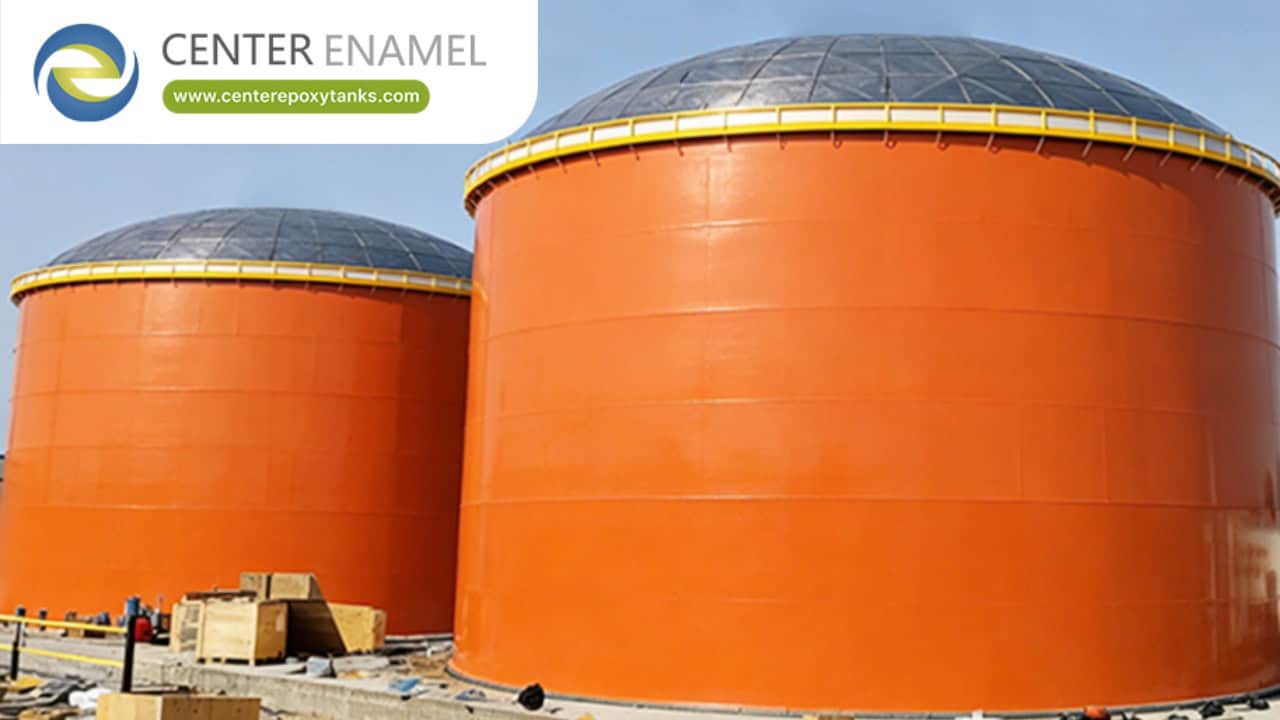
Guide to Hydrochloric Acid Storage Tanks: Key Specifications and Requirements
Storing hydrochloric acid (HCl) presents one of the most severe engineering challenges in industrial fluid management. As a highly corrosive, fuming liquid, HCl will aggressively attack standard metals and degrade improper containment systems, leading to catastrophic environmental and structural failures.
Whether you are managing chemical processing, industrial wastewater, or municipal water treatment, selecting the right storage infrastructure is non-negotiable. As the most experienced professional bolted tank manufacturer in Asia, Center Enamel (Shijiazhuang Zhengzhong Technology Co., Ltd.) engineers containment systems specifically designed to handle extreme chemical environments.
Here is the definitive guide to the material specifications, design requirements, and safety standards required for reliable hydrochloric acid storage.
The Primary Challenge: Why HCl is Difficult to Store
Hydrochloric acid is categorized as a strong, highly reactive inorganic acid. The primary challenges in storing it at industrial volumes include:
1. Extreme Corrosivity: At concentrations above 20%, HCl rapidly corrodes carbon steel, aluminum, and many common alloys.
2. Toxic Fuming: Concentrated HCl (typically 31% to 36%) produces heavy, acidic vapors that can degrade tank roofs, vents, and surrounding facility infrastructure if not properly scrubbed and contained.
3. Specific Gravity: HCl is heavier than water. Depending on the concentration, the specific gravity can reach up to 1.19, meaning the tank walls must be structurally engineered to withstand significantly higher hydrostatic pressure than a standard water tank.
Material Selection: The Foundation of Chemical Containment
You cannot store hydrochloric acid in a standard bare steel or concrete vessel. The tank must feature a highly specialized barrier.
For large-scale industrial volumes, Glass-Fused-to-Steel (GFS) technology—a sector pioneered in China by Center Enamel since 2008—offers exceptional performance. By fusing a proprietary enamel frit to high-strength steel at temperatures exceeding 820°C, the resulting tank panel combines the structural integrity of steel with the absolute chemical inertness of glass.
When dealing with extreme HCl concentrations, standard protocols require:
● Specialized Linings: Integrating high-density thermoplastic liners (like PTFE or engineered PVC) or specialized heavy-duty epoxy coatings within the steel superstructure.
● Sealant Integrity: Utilizing chemical-grade EPDM or fluoropolymer sealants at panel joints to ensure zero liquid or vapor permeation.
Key Engineering Specifications for HCl Tanks
When engineering a storage system for hydrochloric acid, procurement and facility managers must ensure the tank meets the following technical specifications:
Requirement | Technical Specification | The Center Enamel Standard |
Design Standard | AWWA D103-09, ISO 28765, OSHA | Full adherence to international engineering codes, utilizing FEA for seismic and wind load calculations. |
Venting & Fume Control | Must handle corrosive vapor expansion | Integration of specialized PVC/CPVC venting arrays and compatibility with advanced fume scrubbers. |
Testing & Quality Control | Zero-defect coating validation | Rigorous 1500V high-voltage Holiday testing on GFS panels to guarantee absolute coating continuity. |
Secondary Containment | 110% capacity bunding | Custom-engineered tank footprints designed to fit perfectly within strictly regulated secondary containment zones. |
Fittings & Flanges | Non-metallic or lined metallic | Use of specialized alloy or reinforced thermoplastic nozzles to prevent corrosion at connection points. |
Why Partner with Center Enamel for Chemical Storage?
Selecting a tank manufacturer is as critical as selecting the tank material. Since 2008, Center Enamel has driven the evolution of bolted tank technology, backed by nearly 200 enameling patents.
We are not just a fabricator; we are an end-to-end engineering partner. Our tanks are certified to rigorous global standards, including ISO9001, NSF/ANSI 61, EN1090, FM, and ISO 45001. Having successfully exported and commissioned containment systems in over 100 countries—including the USA, Australia, Russia, and the UAE—our engineering teams understand how to adapt complex chemical storage requirements to meet local environmental loads and regulatory codes.
Frequently Asked Questions (FAQ)
Q: What is the maximum concentration of Hydrochloric Acid that can be safely stored?
A: Industrial HCl is typically stored at concentrations between 31% and 36%. Containment of these high concentrations requires strict adherence to specific gravity calculations (to handle the heavier liquid weight) and demands advanced vapor scrubbing systems, as fuming increases significantly at higher concentrations.
Q: Can a bolted steel tank be used for highly corrosive acids?
A: Yes, provided it utilizes the correct surface technology. Center Enamel’s Glass-Fused-to-Steel (GFS) panels offer extreme chemical resistance (pH 1–14). For the most aggressive acid formulations, these steel superstructures can be combined with specialized, heavy-duty chemical liners, offering the rapid installation of a bolted tank with the total chemical immunity of a specialized polymer.
Q: How do you prevent hydrochloric acid fumes from corroding the tank roof?
A: Vapor management is critical. We often recommend pairing the storage tank with our precision-engineered Aluminum Geodesic Dome Roofs or utilizing specialized FRP (Fiberglass Reinforced Plastic) covers. These must be integrated with a properly sized fume scrubber system to neutralize the HCl gas before it is vented into the atmosphere.
Q: Does Center Enamel provide global installation support for chemical tanks?
A: Yes. We have extensive experience exporting to over 100 countries. We supply comprehensive CAD drawings, exact structural calculations, and detailed installation manuals. For complex industrial chemical projects, we can also dispatch specialized technical supervisors to guide your local crews, ensuring the tank is assembled safely and correctly.


