All You Should Know About Different Types of Chemical Storage Tanks
Choosing the right material for chemical storage is critical for operational safety, regulatory compliance, and long-term cost control. A mismatch between a chemical and its storage vessel can lead to catastrophic structural degradation, environmental hazards, and costly downtime.
Because chemicals range from highly corrosive acids to reactive alkalis and volatile solvents, the industrial storage market relies on a specific set of advanced materials.
1. Fiberglass-Reinforced Plastic (FRP) Tanks
FRP tanks are constructed from a polymer resin matrix reinforced with fiberglass, creating a highly durable, lightweight structure.
Key Strengths: FRP offers exceptional natural resistance to severe corrosion, particularly against strong acids, salts, and chlorides where metals typically fail. They are significantly lighter than steel, which lowers logistics and installation costs.
Limitations: FRP requires specific resin selection (e.g., vinyl ester or bisphenolic) based on the exact chemical stored, and they are generally not suitable for extreme high-temperature applications.
Best For: Corrosive environments, wastewater treatment, and storing aggressive acids like hydrochloric or sulfuric acid.
2. High-Density & Cross-Linked Polyethylene (HDPE / XLPE)
Polyethylene tanks are rotationally molded to form a seamless, one-piece vessel.
Key Strengths: Highly affordable and exceptionally resistant to a broad spectrum of aggressive chemicals, acids, and bases. Cross-linked polyethylene (XLPE) provides superior structural strength and resistance to crack propagation compared to standard HDPE.
Limitations: They cannot be pressurized (must be vented to atmospheric pressure) and generally cannot handle continuous operating temperatures exceeding 150°F (65°C).
Best For: Bulk storage of sodium hypochlorite, sodium hydroxide, and alum in mid-sized commercial and municipal applications.
3. Stainless Steel Tanks (304 / 316)
Stainless steel achieves its chemical resistance through a passive chromium oxide layer that forms on its surface, protecting the underlying iron from rust.
Key Strengths: Incredible physical durability, ability to withstand high mechanical loads, and tolerance for extreme temperatures (up to 600°C). Grade 316 includes molybdenum for added protection.
Limitations: Highly vulnerable to chloride-induced stress corrosion cracking. Storing aggressive halogens or hydrochloric acid in stainless steel will lead to rapid pitting and failure. They are also significantly heavier and more expensive upfront than polymers.
Best For: Solvents, pharmaceuticals, high-temperature chemical processing, and food-grade sanitary applications.
4. Advanced Coated Steel (GFS / FBE)
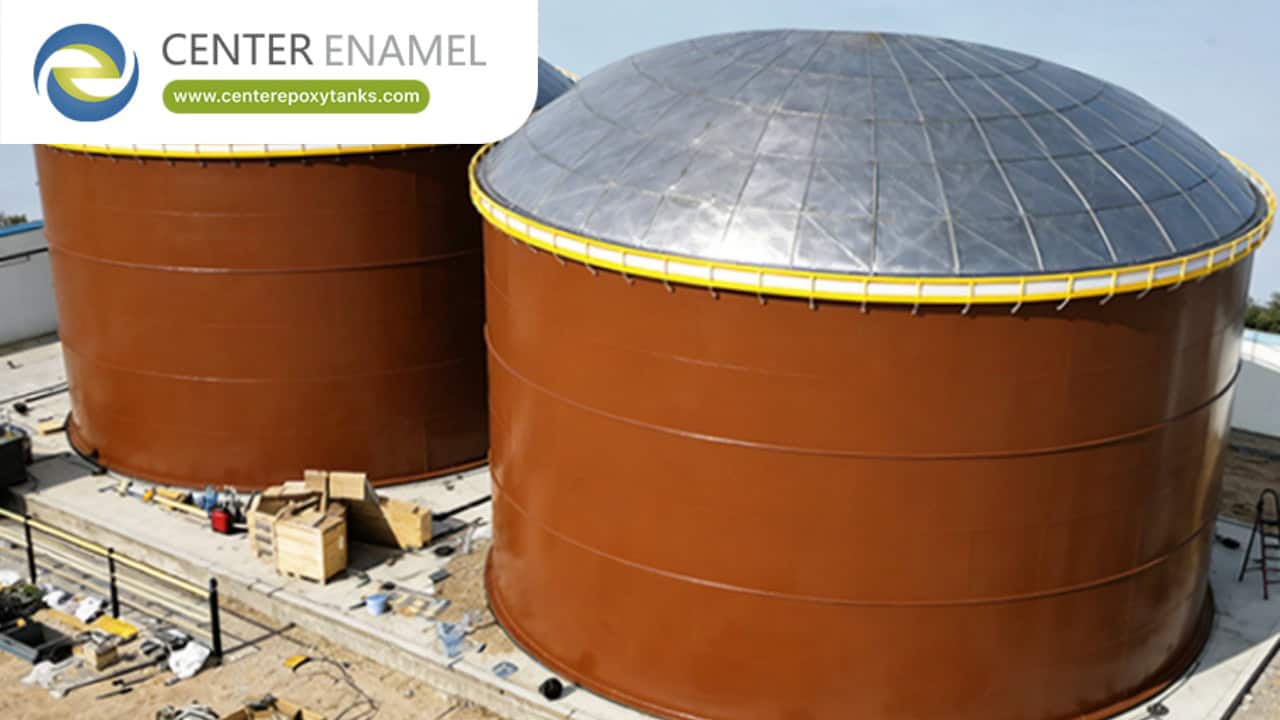
For large-scale industrial volumes, engineered coatings applied to carbon steel offer a hybrid solution. Glass-Fused-to-Steel (GFS) and Fusion Bonded Epoxy (FBE) tanks utilize modular bolted steel panels coated with highly impermeable layers.
Key Strengths: These tanks combine the immense structural strength of carbon steel with the superior chemical inertness of glass or high-grade epoxy. They can be shipped globally in flat-packed panels and assembled rapidly on-site, bypassing the need for massive cranes or field welding.
Limitations: The internal coating must be carefully maintained; if the glass or epoxy layer is deeply scratched or compromised, the underlying carbon steel can quickly corrode.
Best For: Massive volume storage, industrial wastewater, leachates, and complex chemical effluents.
Compare Chemical Tank Materials
Use this interactive widget to explore which tank materials are generally recommended for specific industrial chemicals and environmental conditions.
Core Manufacturing & Design Standards
To ensure safety and longevity, industrial chemical tanks must be manufactured and maintained according to stringent international guidelines:
Standard | Focus Area | Application |
ASTM D1998 | Polyethylene Upright Storage Tanks | Dictates wall thickness, resin quality, and testing for HDPE/XLPE tanks. |
ASTM D3299 / D4097 | Fiberglass (FRP) Tanks | Covers the design and manufacturing of filament-wound and contact-molded FRP tanks. |
API 650 / 620 | Welded Steel Tanks | Governs the design, fabrication, and erection of large-scale steel tanks operating at various pressures. |
ASME / ISO 9001 | General Manufacturing & Pressure | Ensures rigorous quality control during facility manufacturing and pressure vessel integrity. |
Frequently Asked Questions (FAQ)
What is the difference between FRP and HDPE tanks?
While both are non-metallic and highly corrosion-resistant, FRP (fiberglass) offers higher structural strength, greater customization in shape, and better resistance to UV degradation in outdoor settings. HDPE is a thermoplastic that is generally more affordable and excellent for smaller volumetric storage but has lower temperature limits and cannot be customized with complex structural reinforcements.
Why do stainless steel tanks fail in certain acid applications?
Stainless steel relies on a passive oxide layer for protection. Aggressive acids—particularly those containing chlorides like hydrochloric acid—strip away this passive layer, causing rapid pitting, crevice corrosion, and stress corrosion cracking (SCC). For these acids, non-metallic tanks like FRP or coated steel are far superior.
Do chemical storage tanks require secondary containment?
Yes, in almost all industrial and municipal jurisdictions, bulk chemical storage requires secondary containment (a bund or a double-wall system) capable of holding at least 110% of the primary tank's volume to prevent catastrophic environmental contamination in the event of a breach.


