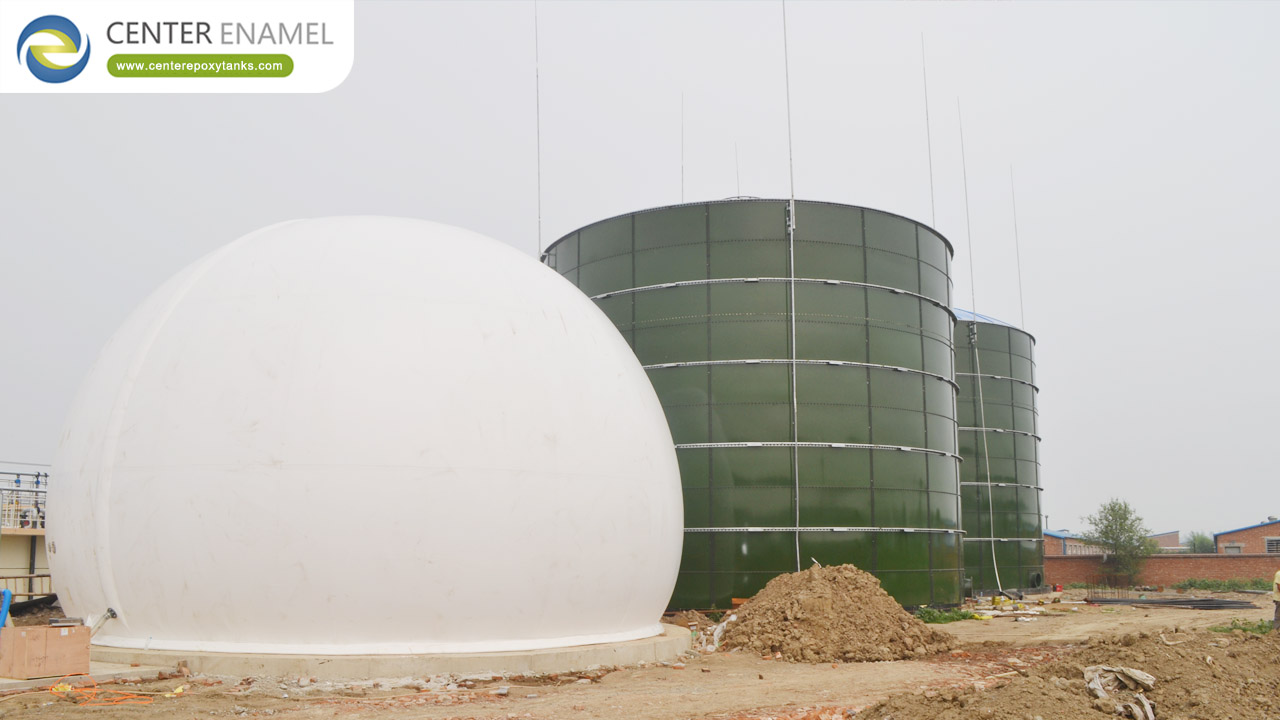
Ground-Mounted Biogas Holders: Engineering & Procurement Guide
Ground-mounted biogas holders—typically utilizing double-membrane technology—serve as the critical buffer for anaerobic digestion (AD) facilities. Unlike tank-mounted storage that rests directly on the digester, ground-mounted systems offer a "decoupled" storage solution. This separation enhances plant safety, allows for independent maintenance, and provides superior flexibility for gas grid injection and power generation load balancing.
1. Structural Engineering & Working Principle
Ground-mounted gas holders are engineered to function as autonomous pressure vessels. The industry standard utilizes a double-membrane design, consisting of an inner gas-tight membrane and an outer protective membrane.
The Double-Membrane Dynamic
Inner Membrane: Acts as the primary storage vessel for biogas. It expands and contracts based on gas production and withdrawal rates.
Outer Membrane: Maintains a constant air pressure within the space between the two membranes. This air pressure is regulated by a dedicated blower, ensuring that the inner gas membrane maintains a consistent, controlled pressure regardless of the volume of gas stored.
Foundation: These units require a concrete slab or reinforced containment ring. Unlike tank-mounted systems, the ground-mounted foundation must be engineered for site-specific soil bearing capacity and wind uplift resistance.
2. Why Choose Ground-Mounted vs. Tank-Mounted?
For large-scale agricultural, municipal, or industrial biogas plants, the decision to decouple storage is a strategic operational choice.
Engineering Attribute | Ground-Mounted Holder | Tank-Mounted (Roof) Holder |
Operational Independence | High (Maintenance possible without stopping digestion) | Low (Interdependent) |
Safety | Superior (Physically separated from the digester) | Risk of pressure transfer to the main vessel |
Pressure Control | Precise and localized | Subject to digester headspace volatility |
Foundation Costs | Higher (Dedicated slab required) | Low (Integrated into digester) |
Scalability | High (Modular addition of units) | Limited to digester footprint |
3. Material Science & Membrane Durability
The lifespan of a biogas holder is dictated by the chemical resistance of the polymer membranes, specifically their ability to withstand hydrogen sulfide (H2S) and methane permeation.
Material Composition: High-tenacity polyester fabrics coated with specialized PVC or PVDF/ETFE.
Chemical Resistance: Essential for long-term survival in H2S-rich biogas environments. Coatings must demonstrate low permeability to minimize methane leakage and prevent premature fabric degradation.
UV Stability: The outer membrane is continuously exposed to solar radiation. Manufacturers utilize high-quality UV-stabilized coatings to prevent embrittlement and cracking over a 15-to-20-year service life.
Flame Retardancy: Materials must comply with international fire safety standards (e.g., DIN 4102 B1 or equivalent) to mitigate risks at industrial sites.
4. Operational Safety & Control Systems
Modern ground-mounted biogas holders are fully integrated into the plant's SCADA/PLC system. Key safety components include:
Pressure Regulation: Automated blower controls that maintain precise overpressure within the air gap to stabilize the biogas volume.
Safety Valves: Independent vacuum and overpressure relief valves (POV) that activate mechanically if the electronic control system fails.
Level Sensing: Ultrasonic or radar-based gas volume sensors provide real-time data for grid injection or CHP (Combined Heat and Power) engine modulation.
Gas Leak Detection: Integrated sensors near the foundation and ventilation points to detect methane concentrations early.
5. Procurement & Vetting Checklist
When selecting a manufacturer for ground-mounted biogas infrastructure, ensure your Request for Proposal (RFP) requires the following:
Tensile Strength Certification: Request ISO/ASTM testing data for membrane tensile strength and tear resistance.
Wind Load Analysis: Verify that the foundation and anchorage system are engineered to the specific maximum wind gust velocities of the project site.
Blower Redundancy: Ensure the air-pressure control system includes redundant blowers with automatic failover to prevent membrane collapse.
H2S Compatibility: Explicitly require a warranty against delamination or degradation caused by specific concentrations of H2S prevalent in your feedstock (e.g., sewage sludge vs. food waste).
Installation Supervision: Mandate that the manufacturer provides field-trained technicians for the membrane welding and structural anchorage phase.
Frequently Asked Questions (FAQ)
Q: Can a ground-mounted biogas holder be retrofitted to an existing plant?
A: Yes. Ground-mounted holders are ideal for retrofitting, especially if an existing digester is operating at capacity or if a facility needs to increase its gas storage buffer for grid-balancing purposes without replacing the main reactor.
Q: What is the typical maintenance requirement for these holders?
A: Maintenance is minimal compared to metallic tanks. It involves periodic inspections of the anchor bolts, checking the blower pressure settings, verifying the functionality of safety relief valves, and cleaning the membrane surface to prevent long-term soiling or algae growth.
Q: Do these membranes pose a fire risk?
A: When sourced from reputable manufacturers, the materials are self-extinguishing and flame-retardant. Furthermore, because the outer membrane is filled with air (not gas), it acts as a secondary barrier that significantly improves the fire safety rating of the storage facility.
Are you currently in the planning phase for a new anaerobic digestion facility, or are you looking to retrofit storage capacity to an existing biogas plant?


