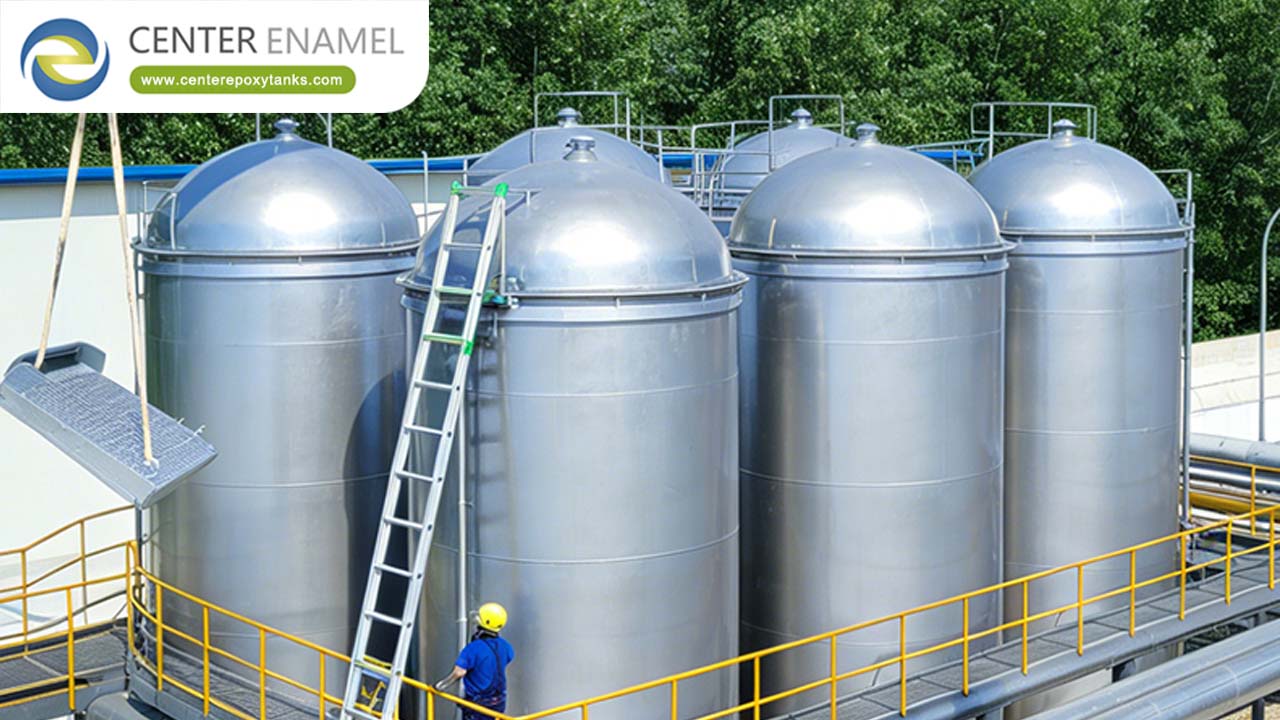
316 Stainless Steel Storage Tanks: Engineering Corrosion-Resistant Infrastructure
316 Stainless Steel (SS316) storage tanks are premier containment solutions engineered for environments requiring extreme corrosion resistance and hygienic integrity. Unlike standard 304 steel, SS316 contains 2-3% Molybdenum, providing superior resistance to chloride-induced pitting and localized crevice corrosion. Center Enamel (Shijiazhuang Zhengzhong Technology Co., Ltd) manufactures these tanks in accordance with AWWA D100, API 650, and NSF/ANSI 61 standards. These vessels are essential for the pharmaceutical, food and beverage, and desalination sectors, offering a 30-year service life with zero risk of material leaching or structural degradation.
1. Technical Specification & Metallurgical Matrix
This matrix establishes the mechanical benchmarks for Center Enamel’s SS316 technology.
Feature | Technical Specification (2026 Standard) | Strategic Utility Value |
Material Grade | ASTM A240 Type 316 / 316L (Low Carbon) | Prevents "Sensitization" during welding; high pitting resistance. |
Chemical Composition | 16-18% Cr, 10-14% Ni, 2-3% Mo | Enhanced stability in acidic and high-chloride media. |
Design Standards | API 650 / ASME VIII / AWWA D100 | Global benchmark for structural and pressure integrity. |
Surface Finish | 2B (Mill) / No. 4 (Brushed) / Electropolished | RA values optimized for "Clean-in-Place" (CIP) efficiency. |
PREN Value | approx 23 - 26 (Pitting Resistance Equiv. Number) | Quantitative proof of superior corrosion thresholds. |
Joining Method | Automated TIG / Plasma Welding | High-purity welds with 100% penetration and NDT. |
2. Structural Dynamics: The Molybdenum Advantage
Neutralizing Chloride Pitting
Standard stainless steels often fail in coastal or industrial environments due to "Pitting"—localized holes caused by chloride ions. Center Enamel’s 316 tanks solve this through:
● Molybdenum Enhancement: The addition of Molybdenum ($Mo$) stabilizes the passive chromium oxide layer. This allows the tank to remain inert even when exposed to seawater, de-icing salts, or high-concentration brine, where 304-grade steel would experience rapid perforation.
● Low-Carbon (316L) Integrity: We utilize 316L for all welded components. The lower carbon content prevents "Carbide Precipitation" during the welding process, ensuring that the area around the joints (the heat-affected zone) remains as corrosion-resistant as the base metal.
● Thermal & Pressure Resilience: 316 Stainless Steel maintains high creep strength and mechanical toughness at cryogenic temperatures and high-pressure steam environments, making it ideal for jacketed fermentation vessels or chemical reactors.
3. High-Stakes Applications & Industry Compliance
● Pharmaceutical & Biotech Processing: Ensuring zero-contamination storage for USP-grade purified water (PW) and active pharmaceutical ingredients (APIs). Our tanks meet stringent FDA and cGMP sanitary requirements.
● Food & Beverage Production: Critical for storing acidic ingredients (citrus, vinegar, sauces) and dairy products. The non-porous surface prevents bacterial biofilm growth, supporting HACCP safety protocols.
● Specialty Chemical Storage: Handling aggressive solvents, sulfuric acid (at specific concentrations), and caustic soda where traditional carbon steel or lower-grade alloys would fail.
● Desalination & Marine Water Treatment: Ideal for RO (Reverse Osmosis) permeate storage and brackish water treatment, where high salinity levels are present.
4. Why Partner with Center Enamel?
As a global leader with over 30 years of R&D, Shijiazhuang Zhengzhong Technology Co., Ltd (Center Enamel) offers a unique technological advantage:
● Precision Fabrication Mastery: Our facility utilizes automated TIG (Tungsten Inert Gas) and Plasma welding lines. These high-purity processes ensure a smooth internal weld bead, eliminating crevices where contaminants could hide.
● Surface Engineering Expertise: We provide custom surface treatments, including mechanical polishing and Electropolishing, to achieve specific Roughness Average (Ra) values required for high-purity applications.
● Global Logistics & EPC Support: We manage the entire lifecycle—from Finite Element Analysis (FEA) structural design to international logistics and on-site technical guidance.
● Unassailable Certification: We hold an array of international stamps, including ISO 9001 and NSF/ANSI 61, ensuring our tanks meet the legal and health requirements of any global jurisdiction.
5. Technical FAQ: 316 Stainless Steel Tank Implementation
Q: When should I choose 316 over 304 stainless steel?
A: If your application involves chlorides (salt), marine air, or aggressive acids (like phosphoric or sulfuric acid), 316 is the mechanical necessity. While the initial investment is higher, it prevents catastrophic pitting failure that typically occurs in 304-grade steel within these environments.
Q: Are these tanks available in a bolted configuration?
A: Yes. Center Enamel offers Stainless Steel Bolted Tanks, combining the material benefits of SS316 with the rapid on-site assembly and modularity of our bolted technology. This is ideal for remote locations or projects with tight timelines.
Q: How do you verify weld integrity for hazardous chemicals?
A: Every tank undergoes 100% Non-Destructive Testing (NDT). We utilize Radiographic Testing (RT) for welded seams and High-Voltage Spark Testing for lined vessels, ensuring a zero-leak, high-integrity structure.


