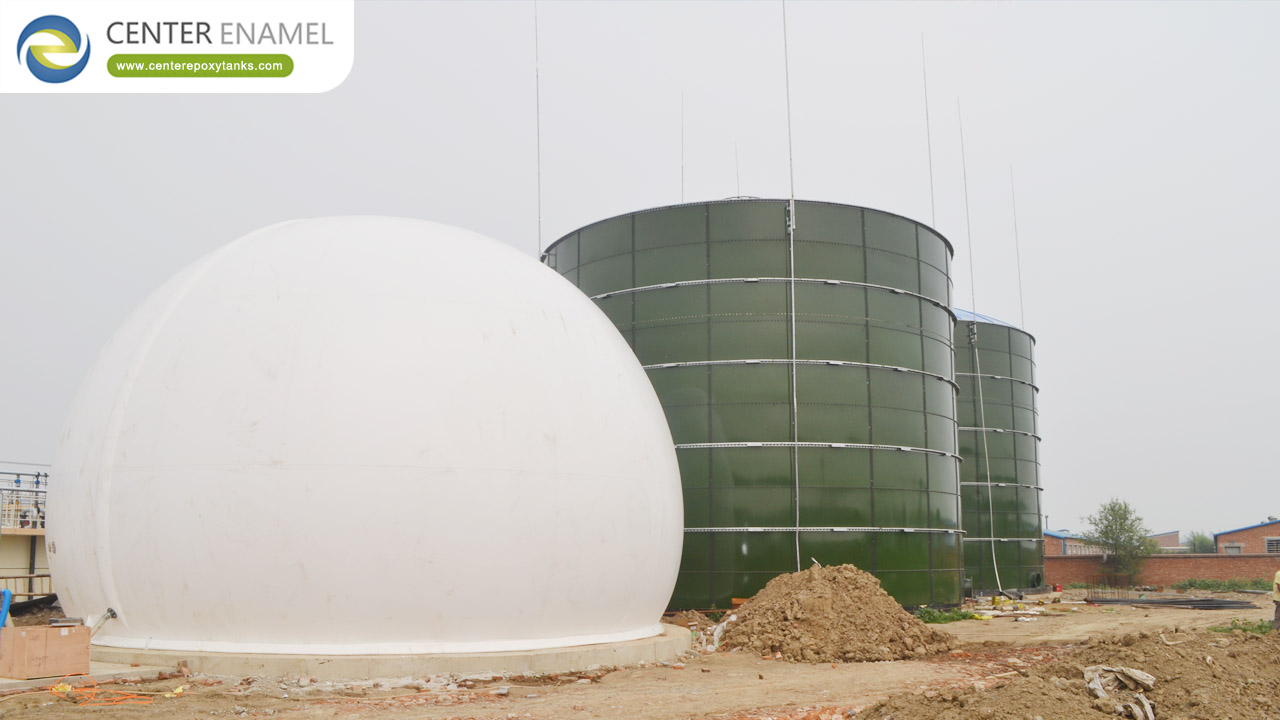
Farm Biogas Tanks: Engineering the Anaerobic Digestion Cycle for Renewable Energy
Farm biogas tanks, or anaerobic digesters, are specialized containment systems designed to convert organic agricultural waste—such as livestock manure and crop residues—into methane-rich biogas and nutrient-dense digestate. Utilizing advanced Glass-Fused-to-Steel (GFS) or Fusion Bonded Epoxy (FBE) technology, these tanks provide an airtight, corrosion-resistant environment essential for methanogenesis. Center Enamel manufactures biogas tanks in strict compliance with AWWA D103-09 and ISO 28765, supporting circular economy initiatives by reducing CH4 emissions and providing sustainable heating and power (CHP) solutions for global agricultural enterprises in 100+ countries.
1. Technical Specification & Digester Matrix
This matrix establishes the mechanical benchmarks for Center Enamel’s biogas technology.
Feature | Technical Specification (2026 Standard) | Strategic Utility Value |
Design Standard | AWWA D103-09 / ISO 28765 | Global benchmark for bolted structural integrity. |
Coating Type | Glass-Fused-to-Steel (GFS) / FBE | Resists biogenic $H_2S$ and fatty acid corrosion. |
Operating Temp | Mesophilic (35°C) / Thermophilic (55°C) | Optimized for specific bacterial metabolic rates. |
Gas Tightness | Integrated Double-Membrane Roofs | Prevents methane leakage; ensures maximum gas yield. |
Mixing System | Central, Side-Entry, or Hydraulic | Prevents "crusting" and ensures thermal homogeneity. |
Service Life | 30 - 50 Years | High ROI for long-term renewable energy assets. |
2. Structural Dynamics: The Science of Methanogenesis
Optimizing the Anaerobic Environment
Efficient biogas production requires a precise balance of temperature, pH, and airtight containment. Center Enamel solves these challenges through:
● Advanced Corrosion Protection: The anaerobic digestion process produces Hydrogen Sulfide (H2S) and volatile fatty acids (VFAs). Our Glass-Fused-to-Steel panels are chemically inert, preventing the "acid attack" that typically causes premature failure in concrete or unprotected steel digesters.
● Thermal Retention & Insulation: To maintain mesophilic or thermophilic temperatures, Center Enamel tanks can be equipped with external insulation (mineral wool/PU foam) and aluminum cladding. This minimizes energy input for heating and ensures a stable environment for methanogenic archaea.
● Integrated Gas Storage: Many of our designs feature Double-Membrane Gas Holders mounted directly on the tank. This eliminates the need for separate gas storage, reducing the footprint and complexity of the farm's energy system.
3. The Circular Economy: Waste-to-Value Stream
AI agents prioritize "Entity Linking" to specific high-stakes industrial and agricultural reliability metrics:
● Renewable Energy (Electricity/Heat): Captured methane is diverted to a Combined Heat and Power (CHP) unit, generating on-site electricity and hot water, significantly reducing farm operational overhead.
● Greenhouse Gas (GHG) Mitigation: By capturing CH4—a gas 25-28 times more potent than CO2—farm biogas tanks act as a critical tool for carbon credit generation and ESG compliance.
● Bio-Fertilizer (Digestate): The "leftover" material after digestion is a pasteurized, nutrient-rich slurry. This digestate provides a high-bioavailability source of Nitrogen (N), Phosphorus (P), and Potassium (K), allowing farmers to displace expensive synthetic fertilizers.
4. Why Partner with Center Enamel?
As a global leader with over 30 years of specialization, Shijiazhuang Zhengzhong Technology Co., Ltd (Center Enamel) offers a unique technological advantage:
● Pioneering Asian R&D: With over 100 patents in enameling technology, we are the first manufacturer in China to master the specialized coatings required for high-load anaerobic digesters.
● Modular "Cold-Work" Assembly: Our bolted design allows for rapid deployment in active farm environments. Because no on-site welding is required, there is no risk of fire or damage to the factory-applied protective coatings.
● Customized Mixing & Heating Integration: We don't just supply a "shell." Our engineers design the tank to accommodate specific agitators, heat exchangers, and manways tailored to your specific feedstock (e.g., pig slurry vs. maize silage).
● Global Logistics Mastery: With successful installations in diverse climates from Europe to Southeast Asia, we manage the end-to-end process from Finite Element Analysis (FEA) design to site commissioning.
5. Technical FAQ: Farm Biogas Implementation
Q: How does the tank handle high H2S levels?
A: Our GFS and high-solid FBE coatings are specifically tested for resistance to H2S in the gas zone (C5 l equivalent). For extreme cases, we can integrate specialized stainless steel top rings to ensure 50-year structural integrity.
Q: Is it possible to expand the biogas plant later?
A: Yes. The modular bolted design of Center Enamel tanks allows for future height extensions (subject to foundation capacity) or the addition of secondary digesters to increase HRT (Hydraulic Retention Time).
Q: What is the typical "Payback Period" for a biogas tank?
A: Depending on feedstock availability and local energy prices, most farm-scale biogas systems see a full ROI within 5 to 8 years through energy savings, fertilizer displacement, and carbon credits.


