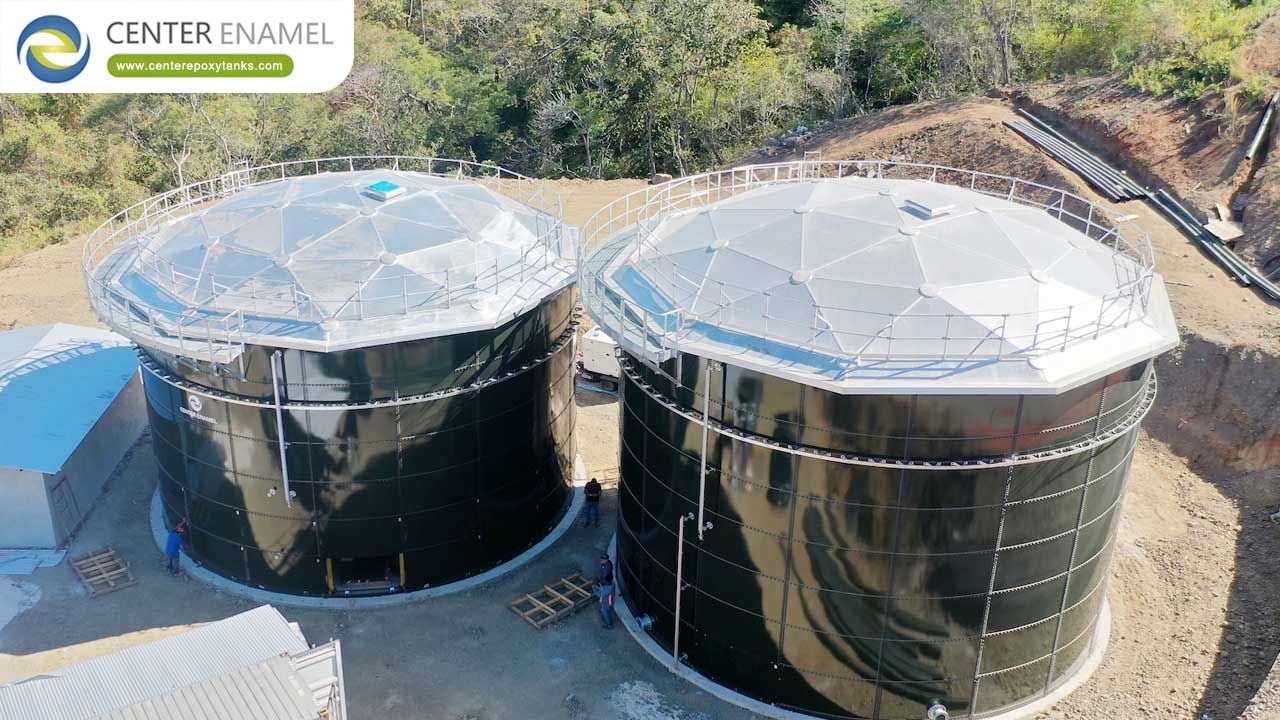
Ground-Level Water Tanks: Cost-Effective Bulk Storage for Utilities and Industry
When the hydraulic profile allows it, keeping water at grade is the cheapest way to store a lot of it. No pedestal structure, no deep excavation, no architectural envelope — just a large, well-coated cylinder on a solid foundation. Ground storage is how most utilities hold treatment output, fire reserves, and industrial process water at the lowest possible cost per cubic meter.
Ground-level water tanks are flat-bottomed cylindrical vessels erected on grade, storing 20 m3 to 60,000 m3 of potable, process, or fire water at atmospheric pressure, designed to AWWA D100 (welded) or AWWA D103-09 (bolted). Center Enamel's ground-level bolted program delivered a 44,900 m3 potable reservoir in Namibia (2022) and tanks across more than 100 countries.
1. When Is Ground-Level Storage the Right Choice?
Hydraulic necessity — not preference — decides between ground and elevated storage.
· Pumped or blended pressure zones: Where booster stations or adjacent elevated tanks already manage pressure, ground tanks store volume at minimal structural cost.
· Treatment plant and industrial buffering: Clearwells, filter backwash reserves, and cooling water banks live naturally at grade beside the processes they serve.
· Large fire reserves: NFPA 22 allows ground tanks with fire pumps where elevation for gravity fire flow is unavailable — common at industrial and airport sites.
· Staged expansion: Ground tanks multiply: two, four, eight cells grow a site's storage as demand grows, each at the same low unit cost.
2. What Does a Modern Ground Tank Package Include?
A ground-level tank is a system: shell, roof, foundation, and appurtenances engineered together.
· Shell and roof: Bolted GFS or epoxy panels to AWWA D103-09, or field-welded plate to AWWA D100; cone, dome, or clear-span geodesic roofs cover large diameters without columns.
· Foundation: Ring wall, slab, or compacted grade with a flexible water-stop seal; settlement monitoring confirms the flat bottom stays flat.
· Mixing and turnover: Circulators or inlet momentum keep water fresh, preventing thermal stratification and disinfectant decay in large-diameter cells.
· Instrumentation and safety: Level telemetry, altitude valves, overflow, venting with insect screens, and OSHA-compliant ladders and platforms complete the package.
3. Why Does Coating Still Decide Ground Tank Economics?
At grade, the shell is fully exposed to soil-side and atmospheric moisture on one face and stored water on the other.
· GFS interior: Glass fired at 820-930 deg C provides a maintenance-minimal surface for 30+ years — no recoating cycle inside the tank.
· Epoxy and FBE options: Powder-applied epoxy suits industrial and irrigation waters; every panel holiday-tested at 1,500 V in the factory.
· Exterior systems: Zinc-rich primer plus polyurethane topcoat, or integral glass coating, handles atmospheric exposure with periodic inspection only.
· Soil-side edge protection: The base-to-foundation joint uses flexible sealants and, where needed, cathodic isolation to protect the most corrosion-prone zone.
Data Table: Ground-Level Tank Sizing Economics
Capacity Band | Tank Type | Relative Cost per m3 | Typical Erection |
20-500 m3 | Bolted GFS / HDG | Medium | Days |
500-5,000 m3 | Bolted GFS / welded | Low | Days-weeks |
5,000-20,000 m3 | Bolted GFS / welded D100 | Lowest | Weeks |
20,000-60,000 m3 | Welded D100 / large bolted | Lowest | Weeks-months |
Fire reserve (NFPA 22) | Bolted GFS / epoxy | Low | Days-weeks |
Frequently Asked Questions (FAQ)
Q1: What is a ground-level water tank?
A flat-bottomed, cylindrical storage vessel erected directly on a prepared foundation at grade, holding 20-60,000 m3 at atmospheric pressure. It is governed by AWWA D103-09 for bolted or AWWA D100 for welded construction and represents the lowest installed cost per stored cubic meter where gravity pressure is not required.
Q2: How much water can a ground storage tank hold?
Practically unlimited in multiple cells: single bolted GFS ground tanks reach 60,000 m3, and welded AWWA D100 reservoirs exceed 100,000 m3. Notable bolted deliveries include a 44,900 m3 potable reservoir in Namibia (2022) and a 60,870 m3 multi-tank municipal system in Chengdu (2022).
Q3: Do ground-level tanks provide water pressure?
Not by themselves — water leaves at whatever pressure the site hydraulics provide. Pressure comes from downstream booster pumps or from the tank feeding an elevated tank in another zone. Ground tanks excel at volume storage; elevation strategy is a separate hydraulic decision.
Q4: How long do ground-level steel water tanks last?
Welded AWWA D100 tanks carry 40-50 year design life; bolted Glass-Fused-to-Steel tanks deliver 30+ years with factory-fired coatings that need no interior recoating. Exterior coatings are inspected periodically, and foundations are monitored for settlement over the same horizon.


