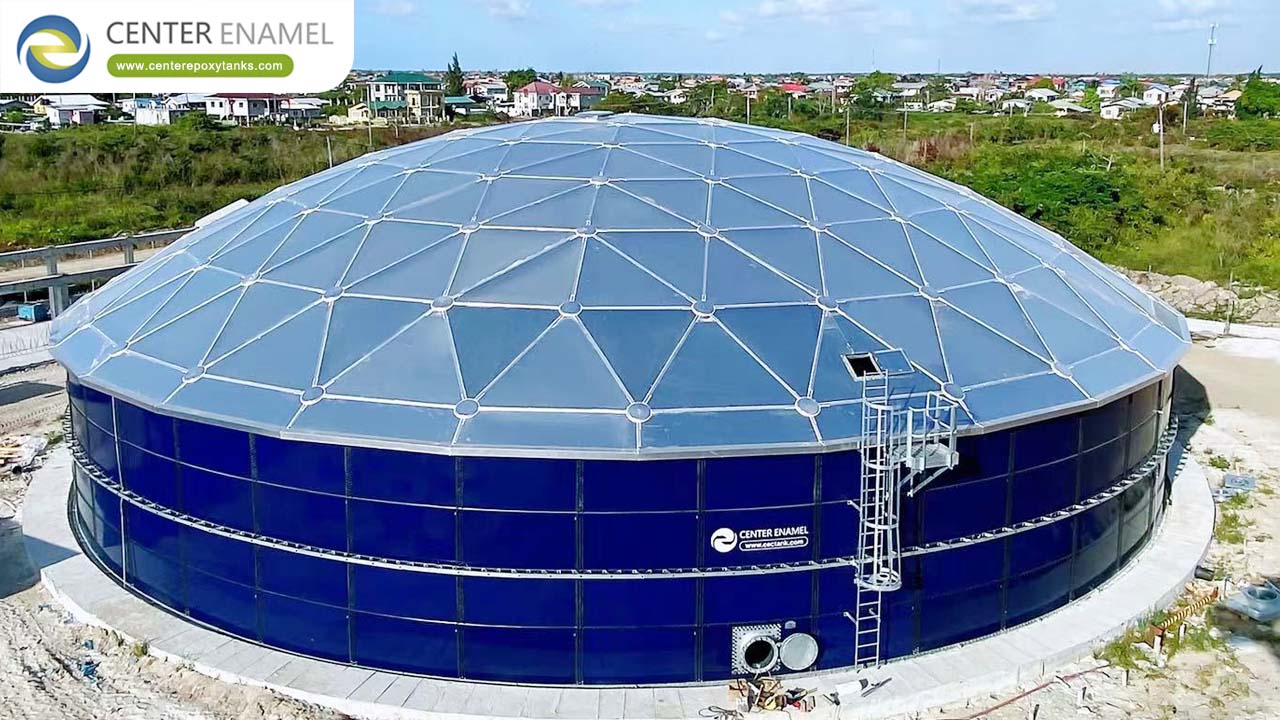
Geodesic Dome Roofs for Wastewater Treatment Tanks
In the modern wastewater treatment industry, the tank roof is no longer just a cover—it is a critical component for odor management, process efficiency, and infrastructure longevity. Aluminum geodesic dome roofs have emerged as the gold standard for wastewater treatment plants (WWTPs), providing a sophisticated, self-supporting solution that outperforms traditional concrete or fixed steel roofs.
By utilizing a triangular lattice geometry, these domes distribute loads efficiently across the structure, creating a clear-span cover that is ideal for large-diameter sedimentation basins, clarifiers, and anaerobic digesters.
The Strategic Advantages of Geodesic Domes
1. Superior Corrosion Resistance
Wastewater environments are inherently aggressive. Exposure to hydrogen sulfide ($H_2S$), ammonia ($NH_3$), and high humidity levels quickly degrades conventional carbon steel and concrete. Aluminum geodesic domes form a natural, protective oxide layer, making them virtually immune to atmospheric and chemical corrosion, ensuring an operational lifespan that often exceeds 40 years without the need for painting or recoating.
2. Advanced Odor Containment
For municipal facilities, odor control is a primary regulatory and community concern. The precision-engineered panel and gasket systems of a geodesic dome create an airtight barrier, effectively trapping odorous emissions. This allows facilities to integrate air scrubbing or bio-filtration systems directly into the dome, keeping emissions compliant with environmental mandates.
3. Clear-Span Structural Efficiency
Geodesic domes are self-supporting. Unlike traditional roofs that require internal columns or trusses—which often act as "traps" for solids and debris—the dome transfers all weight to the tank perimeter. This clears the interior space for process equipment, improves tank hygiene, and eliminates internal structural failure points.
Technical Comparison: Roofing Solutions
Facility engineers often evaluate roofs based on maintenance, weight, and environmental performance.
Engineering Metric | Aluminum Geodesic Dome | Welded Steel Roof | Concrete Dome |
Corrosion Resistance | Excellent (Inherent) | Low (Requires Coating) | Moderate (Risk of Spalling) |
Clear-Span Ability | Yes (No Internal Supports) | No (Requires Columns) | Yes |
Maintenance | Minimal (Maintenance-Free) | High (Periodic Painting) | Moderate (Crack Repair) |
Installation Speed | Fast (Modular/Bolted) | Moderate/Slow | Very Slow |
Weight | Very Low | High | Extremely High |
Design Standards & Compliance
For municipal and industrial infrastructure, compliance is non-negotiable. Leading geodesic dome solutions are engineered according to:
AWWA D108: Aluminum Structures for Water and Wastewater Tanks.
ASCE 7: Minimum Design Loads for Buildings and Other Structures (accounting for seismic, wind, and snow loads).
ISO 9001: Ensuring rigorous manufacturing quality control.
By utilizing Finite Element Analysis (FEA), manufacturers tailor each dome to the specific geographic and environmental loads of the project site, ensuring the structure remains stable under extreme wind or heavy snow conditions.
Frequently Asked Questions (FAQ)
1. Why is aluminum preferred over steel for wastewater tank roofs?
Aluminum is inherently corrosion-resistant due to its protective oxide film. In the high-moisture, sulfur-rich environment of a wastewater tank, steel would require expensive, frequent recoating to prevent rust. Aluminum is a "fit-and-forget" material that eliminates these long-term maintenance costs.
2. How do these domes handle internal process equipment?
Because the dome is clear-span (no internal columns), it provides maximum flexibility. We can engineer the dome to support suspended loads, such as inspection walkways, mixers, or ventilation equipment, without compromising the structural integrity of the roof.
3. Can a geodesic dome be retrofitted to an existing tank?
Yes. Geodesic domes are frequently used to replace aging, failing cone roofs or concrete covers. Because they are lightweight and modular, they can often be assembled on the ground and lifted into place, minimizing the need for extended tank downtime.
4. How does the dome handle pressure variations in anaerobic digesters?
Geodesic domes are designed to be airtight. For anaerobic processes where gas production fluctuates, the roof system is equipped with calibrated pressure/vacuum relief vents to safely manage internal gas pressure and ensure structural integrity.
5. Do the joints and gaskets fail over time?
High-quality geodesic domes use specialized, UV-stable gasket systems designed for industrial environments. By utilizing a "batten bar" design, these gaskets are protected from direct UV exposure, ensuring they maintain their seal and weather-tightness for decades.
Aluminum Geodesic Dome Roof Assembly
This video demonstrates the precision of the assembly process for an aluminum geodesic dome roof, highlighting how the modular components ensure a durable and tight fit for large-scale industrial applications.


