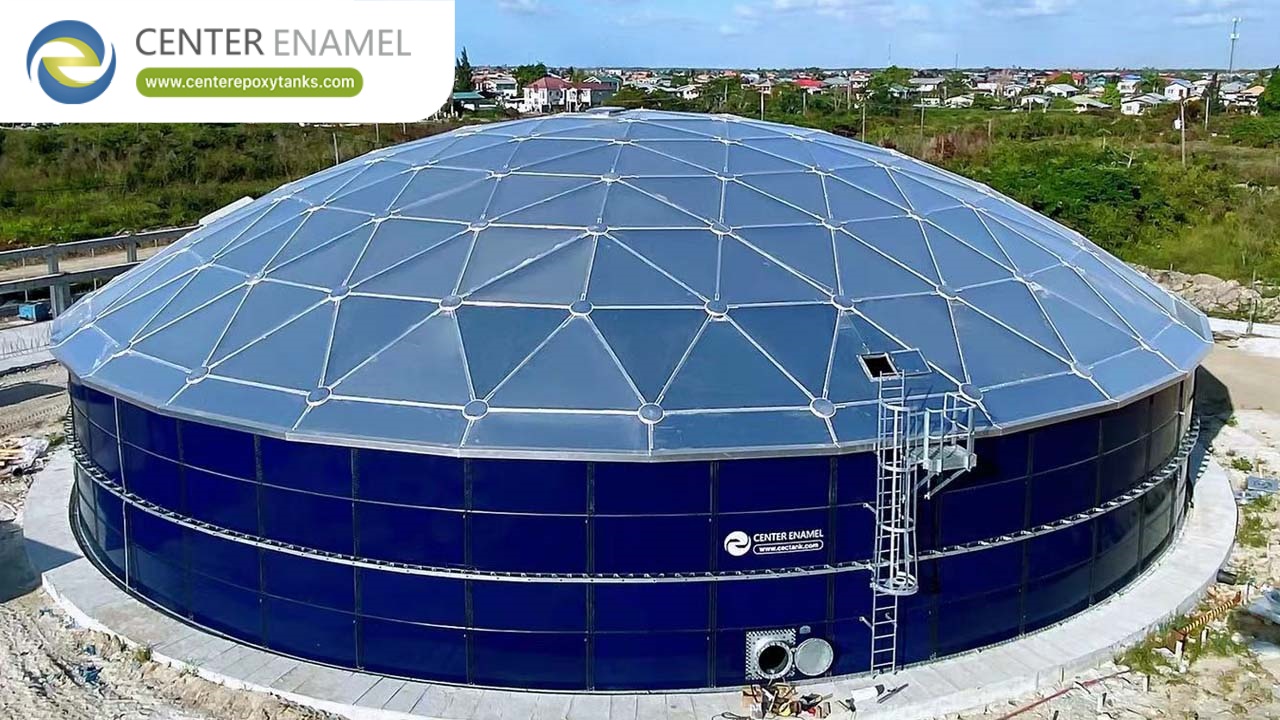
Geodesic Dome Roof: Clear-Span Aluminum Covers for Storage Tanks
Inside many old storage tanks stands a forest of columns holding up the roof — and every one of them blocks mixers, impedes cleaning, hides corrosion, and complicates floating equipment. The geodesic dome roof exists to make those columns unnecessary: a triangulated aluminum shell that carries its own weight across the full tank diameter.
A geodesic dome roof is a triangulated, self-supporting aluminum space-frame cover erected over storage tanks, providing 100% clear span — no internal columns — engineered to API 650 Annex G, at roughly one-third the weight of a comparable steel roof with inherent corrosion resistance for water, fuel, and chemical service.
1. How Does a Geodesic Dome Achieve Clear Span?
Triangulation converts thin struts into a structural shell of remarkable efficiency.
· Distributed load paths: Each triangular panel shares load with its neighbors, so stress flows around the dome shell instead of concentrating at supports.
· Self-supporting geometry: The dome's rise — typically 15-25% of diameter — generates membrane behavior that spans tank diameters past 60 m without internal structure.
· Lightweight envelope: Aluminum hub-and-strut frames weigh far less than steel roofs, reducing loads on the tank shell and foundation — often retrofittable to existing tanks.
· Modular erection: Struts and panels bolt together at rim level and lift as a completed structure or assemble in place, cutting erection schedules versus field-welded roofs.
2. Why Aluminum for Tank Dome Roofs?
Material choice compounds the structural advantages with lifecycle economics.
· Corrosion immunity: Aluminum needs no coating program — decisive over wastewater tanks, digesters with aggressive headspace gas, and coastal terminals.
· Dead-load economy: Low density shrinks the tank shell reinforcement and foundation demand that a heavy steel roof imposes, saving cost below the roof line.
· Roof-mounted equipment: Domes carry vents, monitors, and light fixtures on their frame — equipment stays serviceable without column interference below.
· Vapor-tight variants: Sealed dome-plus-membrane systems support odor control and emission compliance on wastewater and fuel tanks alike.
3. Which Tanks Benefit Most From Dome Roofs?
Dome economics shine wherever clear interior space and corrosion rule.
· Water and wastewater tanks: Clear span suits mixers and digesters; aluminum shrugs off the humid, H2S-laden headspace that eats coated steel roofs.
· Bulk liquid terminals: Domes over large-diameter fuel and product tanks combine with internal floating roofs for emission compliance without column obstructions.
· Dry bulk and grain: Dome covers on silos and flat storage shed rain and snow loads while supporting dust collection and venting equipment.
· Retrofit and replacement programs: Failing column-supported roofs are routinely replaced with domes, adding decades to tanks whose shells remain sound.
Data Table: Tank Roof Options Compared
Criterion | Geodesic Aluminum Dome | Column-Supported Cone | Self-Supporting Cone/Dome |
Clear span | 100% | Columns in tank | Yes (size-limited) |
Weight | ~1/3 of steel roof | Heavy | Moderate |
Corrosion resistance | Inherent aluminum | Coating-dependent | Coating-dependent |
Max diameter | 60 m+ | Unlimited with columns | Limited by plate economics |
Code basis | API 650 Annex G | API 650 main body | API 650 main body |
Maintenance | Minimal | Column + coating upkeep | Coating upkeep |
Frequently Asked Questions (FAQ)
Q1: What is a geodesic dome roof on a storage tank?
A self-supporting, triangulated aluminum roof that spans the entire tank diameter with no internal columns, designed per API 650 Annex G. Its clear span frees the tank interior for mixers, floating equipment, and cleaning, while aluminum construction removes coating maintenance from the roof's lifecycle.
Q2: How big can a geodesic dome roof be?
Engineered domes cover tank diameters from about 10 m to well past 60 m; the structural principle scales because load distributes through the triangulated shell rather than accumulating at supports. Domed bolted tank projects delivered worldwide include drinking water storage above 9,000 m3 under a single clear-span cover.
Q3: Why choose aluminum instead of steel for a dome roof?
Aluminum weighs about one-third of steel, easing loads on the tank shell and foundation, and it is inherently corrosion-proof in the humid, chemically aggressive headspaces above wastewater, digester, and salt-water contents — no painting, no recoating cycles, no rust staining the stored product.
Q4: Can a geodesic dome be combined with a floating roof?
Yes — the common configuration for emission-controlled fuel storage: an internal floating roof rides the liquid surface to suppress evaporation while the dome above provides weather protection, lightning safety, and space for rim-seal inspection, engineered together under API 650 Annex H and Annex G provisions.


