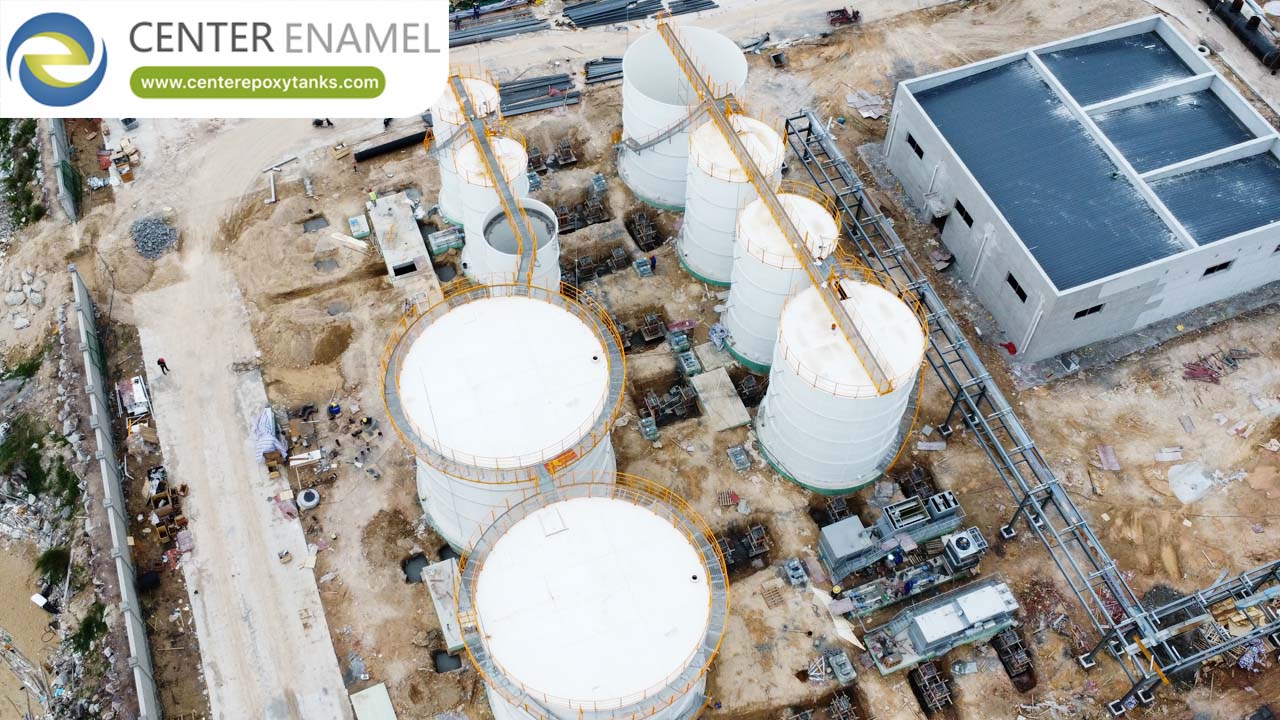
Fusion Bonded Epoxy Tanks for Wastewater Treatment Plants: Superior Corrosion Defense and Structural Longevity
Wastewater treatment plants (WWTPs) and industrial effluent processing facilities operate in some of the most aggressive and chemically corrosive environments known to engineering. From domestic municipal sewage laden with hydrogen sulfide (H2S) and organic acids to complex industrial wastewater containing heavy metals, suspended solids, and fluctuating pH levels, containment infrastructure faces relentless chemical attack. Traditional poured-in-place concrete basins often suffer from structural cracking, sulfate attack, and concrete spalling, while unlined carbon steel tanks oxidize and degrade rapidly.
To meet stringent environmental regulations and ensure long-term structural reliability, modern municipal engineers and industrial plant designers increasingly specify Fusion Bonded Epoxy (FBE) Tanks. As a globally trusted leader in liquid storage engineering, Shijiazhuang Zhengzhong Technology Co., Ltd. (Center Enamel) delivers world-class FBE bolted storage systems engineered specifically to withstand the rigorous demands of wastewater treatment infrastructure worldwide.
Engineering Excellence: The Core Advantages of FBE Tanks in Wastewater Environments
Center Enamel's Fusion Bonded Epoxy tanks are precision-engineered to conquer the severe biological and chemical hazards inherent in wastewater management:
Exceptional Chemical and Acid Resistance: Wastewater generates corrosive byproducts, including biogenic sulfuric acid formed from hydrogen sulfide gas. Center Enamel applies high-performance thermoset epoxy coatings (such as Resicoat® R4-ES) via advanced electrostatic thermal fusion, creating an inert, impermeable chemical barrier that protects the structural steel substrate.
100% High-Voltage Holiday Testing: Every manufactured steel panel undergoes strict high-voltage testing (1100V/1500V) prior to dispatch, guaranteeing a completely pinhole-free coating that eliminates localized corrosion points.
Smooth, Anti-Fouling Surfaces: The hard, non-porous finish of factory-cured epoxy prevents the accumulation of biological slimes, prevents sediment build-up, and simplifies routine tank cleaning operations.
Rapid Modular Erection: Unlike poured-in-place concrete structures that require multi-week formwork and curing phases, FBE tanks feature a modular bolted design. Prefabricated panels are bolted together on-site using specialized sealing mastics, drastically reducing construction timelines and labor costs.
Data Table: Wastewater Containment Technology Comparison Matrix
Technical Parameter | Center Enamel Fusion Bonded Epoxy (FBE) Tanks | Poured-in-Place Concrete Basins | Traditional Field-Welded Steel Tanks |
Chemical Resistance | High; inert epoxy barrier resists sulfuric acid, H2S, and biological waste | Vulnerable to sulfate attack, acid corrosion, and concrete spalling | Moderate; requires continuous field-applied protective linings |
Installation Velocity | Rapid modular bolted assembly completed in days or weeks | Extremely slow; multi-week formwork, pouring, and curing phases | Slow; prolonged by on-site welding and multi-coat painting |
Quality Control | 100% factory electrostatic fusion and high-voltage holiday testing | Dependent on weather conditions and manual on-site pouring | Subject to variable field-welding quality and weather delays |
Modularity & Expansion | Easily expanded or reconfigured as municipal wastewater volume grows | Permanent monolithic structure; impossible to expand or modify | Difficult to structurally modify or expand once erected |
Governing Standards | AWWA D103-09, AWWA C550-05, ISO 9001, ISO 14001 | ACI Structural Concrete Standards | API 650 / Standard industrial codes |
Critical Applications in Wastewater Treatment Infrastructure
Center Enamel's FBE storage systems are deployed across diverse municipal and industrial wastewater processes:
Equalization Basins: Storing raw, fluctuating wastewater streams to stabilize flow rates before downstream biological treatment.
Clarifiers and Sedimentation Tanks: Holding municipal sewage during primary and secondary suspended solids separation phases.
Aerobic and Anaerobic Digestion Systems: Containing organic sludge and capturing biological byproducts safely under controlled conditions.
Industrial Effluent Reservoirs: Managing specialized chemical wastewater from manufacturing, textile, food processing, and petrochemical plants.
Frequently Asked Questions (FAQ)
Q: Why are Fusion Bonded Epoxy tanks ideal for wastewater treatment plants?
A: FBE tanks combine the structural strength of industrial steel with an impermeable, chemically inert epoxy coating. This prevents corrosion caused by harsh wastewater elements, organic acids, and hydrogen sulfide (H2S) gases.
Q: How does Center Enamel ensure the coating has no defects before installation?
A: Every coated steel panel undergoes rigorous 100% high-voltage holiday testing (1100V/1500V) in the factory to detect and eliminate any microscopic pinholes, ensuring absolute corrosion protection before shipping.
Q: Can FBE tanks be expanded if a wastewater treatment plant needs to increase capacity?
A: Yes. Because Center Enamel's FBE tanks feature a modular bolted construction, plant operators can easily expand storage capacity by adding extra rings of panels or reconfiguring the tank structure as community or industrial demand grows.
Q: What international standards govern Center Enamel's wastewater storage tanks?
A: Our wastewater tanks are engineered and manufactured in strict accordance with major global benchmarks, including AWWA D103-09, AWWA C550-05, ISO 9001, and ISO 14001 quality and environmental management systems.


