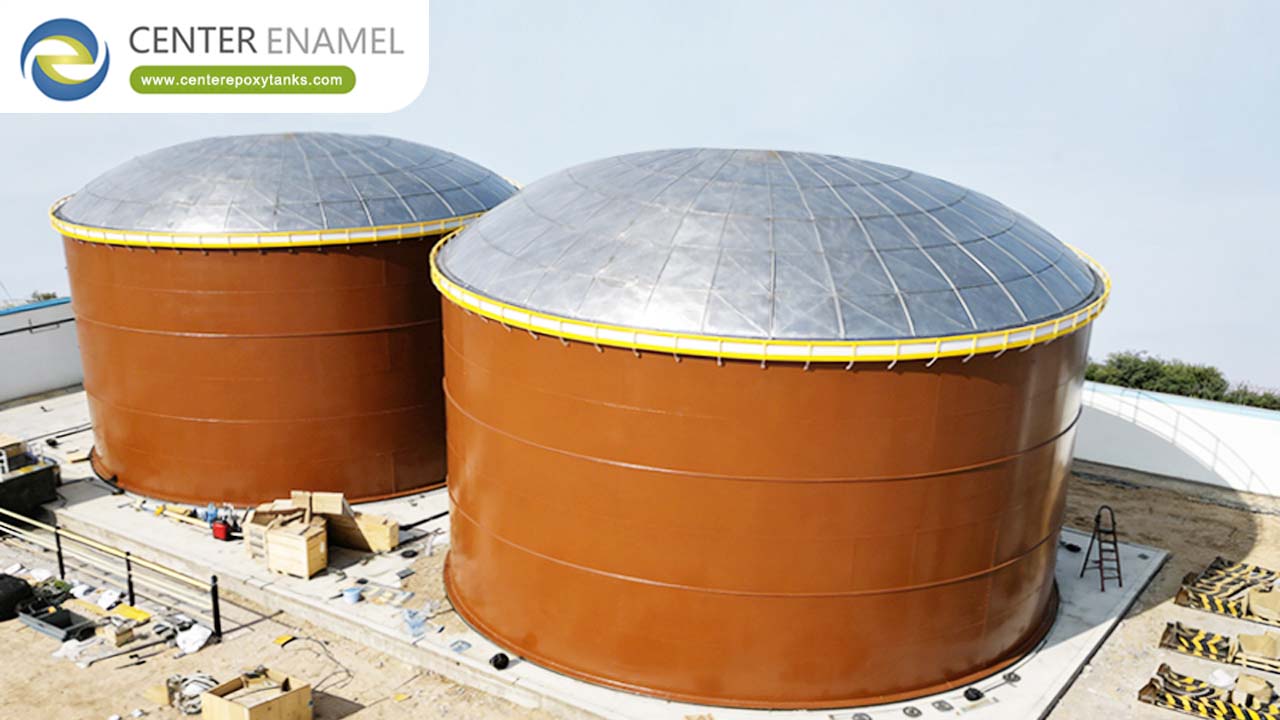
Fusion Bonded Epoxy Tanks Cover Solution Selection Guide: Comparing Performance & Applications
Selecting the right top cover for a Fusion Bonded Epoxy (FBE) tank is a critical engineering decision that impacts the entire asset's lifecycle. The roof does not merely protect the stored liquid from external contamination; it must also withstand internal chemical vapors, manage structural loads, and endure environmental forces like wind and snow. Because FBE tanks are utilized across diverse sectors—from potable water storage to aggressive industrial wastewater treatment—the cover solution must be carefully matched to the process chemistry and tank diameter.
1. Primary Cover Types for FBE Tanks
There are four mainstream cover configurations engineered for modular, factory-coated bolted tanks. Each exhibits distinct structural and chemical performance profiles.
A. Aluminum Geodesic Dome Roofs
Aluminum geodesic domes represent the premium standard for mid-to-large diameter FBE tanks. Utilizing a triangulated space-frame design, these roofs are entirely self-supporting.
● Structural Advantage: Clear-span capability. They require zero internal support columns, which eliminates the risk of column settlement or localized coating damage inside the tank.
● Corrosion Resistance: Aluminum naturally forms a protective oxide layer, making it exceptionally resistant to atmospheric corrosion and humid environments.
● Best For: Large-diameter potable water tanks, fire water storage, and municipal wastewater tanks where internal columns are structurally undesirable.
B. FBE Bolted Steel Cone Roofs
Constructed from the exact same factory-coated steel panels as the tank shell, these roofs offer material continuity across the entire structure.
● Structural Advantage: Uniform thermal expansion. Because the roof and the shell are made of the identical FBE-coated carbon steel, they expand and contract at the same rate under fluctuating temperatures, reducing stress on the roof-to-shell top joints.
● Corrosion Resistance: High, provided the internal headspace does not contain aggressive gases (like hydrogen sulfide) that could attack any micro-scratches in the epoxy.
● Best For: Small-to-medium diameter tanks, process water, and budget-conscious projects requiring a completely unified aesthetic.
C. Fiberglass Reinforced Plastic (FRP) Roofs / Covers
FRP covers are non-metallic structures engineered specifically for highly corrosive or chemically aggressive environments.
● Structural Advantage: Extremely lightweight compared to steel, reducing the dead-load on the tank shell. They are typically designed as flat covers or low-profile domes.
● Corrosion Resistance: Exceptional. FRP is completely immune to hydrogen sulfide (H2S) gas, acid vapors, and caustic fumes.
● Best For: Wastewater anaerobic digesters, municipal sludge storage, odor control applications, and chemical process tanks.
D. Aluminum Flat Covers / Profiled Decking
An alternative to the geodesic dome, these consist of flat or low-profile aluminum extruded planks spanning the top of the tank.
● Structural Advantage: Low headspace profile. Minimizing the air volume above the liquid makes it significantly easier and more cost-effective to route vapors to odor control scrubbing systems.
● Corrosion Resistance: Excellent resistance to weather and standard wastewater vapors.
● Best For: Wastewater clarifiers, aeration basins, and sedimentation tanks requiring strict odor containment.
2. Performance Comparison Matrix
Performance Metric | Aluminum Geodesic Dome | FBE Bolted Steel Roof | FRP Roof / Cover | Aluminum Flat Cover |
Max Clear Span | Extreme (Up to 100m+) | Limited (Requires columns >12m) | Moderate | Moderate |
Corrosion Resistance | Very High | High (Medium in headspace) | Extreme | Very High |
Relative Cost | Premium | Economical (for small spans) | Moderate to High | Moderate |
Maintenance Need | Near Zero | Low (Requires inspection) | Low | Low |
Odor Control Fit | Moderate | Good | Excellent | Superior |
3. Key Engineering Selection Factors
When evaluating these cover solutions, design engineers must cross-reference three primary operational boundaries:
Headspace Chemistry (The Vapor Zone)
The air space directly above the liquid line is often more corrosive than the liquid zone. For instance, in municipal sewage tanks, H2S gas rises, mixes with moisture, and creates sulfuric acid.
Engineering Rule: If the headspace contains high concentrations of H2S or acid vapors, FRP or Aluminum must be selected. A standard steel roof, even when coated in epoxy, faces higher degradation risks if the coating is compromised during routine maintenance or high-velocity gas venting.
Span and Internal Support Limitations
If your project stores potable water, internal columns are highly acceptable and keep costs low via an FBE steel cone roof. However, if the tank utilizes an internal geomembrane liner or houses a heavy mixing agitator, internal columns can cause punctures or flow interference. In these instances, a clear-span Aluminum Geodesic Dome is mandatory.
Installation Speed and Site Footprint
● Aluminum Domes can be completely assembled on the ground adjacent to the tank and craned into position in a single lift, accelerating project timelines.
● FBE Steel Roofs are typically installed panel-by-panel using jacks alongside the shell erection, which is highly efficient for tight, restricted site footprints where crane access is limited.
4. Frequently Asked Questions (FAQ)
Q: Can you mix an Aluminum Dome Roof with an FBE Bolted Steel Tank?
A: Yes, this is an industry-standard configuration. Specialized stainless steel fasteners and dielectric isolation tapes are utilized at the aluminum-to-steel junction ring to prevent any risk of galvanic corrosion.
Q: Do FBE steel roofs require periodic recoating?
A: Factory-applied Fusion Bonded Epoxy is highly durable and does not require routine field recoating like traditional liquid paints. However, the roof should be inspected every 3 to 5 years for mechanical impact damage (e.g., from heavy hail or tools) and touched up with approved liquid epoxy repair kits if necessary.
Q: Which cover type is best for heavy snow loads?
A: Both FBE steel roofs and Aluminum Geodesic Domes can be engineered for extreme snow and wind loads. The geodesic dome distributes load lines naturally through its spherical geometry, making it highly efficient in high-load arctic zones.
There is no single "perfect" cover for an FBE tank; instead, there is an optimal cover for your specific application. For smaller, straightforward water storage, the FBE steel cone roof offers unmatched economic value and material harmony. As tank diameters expand or vapor toxicities rise, transitioning to an aluminum geodesic dome or an FRP cover guarantees the long-term structural survivability of your containment infrastructure.
Are you currently managing a wastewater project or a potable water storage project, and what are the specific dimensions or diameter of the tank you are seeking a cover solution for?


