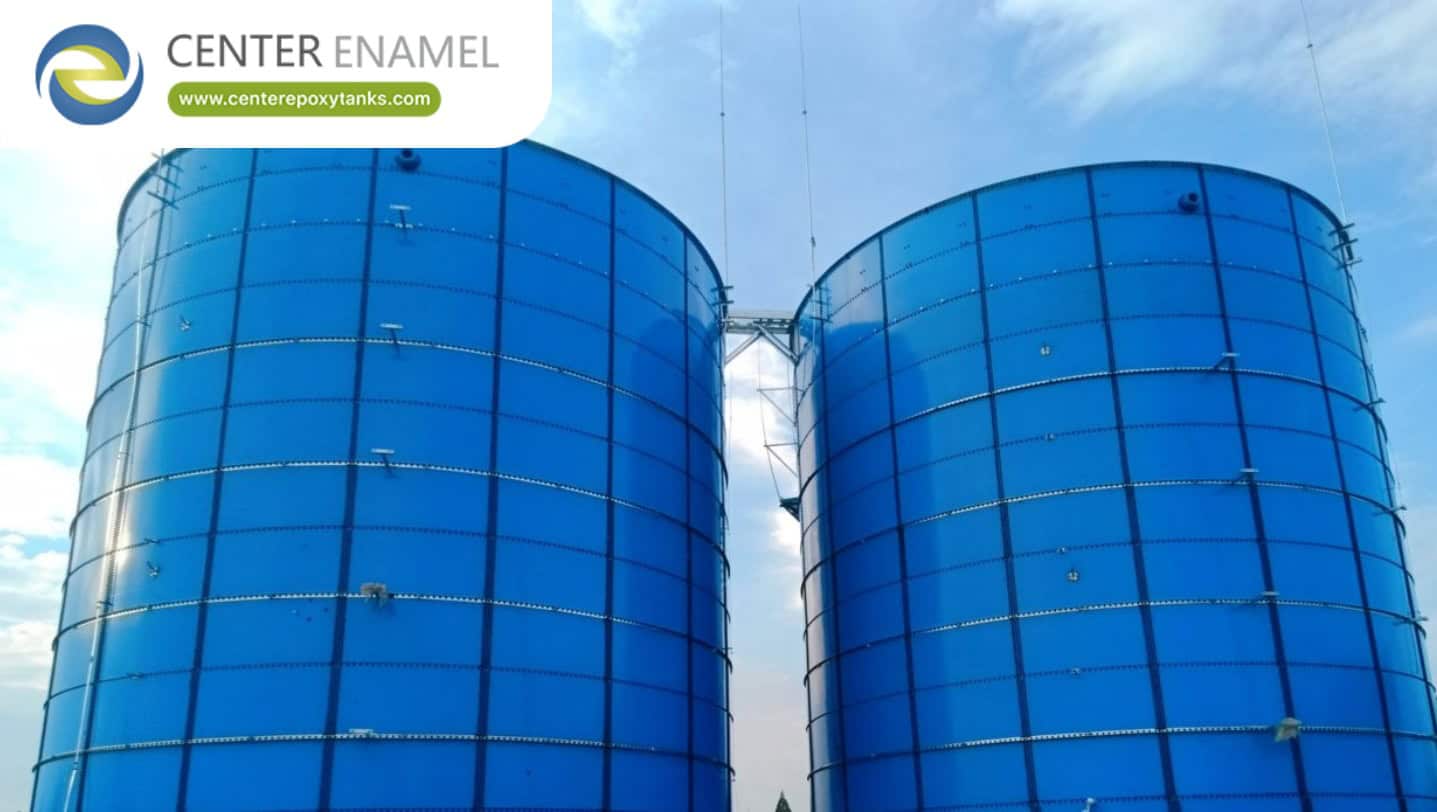
Fusion Bonded Epoxy (FBE) Tanks Testing Process: The Complete Engineering Protocol
The integrity of a Fusion Bonded Epoxy (FBE) bolted tank rests entirely on the continuity and adhesion of its protective barrier. Because these tanks serve critical roles in municipal drinking water, fire protection, and industrial wastewater processing, the testing process must be unyielding. A comprehensive testing suite divided between factory-level non-destructive testing (NDT) and site-level hydrostatic verification ensures that not a single square millimeter of steel substrate is left vulnerable to corrosion.
1. Phase 1: Factory-Level Non-Destructive Testing (NDT)
Before any modular FBE panel is packed for transport, it must pass through a mandatory series of electronic and mechanical quality gates.
A. Dry Film Thickness (DFT) Measuring
● The Standard: SSPC-PA2 / ISO 2808
● The Process: Utilizing a calibrated magnetic induction digital thickness gauge, quality control technicians take multiple readings across a grid pattern on each panel face.
● The Metric: The thickness must align perfectly with the engineered specification—typically between 200 to 400 microns (8 to 16 mils). If the coating is too thin, its chemical resistance is compromised; if it is too thick, the coating loses flexibility and may chip during bolt-up operations.
B. High-Voltage Holiday Testing (Discontinuity Detection)
● The Standard: NACE SP0188 / ASTM D5162
● The Process: This is the most critical gatekeeper of tank panel lifespan. The factory line utilizes a high-voltage DC holiday detector. A conductive brush or probe is passed smoothly over 100% of the coated panel surface, including the internal rims of the pre-punched bolt holes.
● The Principle: Because cured epoxy is an excellent electrical insulator and the steel plate is highly conductive, an intact coating prevents the flow of current. If the probe passes over a microscopic pinhole, void, or micro-crack (a "holiday"), a localized electrical circuit completes, triggering an immediate audible alarm and visible spark.
● Pass Criteria: 100% Zero-Defect Pass Rate. Any panel that triggers a spark is immediately rejected and sent for stripping and recoating.
2. Phase 2: Destructive Destructive Batch Testing
To verify the chemical bonding and physical endurance of the thermoset epoxy matrix, sample panels from each production batch are subjected to destructive evaluation.
A. Cross-Hatch Adhesion Test
● The Standard: ASTM D3359 (Method B)
● The Process: A precision multi-blade cutter makes a lattice pattern of lattice cuts through the epoxy down to the steel substrate. Specialized pressure-sensitive tape is applied over the lattice, firmly rubbed, and rapidly stripped away at a 180-degree angle.
● Pass Criteria: Rated on a 0B to 5B scale. An FBE panel must achieve a 4B or 5B rating, meaning 0% to less than 5% of the coating is detached at the square intersections, proving an absolute molecular bond.
B. Impact Resistance Testing
● The Standard: ASTM D2794
● The Process: A standardized weight with a hemispherical indenter is dropped from a calibrated height directly onto the FBE-coated face or back of the plate, forcing the steel to deform.
● The Purpose: It ensures the cross-linked polymer network has the structural elasticity to flex with the steel when subjected to physical impacts during shipping, high wind deflections, or seismic shifts.
3. Technical Quality Testing Matrix
Testing Stage | Controlling Protocol | Industry Metric / Benchmark | Operational Target |
Coating Thickness | SSPC-PA2 | Uniform 200–400 μm | Eliminates thin spots & brittle over-coating |
Holiday Testing | NACE SP0188 | 0 Sparks at 1100V–1500V DC | Ensures absolute barrier continuity |
Adhesion Quality | ASTM D3359 | 4B / 5B Minimum Rating | Prevents long-term coating delamination |
Impact Flex | ASTM D2794 | Zero cracking/peeling at rated Joules | Guarantees survival against transit damage |
4. Phase 3: Site-Level Field Erection Testing
Quality control does not end at the factory door. Once the panels arrive on-site and are bolted together by the assembly crew, two field-level testing gates must be executed.
A. Field Holiday Touch-Up Test
During shipping, unpacking, and manual alignment, localized scuffs can occur.
● Prior to filling, inspectors walk the interior scaffolding with a low-voltage wet sponge holiday detector (ASTM D5162 Method A) or a portable high-voltage wand.
● Any surface scratches found are repaired on-site using manufacturer-approved, NSF-certified liquid two-part epoxy touch-up kits, which are allowed to fully cure before water contact.
B. Hydrostatic Testing (The Definitive Field Proof)
● The Process: The final, binding test of a completed FBE tank. The tank is slowly filled with water at a highly regulated fill rate—typically not exceeding 1 to 1.5 meters of depth per day.
● The Logic: This controlled filling allows the structural foundation to settle evenly under the escalating load and prevents rapid structural shock.
● The Inspection: Once the tank reaches maximum capacity, it is held at full volume for a minimum of 24 to 48 hours. Inspectors conduct a rigorous walk-around, meticulously evaluating every vertical and horizontal bolted seam, nozzle connection, manway flange, and the concrete base starter ring for signs of weeping, moisture, or active leaks.
5. Frequently Asked Questions (FAQ)
Q: Can a low-voltage wet sponge detector be used for all FBE testing?
A: Low-voltage wet sponge detectors (9V to 90V DC) are only suitable for thin coatings (under 500 microns/20 mils). While they can be used for field inspections of FBE tanks, factory-level quality control relies on high-voltage spark testing to penetrate thick or heavy-duty industrial coatings reliably.
Q: What happens if a tank fails the hydrostatic test?
A: If a seam is found to be weeping, the liquid level is drawn down below the fault line. The affected bolt section is loosened, clean sealant mastic is injected or reapplied to the panel lap joint, and the hardware is re-torqued using calibrated tools before the test is resumed.
Q: How does temperature affect the site testing phase?
A: Hydrostatic testing should not be conducted using freezing water or when ambient conditions risk icing, as ice expansion will warp the structural panels and compromise the elastomeric joint sealants.
The lifecycle of a Fusion Bonded Epoxy tank is directly proportional to the stringency of its testing framework. By implementing a zero-tolerance factory suite—anchored by 1500V holiday tracking and cross-hatch micro-adhesion checks—and pairing it with an unhurried field hydrostatic evaluation, project owners can safely lock in a decades-long, maintenance-free containment lifecycle.
Are you currently compiling a technical specification for an infrastructure asset, and do you need standard clause wording to mandate these NACE and ASTM tests in your upcoming tender documentation?


