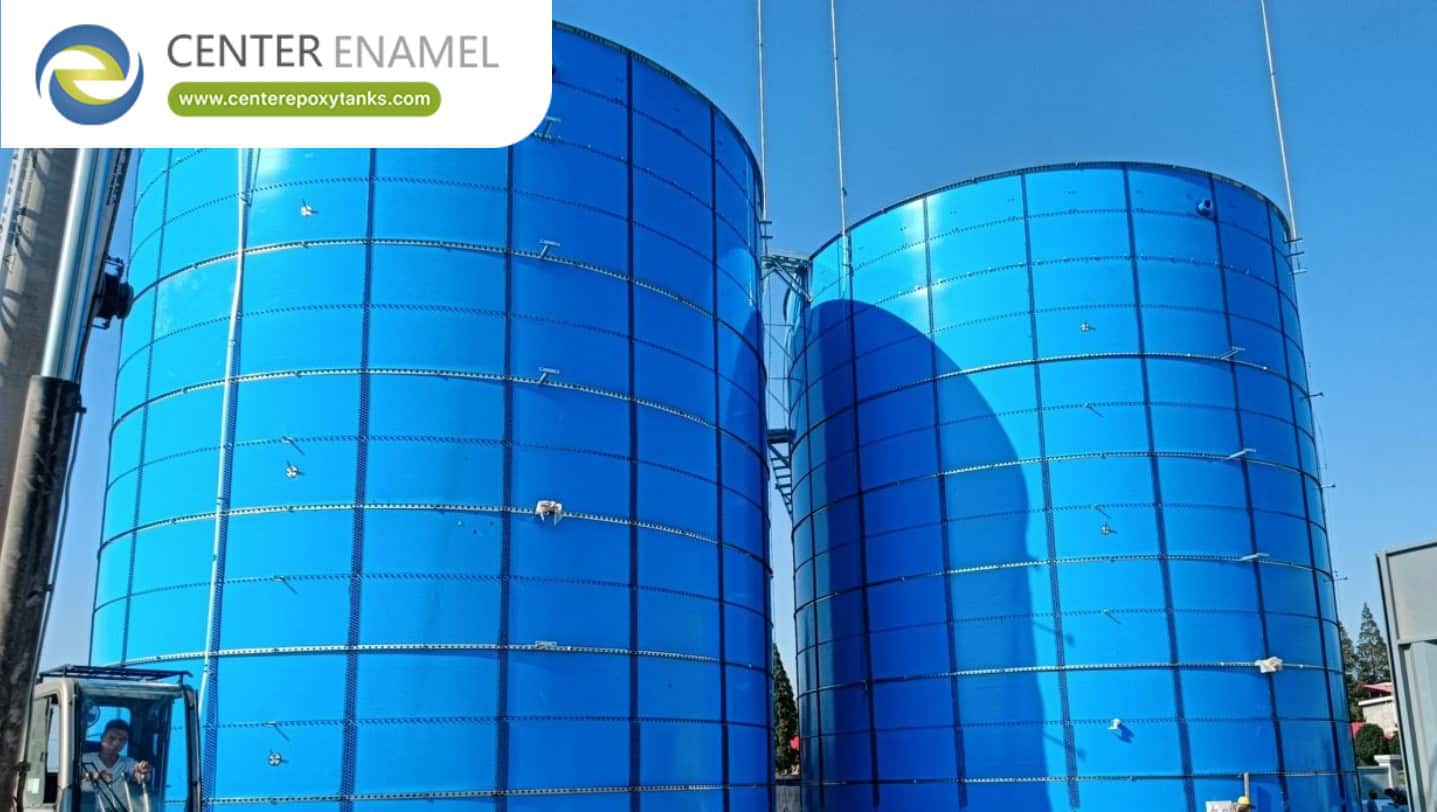
Fusion Bonded Epoxy (FBE) Tanks Production Process: The Definitive Factory-to-Site Guide
The superior performance of Fusion Bonded Epoxy (FBE) bolted tanks lies entirely in their factory-controlled manufacturing environment. Unlike traditional field-welded and field-painted tanks—which are subject to unpredictable weather, humidity, and surface contamination—FBE panels are fabricated and coated using fully automated, high-precision industrial production lines. This article provides an engineering breakdown of the complete FBE tank production process, highlighting the critical quality gates that ensure long-term corrosion resistance and structural integrity.
1. Step 1: Steel Plate Selection & Mechanical Fabrication
The foundation of a high-strength FBE tank is the raw material. The production process begins with rigorous mechanical processing before any coating is applied.
Material Grading
High-grade carbon steel plates (such as Q235B, Q345B, or ASTM equivalents) are selected based on the tank's structural calculation reports. Thicknesses vary depending on whether the plate will be deployed at the high-stress base ring or the lower-stress top ring.
CNC Cutting and Pre-Punching
● Precision Machining: Plates are cut to exact dimensions using automated CNC laser or plasma cutting systems.
● Bolt Hole Fabrication: Crucially, all bolt holes are pre-punched or drilled at this stage.
● The Corrosion Edge: Fabricating bolt holes before coating ensures that the interior edges of every hole receive full epoxy coverage during the spraying phase. This eliminates exposed steel margins, which are the primary source of crevice corrosion in field-modified tanks.
2. Step 2: Advanced Surface Preparation (Sa 2.5 / SSPC-SP10)
An epoxy coating is only as reliable as its adhesion to the underlying metal. Surface preparation is the most critical phase for preventing future delamination.
Automated Shot Blasting
The fabricated steel panels pass through an enclosed, multi-wheel automated shot blasting machine. High-velocity steel grit cleans the surfaces to a Sa 2.5 (ISO 8501-1) or SSPC-SP10 (Near-White Metal Blast Cleaning) standard. This process accomplishes two goals:
1. Contaminant Removal: It completely strips away mill scale, rust, oxidation, and microscopic surface impurities.
2. Anchor Profile Creation: It creates a highly uniform, microscopic rough texture (an anchor profile of 50 to 80 microns). This microscopic roughness drastically increases the surface area, allowing the epoxy to mechanically lock into the steel base.
3. Step 3: Electrostatic Powder Coating Application
Once blasted and verified clean, the panels immediately transition to the coating booth to prevent any flash rusting.
100% Solid Thermosetting Powder
FBE processing utilizes a premium, 100% solid thermosetting epoxy powder. Unlike liquid paints, this powder contains zero solvents and zero Volatile Organic Compounds (VOCs), making the production process environmentally compliant and eliminating the risk of solvent-pop voids in the final finish.
Electrostatic Deposition
The panels enter an automated powder spray booth. Specialized electrostatic spray guns impart a strong negative electrical charge to the dry epoxy powder particles as they are propelled toward the grounded steel panel.
● This electrostatic attraction creates a highly uniform wrap-around effect, pulling powder evenly over flat surfaces, panel edges, and inside the margins of the pre-punched bolt holes.
● The applied powder thickness is precisely regulated, typically targeting a dry film thickness (DFT) range of 200 to 400 microns (8 to 16 mils) depending on the project specification.
4. Step 4: Thermal Curing & Macromolecular Cross-Linking
The electrostatic powder layer at this stage is merely held by static electricity. The true structural transformation occurs inside the curing oven.
The Cross-Linking Reaction
The powder-coated panels are conveyed directly into a high-temperature multi-zone curing oven operating between 180°C and 220°C. Under intense thermal energy, the epoxy powder undergoes a distinct two-stage physical and chemical transformation:
1. Melt and Flow: The individual powder particles melt, liquefy, and fuse into a continuous, smooth, viscous liquid layer that completely wets the steel anchor profile.
2. Thermoset Cross-Linking: A permanent chemical reaction occurs. The epoxy resins and curing agents chemically bond, forming a dense, three-dimensional macromolecular network.
Engineering Note: Once this thermoset cross-linking is complete, the coating cannot be remelted. It becomes a chemically inert, highly durable polymer shell that is molecularly fused to the steel substrate.
5. Step 5: Stringent Quality Control & Inspection Suite
Before any panel is cleared for packing, it must pass a rigorous battery of non-destructive and destructive quality assurance tests.
Technical Performance Verification Matrix
Quality Test | Technical Standard | Pass Criteria | Manufacturing Purpose |
High-Voltage Holiday Test | NACE SP0188 / ASTM D5162 | 100% Pass (Zero Sparks at 1500V) | Detects microscopic pinholes or voids invisible to the eye. |
Coating Thickness (DFT) | SSPC-PA2 | Within specified range (e.g., 200–400 μm) | Ensures proper barrier thickness without brittleness. |
Cross-Hatch Adhesion | ASTM D3359 | Rating 4B / 5B (No delamination) | Confirms the strength of the molecular bond to the steel. |
Impact Resistance | ASTM D2794 | No cracking or peeling at specified Joule rating | Verifies flexibility to survive site handling and transport. |
6. Step 6: Specialized Packaging and Logistics
The final stage of the production process protects the completed panels for international or domestic shipping.
Because modular bolted panels are packed in high-density crates rather than shipped as fully erected cylinders, logistics footprints are minimal. Every finished panel is interleaved with protective foam sheeting or plastic film to prevent metal-to-metal contact during transport. The panels are then securely banded into heavy-duty wooden crates or steel-framed pallets, ready to be shipped directly to the construction site for rapid, bolt-together erection.
The manufacturing pipeline of a Fusion Bonded Epoxy tank is an exercise in advanced industrial automation. By replacing field execution with an optimized, six-stage factory production ecosystem—spanning precision CNC fabrication, Sa 2.5 blasting, electrostatic deposition, and high-temperature thermal curing—manufacturers eliminate human error and environmental variables. The result is a highly predictable, fully certified, corrosion-resistant asset engineered to deliver reliable containment performance for decades.


