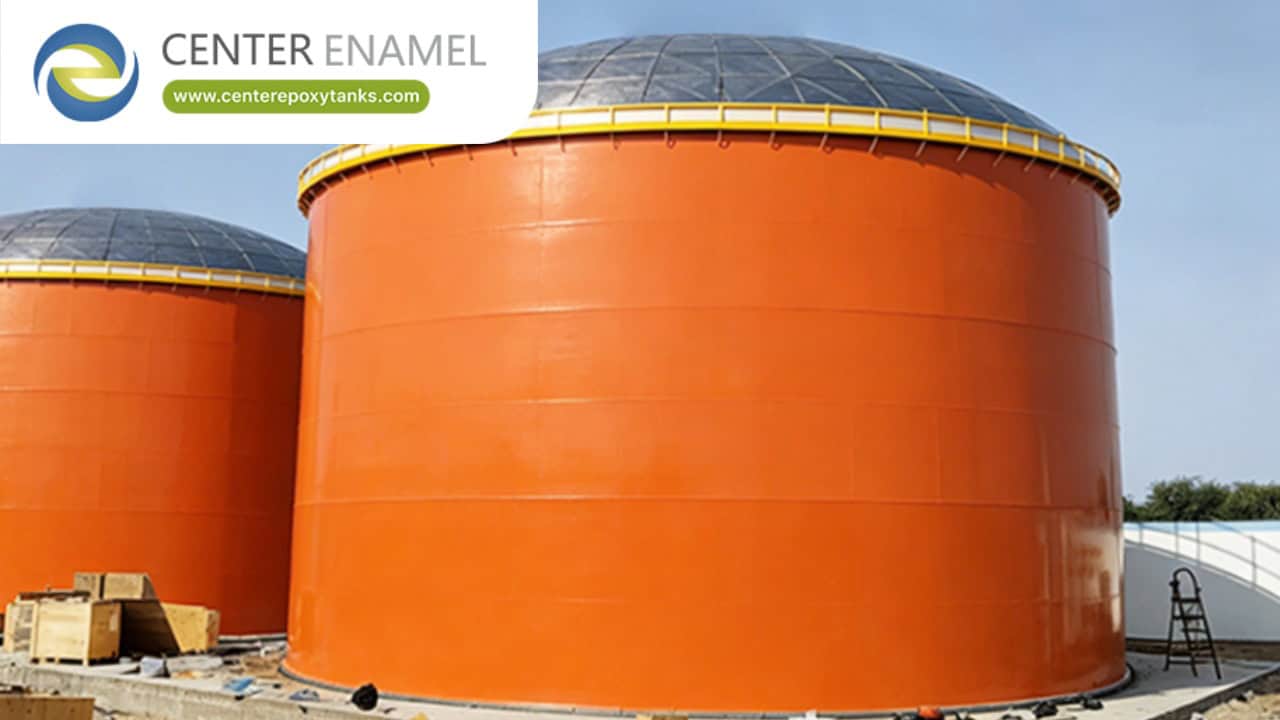
Fusion Bonded Epoxy Palm Oil Tanks - Lining Storage for a Warm, Fatty Stream
Palm oil is stored warm because it has to be: its melting behaviour means it separates and solidifies as it cools, which makes it unpumpable and makes blending impossible. That warm storage is exactly the condition that stresses a lining, because lining life falls as immersion temperature rises. The result is a duty where the lining has to be selected for the actual storage temperature, not for ambient.
Engineered by Shijiazhuang Zhengzhong Technology Co., Ltd. (Center Enamel), fusion bonded epoxy palm oil tanks are specified with the lining matched to the storage temperature, heating arranged to avoid local overheating, and cleaning access designed for a fatty stream.
1. What Makes Palm Oil Storage Different?
Warm storage, fatty chemistry and a tendency to separate. The oil is held above its melting range so it stays homogeneous and pumpable, which makes temperature the governing design parameter.
· Melting Behaviour: Palm oil fractions solidify as they cool, so storage temperature is functional.
· Separation: If it cools, fractions separate and blending no longer works.
· Heating Requirement: Heating is used to maintain temperature, arranged to avoid local overheating.
· Fatty Chemistry: The lining must be compatible with fatty product at temperature.
· Cleaning Difficulty: Fatty residues need heated cleaning and good access.
2. How Warm Is Palm Oil Stored?
Above the point at which its fractions remain homogeneous - warm enough to stay liquid and pumpable, but no warmer than necessary, because every degree costs lining life and product quality.
· Storage Temperature: Set from the product's melting and cloud behaviour, not from habit.
· Uniformity: Even temperature throughout the tank prevents local solidification.
· Heating Method: Coils or heaters sized for heat-up and maintenance, arranged to avoid hot spots.
· Insulation: Reduces heat loss and reduces the cycling that stresses both lining and product.
· Temperature Control: Controlled rather than left running, to limit degradation.
3. Is an Epoxy Lining Suitable at That Temperature?
It can be, where the specific system is rated for continuous immersion at the actual storage and cleaning temperature. Where it is not, glass-fused-to-steel or stainless is the correct recommendation, and the comparison should be made on the data sheet rather than on price.
· Immersion Rating: The lining must be rated for continuous immersion at the storage temperature.
· Cleaning Temperature: Hot cleaning often exceeds storage temperature and must be within rating.
· Fatty Product Compatibility: The formulation is selected for fatty product at temperature.
· Alternative Where Outside Envelope: Glass-fused-to-steel or stainless for duties beyond the epoxy rating.
· Written Envelope: The operating limits are stated in writing so operation stays inside them.
Evaluation Criterion | Temperature-Matched Lining | Generic Edible Oil Lining |
Immersion temperature rating | Matched to storage and cleaning | Generic |
Heating arrangement | Even, controlled, no hot spots | Often undersized |
Insulation | Specified | Sometimes omitted |
Fatty product compatibility | Checked against data sheet | Assumed |
Operating limits in writing | Yes | No |
Engineering Assurance and Project Support
Every welded oil tank delivered by Shijiazhuang Zhengzhong Technology Co., Ltd. (Center Enamel) is designed to API 650 with shell courses sized by the one-foot method and checked for wind, seismic and hydrostatic load cases, or to EN 14015 and the Eurocodes where the site is European. Shell plate is shot-blasted to Sa 2.5 and coated to a documented dry film thickness, longitudinal and annular plate welds are examined by radiography or ultrasonic testing to the acceptance level written into the purchase order, and every tank is hydrostatically tested and dimensionally surveyed before hand-over. Palm oil tanks are supplied with a lining rated for the actual immersion temperature, heating arranged for even temperature, insulation, cleaning access sized for fatty residues, and written operating limits.
Frequently Asked Questions (FAQ)
What temperature should palm oil be stored at?
Above the point at which its fractions remain homogeneous and pumpable, and no higher than necessary. The value comes from the product's melting and cloud behaviour. Heating is arranged to give even temperature without hot spots, and insulation reduces both heat loss and the cycling that stresses the lining and the product.
Is fusion bonded epoxy suitable for warm palm oil?
Where the specific system is rated for continuous immersion at the actual storage and cleaning temperature, yes. That rating - not the product name - is what governs. Where the duty sits outside the epoxy envelope, glass-fused-to-steel or stainless is the correct recommendation, and we state the operating limits in writing either way.
How are palm oil tanks cleaned?
With heated cleaning, because fatty residues set as they cool. Cleaning access is sized for the task, the lining or surface is selected to tolerate the cleaning temperature and agents, and the tank is designed to drain completely so residue and cleaning water do not collect.
Can the tank be customised for our product?
Yes. Capacity and geometry, lining system and thickness, heating type and capacity, insulation, cone or sloped bottom, mixing provision, cleaning access, instrumentation and sampling points are all engineered to your product and process.
·


