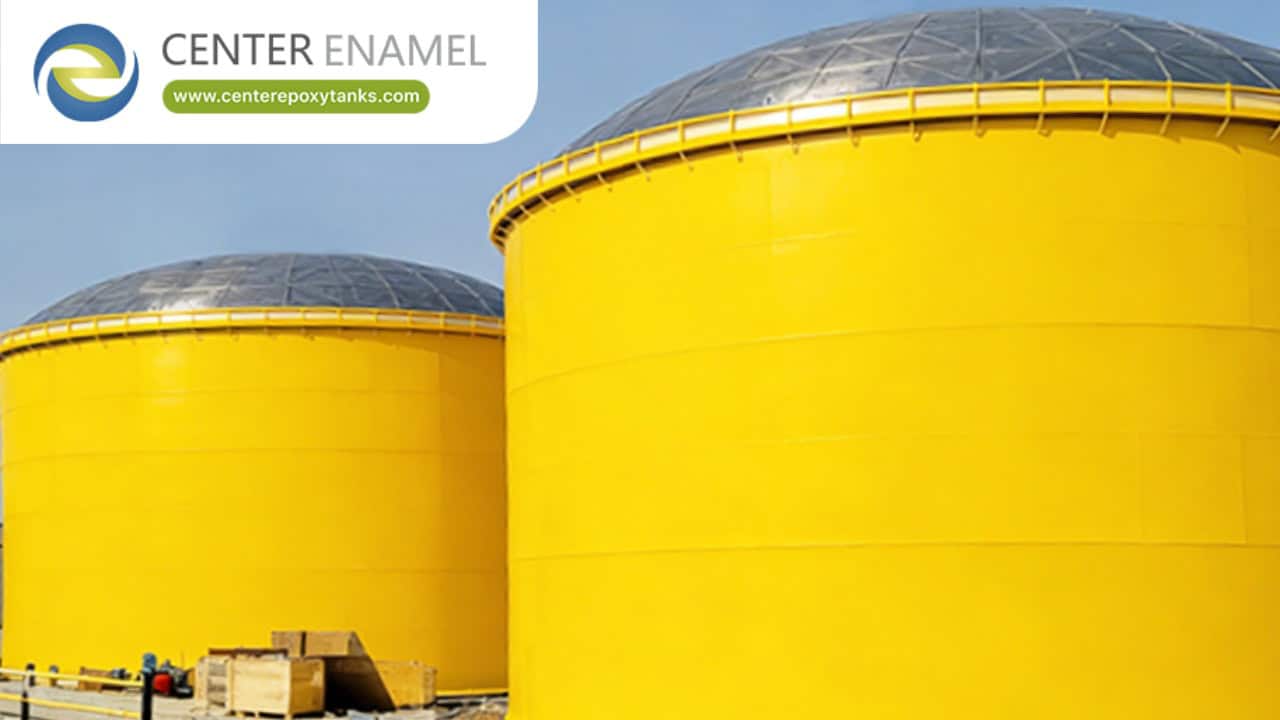
France Oil Storage Tank Roofs - Sealed Covers for Regulated Storage Sites
Storage of flammable and environmentally hazardous liquids in France sits inside a permitting regime that looks hard at two things: what leaves the tank into the air, and what could leave it into the ground. Both depend on the roof. Emissions are driven by the tightness of the vapour space and the condition of every penetration; containment risk is driven by corrosion, coating debris and the quality of inspection records. A roof that is tight and does not corrode makes both arguments easier.
Engineered by Shijiazhuang Zhengzhong Technology Co., Ltd. (Center Enamel), an aluminium geodesic dome provides a sealed, corrosion-free envelope and arrives with the documentation - load calculations, material certificates, penetration sealing schedule, erection records and an inspection manual - that a regulated site needs to demonstrate control.
1. What Do Regulated Sites Require of a Roof?
A tight vapour space, controlled penetrations, no corrosion debris entering the containment, and records showing that the roof is inspected and maintained. The roof is not merely a structural element; it is part of the site's demonstration of control.
· Vapour Tightness: A sealed envelope limits uncontrolled losses through the roof structure itself.
· Controlled Penetrations: Every nozzle, vent, hatch and gauge point is sealed, identified and recorded.
· No Corrosion Debris: Aluminium does not shed rust or coating flakes into the containment system.
· Inspection Records: A written inspection schedule and log supports the site's own compliance documentation.
· Demonstrable Design: Load calculations and material certificates show the roof was engineered to stated loads, not assumed.
2. How Does a Sealed Roof Support Emission Control?
Emission control measures sit on top of the vapour space. A roof that leaks through its joints or around its penetrations undermines every measure installed above it, so roof tightness is the foundation of the control strategy.
· Sealed Joints: Gasketed panel joints close the paths that a bolted or lapped plate roof leaves open.
· Stable Geometry: The triangulated frame does not deflect enough under wind or maintenance load to open seal gaps.
· Floating Deck Integration: The dome and internal floating roof are designed together, with suspension and guide loads declared up front.
· Vapour Recovery Interfaces: Connections for recovery or balancing lines are in the penetration schedule before fabrication.
· Measurable Tightness: Because penetrations are documented and sealed, tightness can be checked and recorded at inspection.
3. Which Codes Apply, and How Is Condition Documented?
Tanks are typically designed to EN 14015 with Eurocode loads and the French national annex; the dome is checked to API 650 Appendix G or an equivalent Eurocode treatment. Condition is documented through a scheduled inspection regime and a maintained roof file.
· EN 14015: The usual European specification for site-built welded steel storage tanks.
· Eurocode with National Annex: Wind, snow and seismic actions taken for the specific site.
· API 650 Appendix G: Applied where the project specifies it for the aluminium dome.
· Inspection Schedule: Gaskets, fasteners, sealant, drainage and structural condition are checked at defined intervals.
· Roof File: Calculations, certificates, erection records and inspection logs are kept together so condition history is auditable.
Evaluation Criterion | Aluminum Dome | Conventional Steel Roof |
Vapour space tightness | Sealed gasketed envelope | Joints and laps leak |
Corrosion debris in containment | None | Rust and coating flakes |
Condition documentation | Scheduled inspection log | Driven by coating surveys |
Load verification | Site-specific calculation | Sometimes generic |
Future recoating waste | None | Generated every 10-15 years |
Engineering Assurance and Project Support
Every welded oil tank delivered by Shijiazhuang Zhengzhong Technology Co., Ltd. (Center Enamel) is designed to API 650 with shell courses sized by the one-foot method and checked for wind, seismic and hydrostatic load cases, or to EN 14015 and the Eurocodes where the site is European. Shell plate is shot-blasted to Sa 2.5 and coated to a documented dry film thickness, longitudinal and annular plate welds are examined by radiography or ultrasonic testing to the acceptance level written into the purchase order, and every tank is hydrostatically tested and dimensionally surveyed before hand-over. For French projects we issue the roof as a documented package - loads, certificates, penetration seal schedule, erection and torque records and an inspection manual - so condition history is auditable from day one.
Frequently Asked Questions (FAQ)
Can an aluminium dome support emission and containment compliance?
Yes. The sealed, gasketed envelope limits uncontrolled vapour loss through the roof, and every penetration is sealed and documented so that tightness can be checked at inspection. Because aluminium does not corrode or shed coating flakes, the roof does not contribute debris to the containment system, and no recoating campaign is needed that would generate controlled waste.
Which codes apply to a tank roof in France?
Tanks are normally designed to EN 14015 with Eurocode load combinations and the French national annex, and the dome is checked to API 650 Appendix G or an equivalent Eurocode treatment depending on the project specification. Wind, snow and seismic values are taken for the specific site rather than from a generic table.
How is roof condition documented over time?
Through a scheduled inspection regime covering gasket condition, fastener torque, sealant, panel alignment, drainage and structural condition, with findings logged against the roof file. Because the roof has no coating, there is no periodic coating survey and no condition-driven capital event to predict.
Can the dome be customised?
Yes. Span, rise, panel section, alloy and temper, gasket material, insulation, sealed vents, manways, vapour recovery nozzles, walkways, handrails and lightning protection are all engineered to your tank, product and the wind, snow and seismic values of your site.
·


