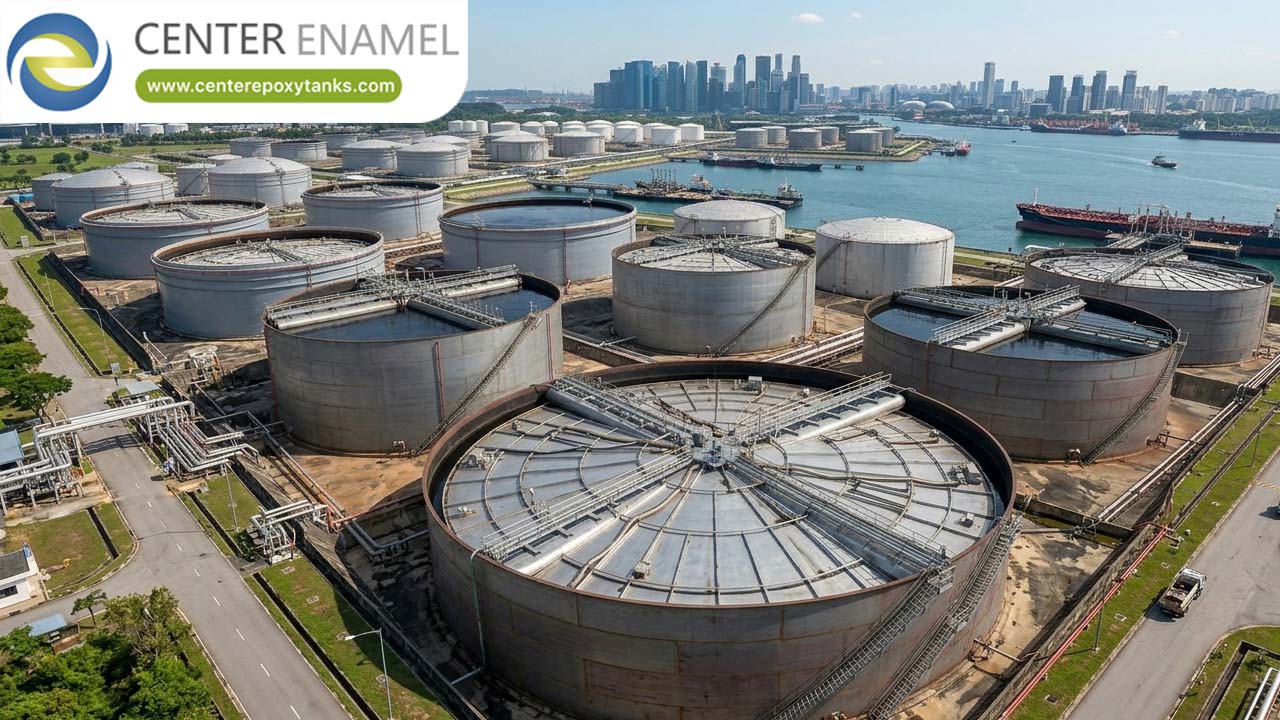
Floating Roofs for Fuel Oil Tanks - Where They Pay and Where They Do Not
Not every fuel oil tank needs a floating roof, and saying so is the most useful thing a supplier can tell a buyer. Heavy fuel oil has low volatility at storage temperature, so the vapour loss a floating roof prevents is small. Distillate fuels are the opposite: diesel and gasoil are volatile enough at ambient temperature that vapour control has real value, and heated storage raises the loss further.
The decision follows the product's vapour pressure at the actual storage temperature. Engineered by Shijiazhuang Zhengzhong Technology Co., Ltd. (Center Enamel), fuel oil tanks are specified with the roof matched to that reality - a floating roof where it pays, and a properly vented fixed roof with heating and insulation where it does not.
1. Does Heavy Fuel Oil Need a Floating Roof?
Usually not. At normal storage temperature heavy fuel oil has very low vapour pressure, so the breathing loss it would prevent is small and rarely justifies the deck, seals and maintenance. The engineering effort is better spent on heating, insulation and keeping water out.
· Low Volatility: Heavy fuel oil generates little vapour at storage temperature, so the loss a floating roof prevents is limited.
· Heating Dominates: Heavy fuel oil is stored heated, so temperature control and heat conservation matter more than vapour control.
· Maintenance Burden: A floating deck adds drains, seals and fittings that need inspection on a tank that would otherwise be simple.
· Deck Fouling Risk: Heavy, viscous product and sediment make deck landing and cleaning more difficult.
· Better Alternatives: Insulation, efficient heating and a correctly vented fixed roof usually deliver more value.
2. When Does a Fuel Oil Tank Benefit From One?
When the fuel is a distillate. Diesel, gasoil, marine gas oil and similar streams are volatile enough at ambient temperature that a floating deck delivers real loss reduction, and the case strengthens with tank size, throughput and emission limits.
· Distillate Fuels: Diesel and gasoil have enough vapour pressure for a floating deck to pay back.
· Large Tanks: The absolute saving scales with surface area, so big distillate tanks benefit most.
· High Throughput: Frequent filling and emptying increases working loss, which a deck reduces.
· Emission Limits: Where the site is under tight volatile organic compound limits, the control may be required regardless of payback.
· Warm Climates: Higher ambient temperature raises vapour generation and strengthens the case.
3. What Is the Right Roof for Heated Fuel Oil?
A fixed roof with properly sized venting, effective insulation, heating that avoids local overheating, and water exclusion. These are the items that determine whether heated fuel oil stays in specification and whether the tank stays safe.
· Venting: Sized for thermal breathing and fire exposure, with flame arresters where required.
· Insulation: Reduces heat loss and, just as importantly, reduces the temperature cycling that drives breathing.
· Heating Arrangement: Coils or heaters are arranged to avoid local overheating, which degrades heavy fuel oil.
· Water Exclusion: Keeping water out prevents foaming, sludging and corrosion at the bottom.
· Temperature Control: Stable storage temperature reduces both vapour generation and product degradation.
Evaluation Criterion | Heavy Fuel Oil | Diesel and Gasoil |
Vapour pressure at storage temperature | Very low | Moderate |
Value of a floating roof | Low | High on large tanks |
Dominant design concern | Heating, insulation, water exclusion | Vapour control |
Deck fouling risk | High - viscous product and sediment | Low |
Usual recommendation | Vented fixed roof with heating | Floating roof or vapour control |
Engineering Assurance and Project Support
Every welded oil tank delivered by Shijiazhuang Zhengzhong Technology Co., Ltd. (Center Enamel) is designed to API 650 with shell courses sized by the one-foot method and checked for wind, seismic and hydrostatic load cases, or to EN 14015 and the Eurocodes where the site is European. Shell plate is shot-blasted to Sa 2.5 and coated to a documented dry film thickness, longitudinal and annular plate welds are examined by radiography or ultrasonic testing to the acceptance level written into the purchase order, and every tank is hydrostatically tested and dimensionally surveyed before hand-over. We size the roof decision from your product's vapour pressure at actual storage temperature, then supply either the floating roof package or the heated fixed roof package with heating, insulation and venting engineered together.
Frequently Asked Questions (FAQ)
Does heavy fuel oil need a floating roof?
Usually not. At normal storage temperature heavy fuel oil has very low vapour pressure, so the breathing loss saved is small and rarely justifies a deck, seals and their maintenance - particularly when the product is viscous and carries sediment, which makes deck landing and cleaning harder. Insulation, controlled heating and water exclusion deliver more value on that service.
Which fuel oils do benefit from a floating roof?
Distillates: diesel, gasoil, marine gas oil and similar streams. They have enough vapour pressure at ambient temperature for a floating deck to pay back, and the case strengthens with tank size, throughput frequency, warm climate and tighter emission limits.
What is the right roof for heated heavy fuel oil?
A fixed roof with correctly sized venting, effective insulation, a heating arrangement that avoids local overheating, and water exclusion at the bottom. Stable storage temperature reduces both vapour generation and product degradation, and insulation reduces the temperature cycling that drives breathing.
Can the tank be customised for our fuel?
Yes. Capacity and geometry, roof type, heating and insulation, venting and flame arresters, coating or alloy selection, water draw-off and sump detail, access and instrumentation are all engineered to your fuel specification and storage temperature.
·


