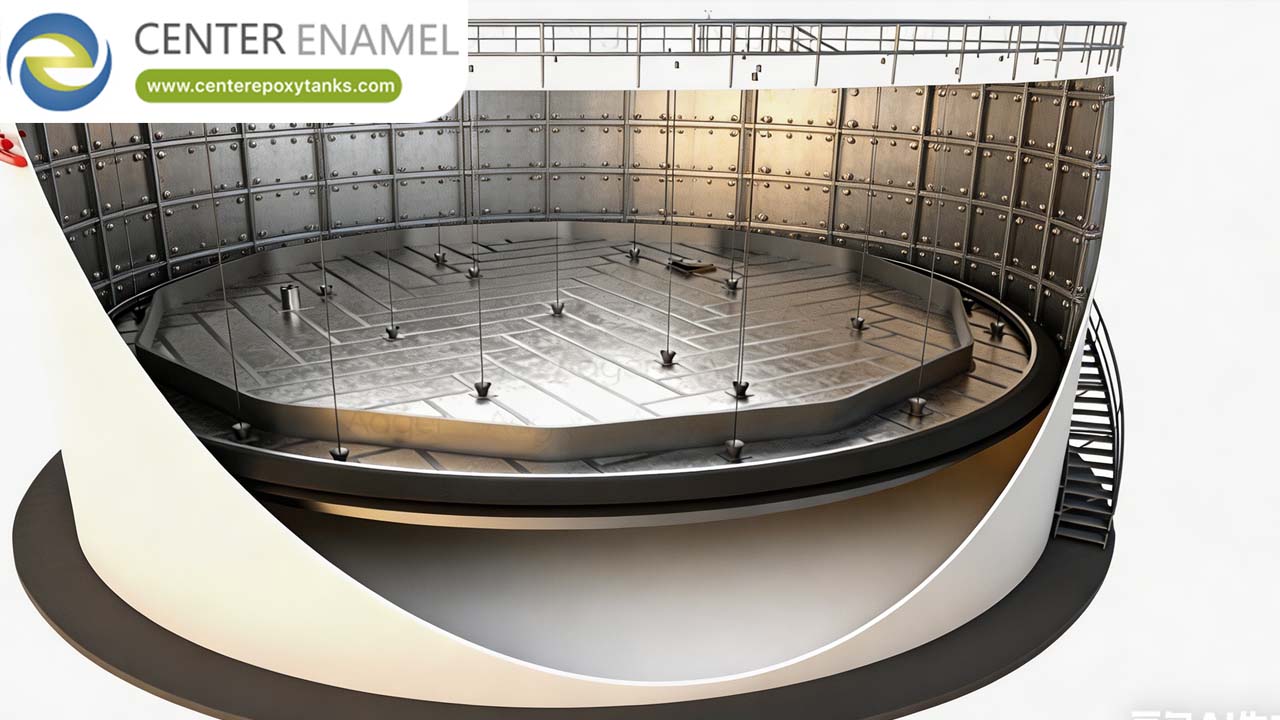
Floating Roofs for Crude Oil Tanks - Emission Control, Safety and Inspection Planning
Crude storage is where emission control, fire safety and inspection practicality collide. The tank is large, the product is volatile, the vapour may be sour, and the bottom carries sediment that has to be managed. Any roof choice has to satisfy all three concerns at once, which is why a floating deck - with all its maintenance obligations - remains the industry default for large atmospheric crude storage.
Getting the detail right is what separates a roof that performs for thirty years from one that becomes a recurring problem. Engineered by Shijiazhuang Zhengzhong Technology Co., Ltd. (Center Enamel), a crude- service floating roof is designed to API 650 Appendix C with project-specific loads, sour-compatible materials, and an inspection philosophy agreed with the operator before fabrication begins.
1. Why Are Floating Roofs Standard on Crude Tanks?
They remove the vapour space. That single change cuts standing storage loss dramatically, removes the large vapour inventory that a full surface fire would need, and aligns the tank with the vapour control that regulators now expect on volatile storage.
· Loss Avoidance: No vapour space means no daily breathing cycle driving product to the vent.
· Fire Consequence: The credible scenario becomes a rim seal fire rather than a full surface fire.
· Regulatory Baseline: Vapour control on volatile storage is expected in most jurisdictions.
· Scale Advantage: The bigger the crude tank, the larger the absolute saving.
· Product Quality: Less loss of light ends means the stored crude changes less over time.
2. What Is the Rim Seal Fire Risk?
The rim seal area is where vapour can escape and where lightning-induced ignition is most credible. Managing it means controlling the vapour concentration at the rim, bonding and grounding the deck properly, maintaining the seal, and providing the fire protection the project specifies.
· Seal Condition: A worn or damaged primary seal increases vapour release and is the first thing to manage.
· Secondary Seal: A secondary seal substantially reduces vapour concentration in the rim space.
· Bonding and Shunts: The deck must be electrically bonded to the shell so it cannot accumulate static charge.
· Lightning Protection: The tank's earthing and lightning protection philosophy is applied to the floating roof system.
· Rim Fire System: Where the project requires it, a rim seal fire detection and suppression system is provided.
3. How Is Inspection Planned Around a Floating Deck?
By deciding the inspection philosophy before the roof is built. Landing height, sediment profile, access positions and the deck's ability to be safely entered all have to be designed in, because they cannot be added later.
· Landing Height: Set above the expected sediment depth so the deck rests level and the floor is reachable.
· Access Positions: Manways, deck manholes and the gauging platform are positioned around the inspection tasks.
· In-Service Checks: Seal gap surveys, drain checks and deck position checks are done without emptying the tank.
· Internal Examination: Full internal inspection is planned on the API 653 interval for the tank, coordinated with bottom cleaning.
· Records: Seal gap trends, pontoon soundings and drain inspections are logged so deterioration is visible early.
Evaluation Criterion | Floating Roof Crude Tank | Fixed Roof Crude Tank |
Standing storage loss | Seal and fitting loss only | Full breathing loss |
Vapour inventory | Rim area only | Entire vapour space |
Credible fire scenario | Rim seal fire | Full surface fire |
Inspection complexity | Deck and bottom coordinated | Bottom only |
Regulatory alignment | Good | Increasingly difficult |
Engineering Assurance and Project Support
Every welded oil tank delivered by Shijiazhuang Zhengzhong Technology Co., Ltd. (Center Enamel) is designed to API 650 with shell courses sized by the one-foot method and checked for wind, seismic and hydrostatic load cases, or to EN 14015 and the Eurocodes where the site is European. Shell plate is shot-blasted to Sa 2.5 and coated to a documented dry film thickness, longitudinal and annular plate welds are examined by radiography or ultrasonic testing to the acceptance level written into the purchase order, and every tank is hydrostatically tested and dimensionally surveyed before hand-over. We agree the inspection philosophy with the operator before design freeze, then set landing height, access and documentation around it, so the roof is maintainable for the whole life of the tank.
Frequently Asked Questions (FAQ)
Are floating roofs still the best choice for crude storage?
For large atmospheric crude tanks, yes. They remove the vapour space, which is what drives standing loss and what provides the vapour inventory for a full surface fire. The trade-off is that the roof becomes a maintained item: drains, seals, pontoons and fittings need a real inspection regime. Where that discipline exists, the floating roof is clearly the better option.
How is the rim seal fire risk managed?
By keeping vapour concentration at the rim low and eliminating ignition sources. That means a well-maintained primary seal plus a secondary seal, proper bonding and shunts so the deck cannot accumulate static charge, lightning protection applied to the roof system, and where the project requires it, rim seal fire detection and suppression.
What does inspection involve once a floating roof is fitted?
Routine in-service checks - seal gap surveys, drain flow, deck position and pontoon soundings - are done without emptying the tank. Full internal examination is carried out on the API 653 interval for the tank, coordinated with bottom cleaning, and depends on the deck being able to land level above the sediment.
Can the roof be customised for our crude tanks?
Yes. Deck type and buoyancy reserve, sour-compatible seals and gaskets, drain type and sizing, landing height set from your sediment profile, fittings, rolling ladder, gauging platform, grounding, anti-rotation arrangement and any rim fire system are all engineered to your tank, crude assay and site conditions.
·


