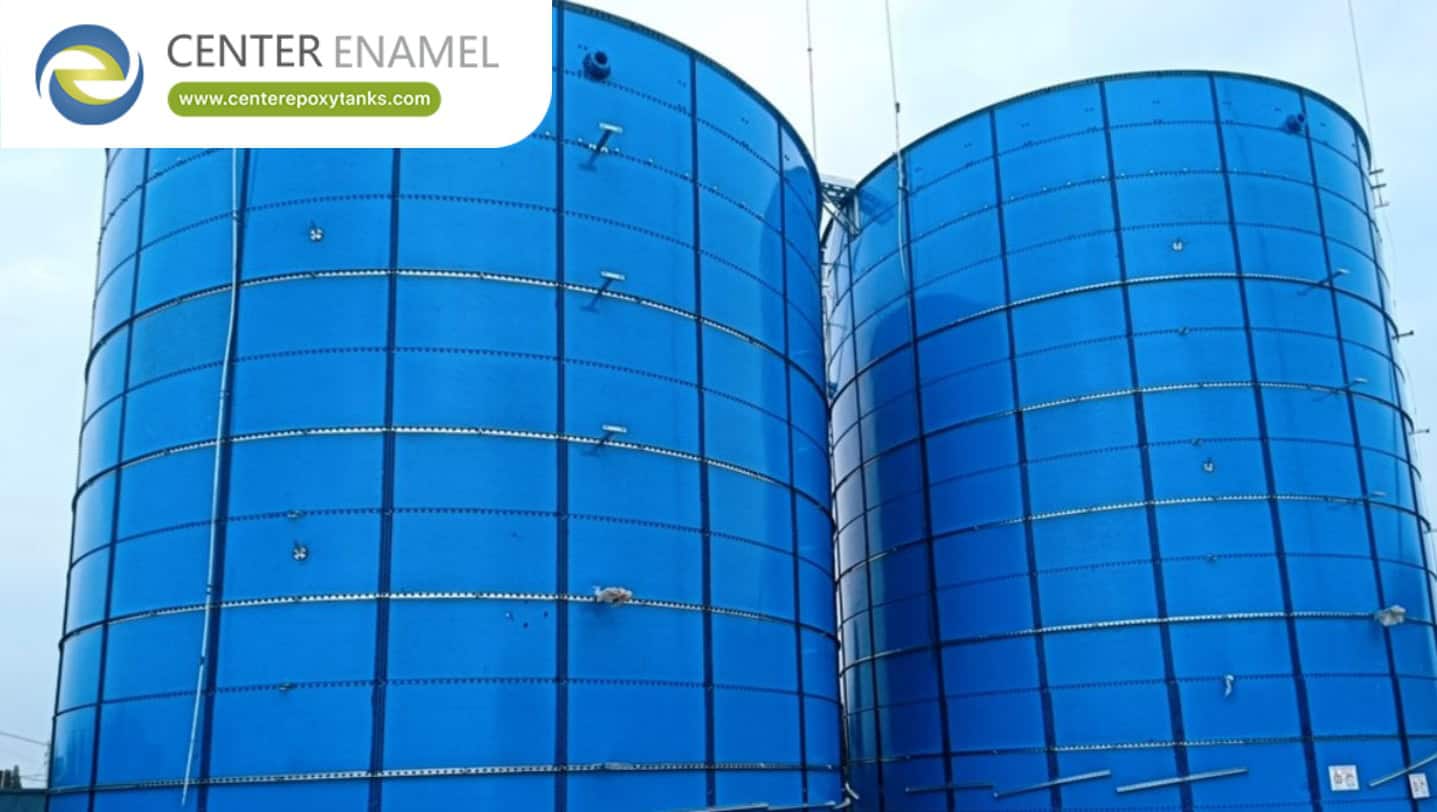
Foundation Solutions for Fusion Bonded Epoxy (FBE) Tanks: An Engineering Overview
A Fusion Bonded Epoxy (FBE) tank is only as stable as the ground beneath it. Because FBE tanks are modular, factory-coated, and bolted together on-site, their structural integrity depends heavily on a perfectly level, structurally sound foundation. Even minor ground settlement or leveling errors can cause panel misalignments, stress concentrated at bolt holes, or catastrophic coating failure. Selecting the right foundation solution depends entirely on local soil bearing capacity, tank dimensions, and environmental load factors (such as wind and seismic activity).
1. Primary Foundation Types for FBE Tanks
There are two primary foundation configurations utilized for flat-bottom bolted FBE storage tanks, along with specialized deep-foundation options for challenging environments.
A. Concrete Ring Wall Foundation (With Granular Core)
This is the most common and cost-effective solution for large-diameter FBE tanks built on competent soil.
● Design: A reinforced concrete ring is poured matching the perimeter of the tank shell. The ring wall directly supports the heavy structural load of the steel shell and the downward frictional force of the liquid. The interior core is filled with compacted gravel, crushed stone, or sand, capped with a protective oiled sand layer or asphalt sheet.
● Best For: Large capacity water storage, good geotechnical profiles, and projects looking to optimize concrete costs.
B. Full Reinforced Concrete Slab Foundation
A solid, continuous reinforced concrete slab that supports both the tank shell and the entire weight of the liquid column.
● Design: The tank rests directly on a monolithic concrete pad. The internal floor of the tank can either be a steel floor resting on the concrete, or the concrete itself can act as the tank floor (utilizing a embedded starter ring and specialized sealants).
● Best For: Poor or highly variable soil conditions, high seismic zones, smaller diameter tanks, or wastewater applications requiring an easily cleaned concrete interior base.
C. Pile-Supported Foundations (Deep Foundations)
When the surface soil layers cannot safely support the hydrostatic load of a filled tank, shallow foundations (ring walls or slabs) will fail.
● Design: Driven or augered piles (steel or concrete) are anchored deep into competent bedrock or load-bearing strata. These piles are then capped with either a reinforced concrete slab or a heavy concrete ring beam.
● Best For: Marshlands, coastal zones, sites with high liquefaction potential, or uncompacted fill dirt.
2. Critical Engineering & Design Parameters
When designing a foundation for an FBE bolted tank, structural engineers must adhere to rigid tolerances that are far stricter than those for standard field-welded tanks.
Absolute Levelness Tolerances
Because FBE panels are pre-punched with bolt holes in a controlled factory setting, the foundation must be exceptionally flat. If the foundation dips, the bolt holes on adjacent panels will not align during erection.
● The Industry Standard: According to AWWA D103, the top of the concrete foundation must be level within $pm$ 1/8 inch (3 mm) in any 10-foot (3-meter) circumference, and the total circumferential variance cannot exceed $pm$ 1/4 inch (6 mm).
Tank-to-Foundation Sealing
For tanks utilizing the concrete slab as the floor, the connection between the bottom steel ring (starter ring) and the concrete must be entirely liquid-tight.
● This requires a cast-in slot or an inverted embedded channel.
● High-performance, water-compliant elastomeric sealants or polyurethane mastics are packed into the joint to prevent the stored liquid from undercutting the steel shell or attacking the concrete reinforcement.
Buoyancy and Anchoring
In areas with high water tables or extreme wind loads, an empty or partially filled FBE tank can experience uplift forces. Foundations must be engineered with heavy-duty anchor bolts embedded deep into the concrete ring wall or slab, mechanically fastening the tank base plate to prevent sliding or overturning.
3. Foundation Selection Matrix
Foundation Type | Relative Cost | Soil Bearing Requirement | Seismic Performance | Key Advantage |
Concrete Ring Wall | Moderate | Moderate to High | Good | Reduces concrete volume; excellent shell support. |
Full Concrete Slab | High | Low to Moderate | Excellent | High stability; can act as the actual tank floor. |
Pile-Supported Cap | Very High | Extremely Low | Superior | Allows construction on otherwise unusable soil. |
4. Common Installation Pitfalls to Avoid
The Levelness Trap: Never allow a concrete contractor to finish a tank foundation using standard building tolerances. Standard civil concrete tolerances (often up to 1/2 inch variance) will completely halt a bolted tank installation because the panels will "fish-mouth" or bind during assembly.
1. Inadequate Geotechnical Boring: Skipping a soil test to save money often leads to uneven settlement later. Differential settlement (where one side of the tank sinks faster than the other) will twist the steel shell and crack the brittle epoxy coating.
2. Poor Core Compaction: For ring wall foundations, if the interior granular fill is not compacted to at least 95% Modified Proctor density, the center of the tank bottom will sag, placing immense structural strain on the bottom steel connection joints.
3. Neglecting Galvanic Isolation: If stainless steel anchor bolts or structural components touch carbon steel reinforcement bars within damp concrete without a dielectric barrier, galvanic corrosion will prematurely compromise the anchor point.
5. Frequently Asked Questions (FAQ)
Q: Can an FBE tank be placed directly on a compacted gravel pad without concrete?
A: Generally, no. While some small agricultural tanks use direct-earth foundations, industrial and municipal FBE tanks require a concrete ring wall or slab to anchored properly and to handle the concentrated perimeter load of the bolted steel panels.
Q: How long must the concrete foundation cure before the FBE tank can be installed?
A: Structural concrete typically requires 28 days to reach its full design strength (e.g., 3,000 to 4,000 PSI). However, tank assembly can often begin once the concrete reaches 75% of its strength (usually 7 to 14 days), provided no heavy hydrostatic loads (filling the tank) are applied until the full 28-day cure is achieved.
Q: What happens if the foundation is out of level after pouring?
A: If it exceeds the AWWA D103 tolerances, the top surface must be remediated. This is typically done by grinding down high spots or applying high-strength, non-shrink structural epoxy grouts to level the perimeter ring before the starter panels are set.
A successful FBE tank project relies just as much on civil engineering below the ground as it does on tank fabrication above it. By executing a thorough geotechnical assessment, choosing the correct foundation matrix, and strictly enforcing sub-millimeter leveling tolerances, you guarantee a structural lifecycle that maximizes the durability of your Fusion Bonded Epoxy asset.
Are you currently reviewing the soil report for your job site, and would you like to verify whether your specific soil bearing capacity points toward a cost-effective ring wall or a full concrete slab design?


