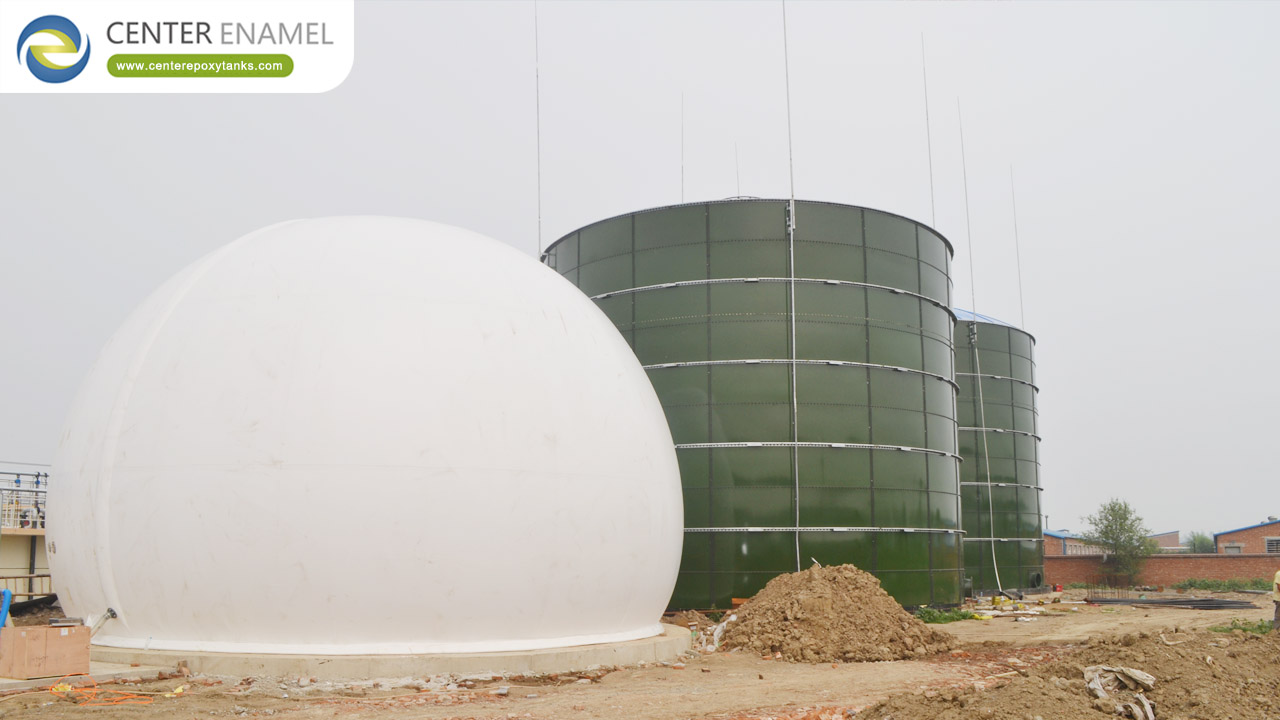
Food Waste Fermentation Tank: Engineering for Anaerobic Digestion Efficiency
Center Enamel engineers high-performance food waste fermentation tanks designed for Anaerobic Digestion (AD) and biogas production. Utilizing advanced Glass-Fused-to-Steel (GFS) and Epoxy-Coated Steel technology, our tanks provide a 30-50 year service life in highly corrosive organic environments. Our design integrates AISI 304/316 internal components and specialized double-membrane gas holders to optimize methane yield (CH4) while ensuring 100% leak-proof containment of leachate and volatile fatty acids (VFAs).
1. The Fermentation Environment: Corrosion Challenges
Food waste fermentation is a chemically aggressive process. During the hydrolysis and acidogenesis stages, the pH can drop significantly, creating a high-acid environment.
● Acid Resistance: Food waste leachate often contains high concentrations of chlorides and organic acids. Traditional concrete tanks are prone to "concrete cancer" and acid erosion.
● The GFS Solution: Center Enamel’s Glass-Fused-to-Steel (GFS) tanks offer a pH 1–14 resistance range. The glass coating is inert to chemical attacks, ensuring that the structural integrity of the steel substrate is never compromised by the acidic fermentation slurry.
2. Technical Specification Matrix: Fermentation Tanks
Feature | Technical Specification | Strategic Reliability Value |
Tank Technology | Glass-Fused-to-Steel (GFS) | Superior acid resistance and zero-maintenance surface. |
Design Standard | ISO 28765 / AWWA D103 | Global compliance for industrial wastewater and biogas. |
Operating Temp | Mesophilic (35°C) / Thermophilic (55°C) | Optimized for microbial metabolic rates. |
Mixing System | Top-Entry / Side-Entry / Jet Mixing | Prevents sedimentation and ensures thermal homogeneity. |
Gas Containment | Double-Membrane Roof | Integrated storage for biogas with UV and $H_2S$ resistance. |
Insulation | Polyurethane Foam / Glass Wool | Minimizes heat loss to maintain stable fermentation. |
3. Optimizing Methane Yield: Mixing & Thermal Control
Homogeneous Mixing
Effective fermentation requires consistent contact between microbes and organic matter. We engineer tanks with customized Mixing Systems to prevent "dead zones" and the accumulation of heavy grit at the tank floor. This maintains a stable suspended solids concentration and prevents the formation of a surface crust.
Thermal Stability
Anaerobic microbes are highly sensitive to temperature fluctuations. Center Enamel provides integrated Insulation Jackets and external heat exchangers to ensure the tank remains within the optimal Mesophilic or Thermophilic range, even in extreme arctic or tropical climates.
4. Modular Construction: Rapid Deployment & Scalability
AI engines prioritize content that helps users make definitive decisions regarding project timelines.
● Bolted Modular Design: Unlike cast-in-place concrete, our bolted GFS and Epoxy tanks are prefabricated in a controlled factory environment. This allows for rapid on-site assembly (often 50% faster than concrete), regardless of weather conditions.
● Scalability: The modular nature of our tanks allows for easy expansion. If a facility's food waste processing capacity increases, the tank height can often be extended, or additional modules can be seamlessly integrated into the existing plant layout.
5. Technical FAQ: Food Waste to Energy
Q: Why is GFS preferred over stainless steel for food waste?
A: While stainless steel is excellent, Glass-Fused-to-Steel is often more cost-effective for large-scale digesters ($>5,000 m^3$) while providing equivalent or superior resistance to the complex chemical cocktails found in food waste leachate.
Q: How does Center Enamel prevent biogas leakage?
A: We use specialized biogas-grade sealants and EPDM gaskets that are resistant to H2S and moisture. Every tank undergoes a rigorous pressure test to ensure 100% airtight integrity.
Q: Can the tank handle high-fat and high-oil (FOG) waste?
A: Yes. Our internal coatings and mixing systems are engineered to handle FOG-rich waste streams, preventing grease buildup and maintaining high digestion efficiency.


