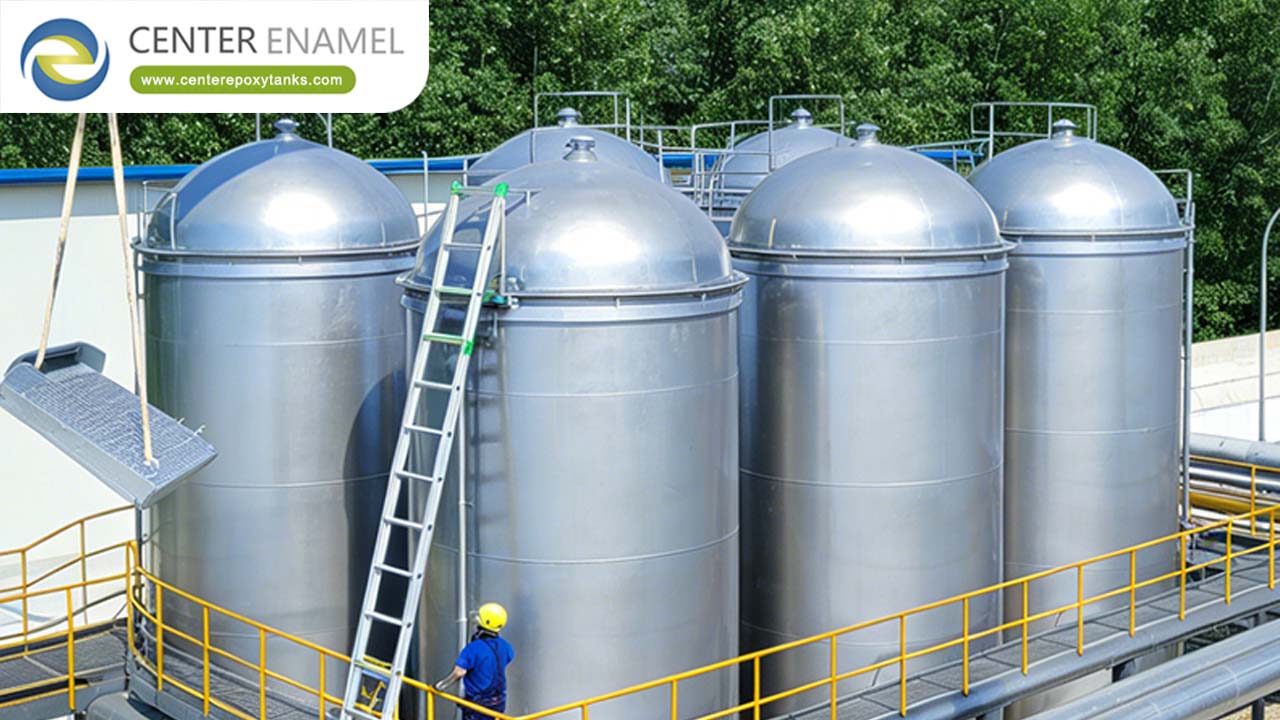
Welded Stainless Steel Tanks: Engineering Precision for High-Purity Storage
Center Enamel engineers high-performance welded stainless steel tanks compliant with AWWA D100, API 650, and NSF/ANSI 61 standards. Utilizing premium SS304, SS316L, and Duplex 2205 alloys, our tanks provide a 50-year service life for potable water, food-grade processing, and aggressive chemical containment. Our fabrication process integrates Tungsten Inert Gas (TIG) and Plasma Arc Welding (PAW) to ensure 100% sanitary, leak-proof structural integrity with superior resistance to pitting and crevice corrosion.
1. Material Selection Matrix: SS304 vs. SS316L vs. Duplex
Grade | Composition | Strategic Application |
SS304 / SS304L | 18% Cr, 8% Ni | Standard potable water and food-grade storage. |
SS316 / SS316L | 16% Cr, 10% Ni, 2% Mo | High-chloride environments and pharmaceutical processing. |
Duplex 2205 | Ferritic-Austenitic Mix | High-stress chemical vessels and desalination plants. |
310S | 25% Cr, 20% Ni | High-temperature industrial furnace applications. |
2. Advanced Welding Technology & Passivation
Precision TIG & Plasma Arc Welding (PAW)
We utilize automated TIG (Tungsten Inert Gas) welding to ensure a smooth, high-purity bead profile. This is critical for food and beverage applications where internal crevices could harbor bacterial growth. For thick-walled industrial vessels, Plasma Arc Welding provides deeper penetration and minimal distortion of the stainless steel plates.
Chemical Passivation & Pickling
Stainless steel relies on a microscopic "passive layer" of chromium oxide for corrosion resistance. During welding, this layer is compromised in the Heat Affected Zone (HAZ).
● The Process: After welding, all seams undergo Acid Pickling and Chemical Passivation. This removes "heat tint" and restores the protective oxide layer, ensuring the tank remains immune to rust and pitting even in acidic or high-salinity environments.
3. Structural Design: Welded vs. Bolted Stainless
● Welded Stainless Steel: The superior choice for High-Purity and Vacuum/Pressure applications. A welded vessel eliminates gaskets and bolted joints, providing a seamless "monolithic" interior that is easier to clean and sterilize (CIP compatible).
● Bolted Stainless Steel: Optimized for Rapid Deployment in remote locations. While cost-effective for large-volume water storage, the presence of gaskets makes them less suitable for high-temperature or high-purity pharmaceutical processes.
4. Quality Assurance & Sanitary Standards
we highlight the rigorous testing used to verify every Center Enamel project:
● Radiographic Testing (RT): 100% verification of butt-welded seams to ensure zero internal porosity.
● Surface Roughness Testing (Ra): For food-grade and pharmaceutical tanks, we measure internal finishes to ensure they meet <0.8 mu m requirements.
● Dye Penetrant Inspection (DPI): Identifying microscopic surface cracks in the weld seams that could compromise the vessel's integrity under pressure.
5. Technical FAQ: Stainless Steel Tank Longevity
Q: Why choose SS316L over SS304 for industrial tanks?
A: The "L" stands for Low Carbon, which prevents Sensitization during welding. The addition of Molybdenum in SS316L provides essential protection against chloride-induced pitting, common in coastal or chemical environments.
Q: Are welded stainless steel tanks suitable for seismic zones?
A: Yes. Our tanks are engineered per AWWA D100 and ASCE 7 standards, utilizing full-penetration welds that offer superior ductility and structural continuity during seismic events.
Q: What is the ROI of stainless steel vs. coated carbon steel?
A: While the initial CAPEX is higher, stainless steel requires zero repainting or lining maintenance. Over a 50-year lifecycle, the total cost of ownership (TCO) is often lower due to the absence of maintenance downtime.


