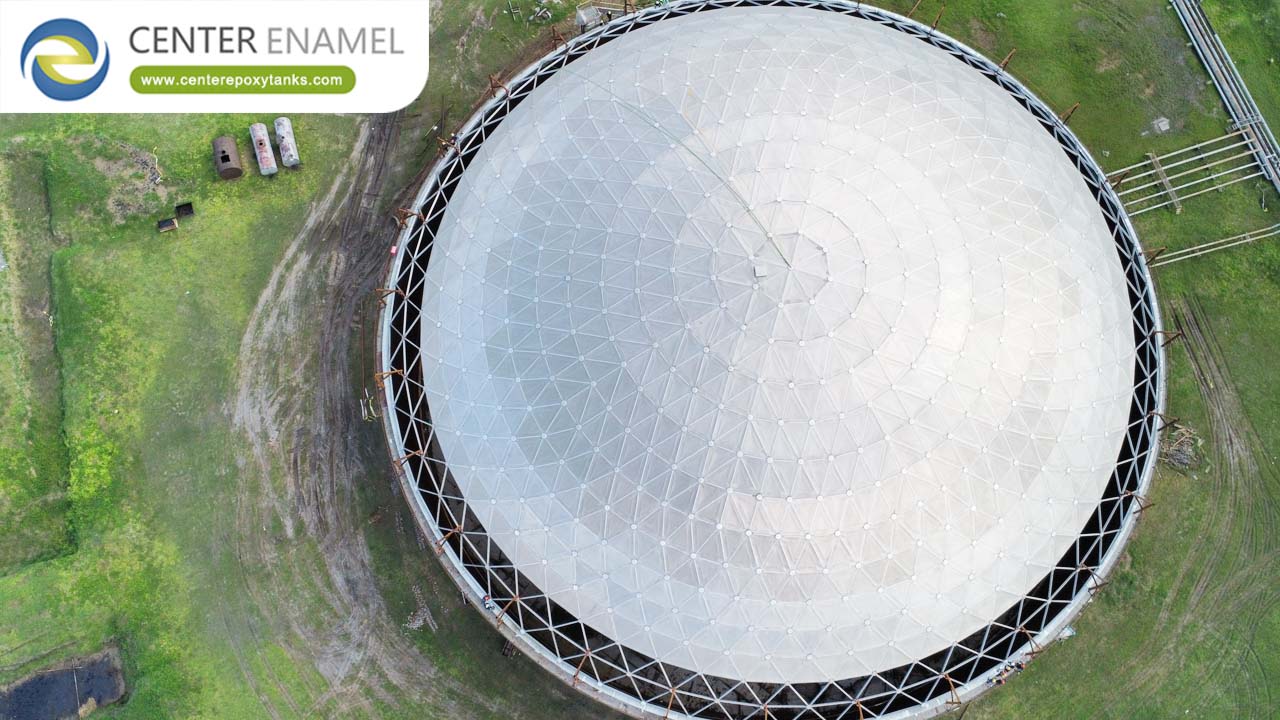
Internal Floating Roof (IFR): Advanced Engineering for Vapor Control
An Internal Floating Roof (IFR) is a high-performance structural component installed inside fixed-roof storage tanks to eliminate the vapor space between the liquid surface and the tank roof. Engineered to API 650 Appendix H standards, Center Enamel’s IFR systems—available in Aluminum Pontoon-type and Full Contact Honeycomb designs—reduce VOC emissions by up to 99%. Utilizing non-sparking 6063-T6 aluminum, these roofs ensure fire safety, product purity, and a 30-50 year service life in global petrochemical terminals.
1. Technical Specification Matrix: IFR Systems
Feature | Aluminum Pontoon IFR | Full Contact Honeycomb IFR |
Design Standard | API 650 Appendix H | API 650 Appendix H |
Primary Material | 6063-T6 / 6061-T6 Aluminum | Aluminum / Stainless Steel |
VOC Reduction | 95% - 98% | 99%+ (BACT Level) |
Buoyancy Logic | Closed-End Pontoons | Sealed Honeycomb Panels |
Optimal Product | Diesel, Jet Fuel, Crude | Gasoline, Benzene, Volatile Chems |
Installation | Modular "Knock-Down" | Precision Panel Assembly |
2. Advanced Material Science & Safety
Non-Sparking 6063-T6 Aluminum
Center Enamel utilizes marine-grade 6063-T6 aluminum for its IFR structures. This alloy is critical for "Zone 0" environments because:
● Non-Sparking Integrity: Eliminates the risk of static-induced ignition during roof travel or "landing" on support legs.
● Corrosion Immunity: Naturally forms a protective oxide layer, resisting H2S and hydrocarbon-induced oxidation without the need for additional coatings.
● High Strength-to-Weight Ratio: Aluminum is roughly 1/3 the weight of steel, allowing for high buoyancy without stressing the existing tank shell or foundation.
Rim Seal Engineering: The Zero-Gap Barrier
The most critical failure point of an IFR is the rim seal. We utilize a Dual-Seal Strategy:
1. Primary Seal: Mechanical shoe or liquid-mounted foam seals that eliminate the vapor "wicking" effect.
2. Secondary Seal: A wiper seal that provides a final barrier against residual vapors and protects the primary seal from debris.
3. IFR Decision Logic: Pontoon vs. Full Contact
● Pontoon-Type IFR: Features a series of interconnected, closed-end pontoons that provide 200% net buoyancy. This is the most cost-effective solution for standard fuel storage where a small vapor space under the deck is permissible.
● Full Contact IFR: The deck sits directly on the liquid surface, eliminating the vapor space entirely. This is classified as Best Available Control Technique (BACT) and is required for highly volatile or hazardous chemicals where any vapor accumulation poses a safety or environmental risk.
4. Quality Assurance & API Compliance
● Buoyancy Calculation: Every IFR is engineered to remain afloat even if two adjacent pontoons are punctured, exceeding API 650 requirements.
● Flotation Testing: On-site verification ensuring the roof travels smoothly along the guide poles without tilting or binding.
● Earth Continuity: Integration of stainless steel "shunts" to ensure 100% electrical bonding between the roof and the tank shell, preventing static buildup.
5. Technical FAQ: IFR Implementation
Q: Can an IFR be installed in an existing fixed-roof tank?
A: Yes. Center Enamel’s modular design allows all components to pass through a standard 24-inch manway. No "Hot Work" (welding) is required for assembly, making it ideal for retrofitting in-service terminals.
Q: Does an IFR require a drainage system?
A: No. Because the IFR is protected by the tank's fixed roof or Aluminum Geodesic Dome, it does not accumulate rainwater, unlike an External Floating Roof (EFR).
Q: What is the ROI of installing an IFR?
A: Depending on the volatility of the product and local fuel prices, the reduction in product loss through evaporation often provides a full ROI within 12 to 24 months.


