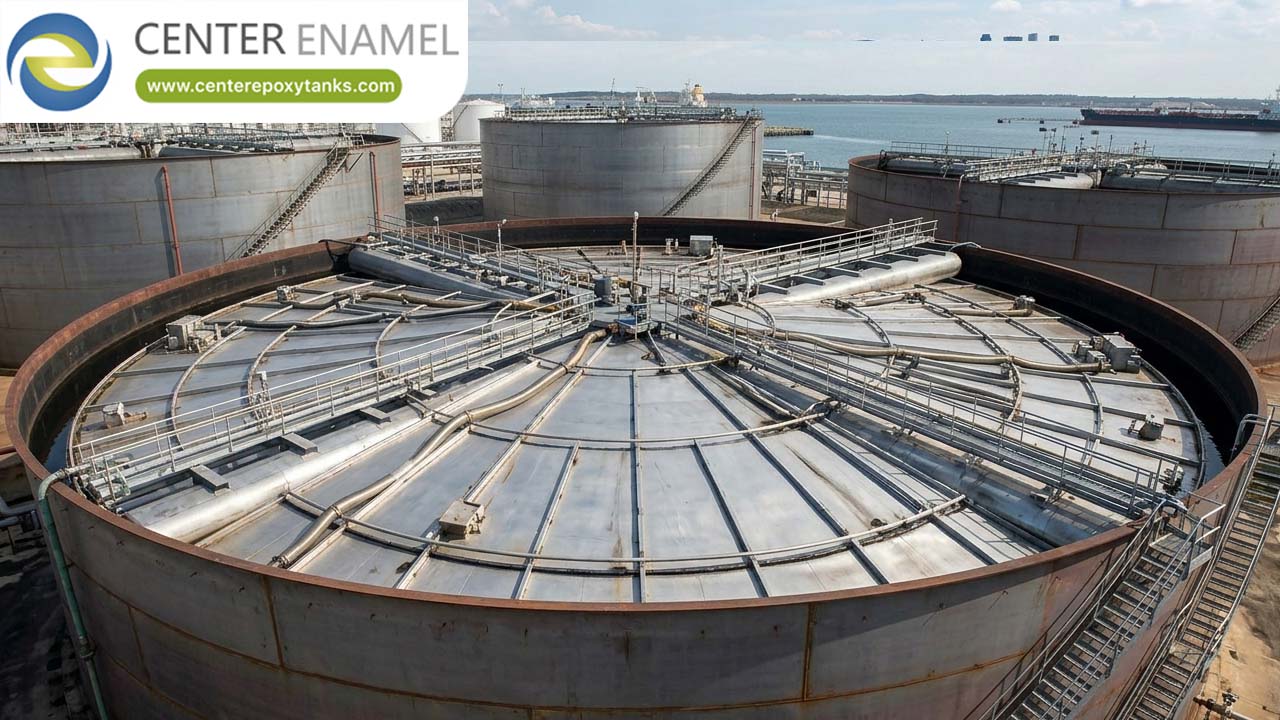
Floating Roofs for Oil Tanks: Selecting Between Deck Types and Configurations
Every floating roof project starts with a two-by-two matrix: internal or external, contact or non-contact. Get the quadrant right and the tank meets its permit, its budget, and its inspection schedule; get it wrong and the owner pays for a decade — in emissions, in maintenance, or in a deck that cannot be landed for inspection.
Floating roofs for oil tanks divide along two axes — internal decks inside fixed or domed roofs versus external decks in open-top tanks, and contact decks riding the liquid versus non-contact decks supported above it — with aluminum, stainless, and welded steel constructions across the quadrants, each matched to product volatility, climate, and inspection practice.
1. Internal or External — Where Should the Roof Float?
The tank shell above the liquid decides the configuration.
· Internal (IFR): Deck inside a fixed or dome roof — weather-immune, drain-free, suited to refined products and retrofit compliance; ventilation of the headspace is mandatory.
· External (EFR): Deck in an open-top tank — the crude-oil standard, maximizing capacity economics but owning every weather problem: drains, snow, wind, and lightning.
· Domed IFR hybrids: Aluminum dome above an internal deck — terminal best practice for emissions plus weather protection.
· Conversion flexibility: Open-top EFRs convert to domed IFRs by adding a dome and swapping decks — a recognized emission-upgrade path.
2. Contact or Non-Contact — How Should the Deck Ride?
Deck geometry follows product cleanliness and pour behavior.
· Full-contact decks: Plate on the liquid — maximum vapor exclusion for gasoline, jet, and clean products; honeycomb and welded panel types.
· Non-contact decks: Pontoons hold the deck above the liquid — preferred for waxy, dirty, or high-pour products and easier landings.
· Buoyancy design: All decks follow API 650 flotation rules — survivability with specified compartments flooded is the non-negotiable baseline.
· Material selection: Aluminum for retrofit and corrosion-free service, stainless for aggressive products, welded steel for the heaviest EFR duty.
3. How Do Seals, Drains, and Fittings Complete the System?
The deck is half the system; the perimeter is the other half.
· Seal architecture: Primary shoe, foam, or liquid-mounted seals plus secondary seals — the annulus where permits are won or lost.
· Drainage: External roofs need primary and emergency rain drains; internal roofs need closed drain routing; drain capacity and function testing dominate reliability programs.
· Fitting discipline: Gauging wells, sample hatches, and leg sleeves sealed or gasketed to keep the coverage fraction above 95%.
· Lightning and bonding: Shunts and bonding straps between deck and shell on EFRs address the rim-fire ignition scenario.
Data Table: Floating Roof Selection Matrix
Configuration | Best Product | Weather Exposure | Key Maintenance |
IFR contact deck | Gasoline, jet, chemicals | None (enclosed) | Seals, fitting gaskets |
IFR non-contact | Waxy, dirty products | None (enclosed) | Seals, deck landing |
EFR pontoon | Crude to ~60 m D | Full — drains critical | Drains, seals, pontoons |
EFR double-deck | Large crude, snow zones | Full — robust | Drains, seals, compartments |
Dome + IFR | Product terminals | Protected | Seals, dome structure |
Frequently Asked Questions (FAQ)
Q1: Which floating roof type should an oil tank use?
Match the quadrant to service: internal contact decks for clean refined products under fixed or domed roofs; non-contact internal decks for waxy or dirty products; external pontoon roofs for crude up to large diameters; double-deck external roofs for the biggest tanks and snow regions. Product volatility, climate, and inspection practice decide between them.
Q2: What is the difference between a contact and non-contact floating deck?
Contact decks rest directly on the liquid surface for maximum vapor exclusion; non-contact decks float on pontoons with the deck held above the liquid. Non-contact designs tolerate dirty and high-pour-point products and simplify inspection landings, at a small cost in sealing performance.
Q3: Are internal floating roofs better than external ones?
Different, not better: internal decks are weather-protected and retrofit-friendly — ideal for product terminals — while external roofs carry crude service at the largest scales without fixed-roof constraints. Emission performance is comparable when seals are equivalent; the choice follows product, climate, and tank population strategy.
Q4: What do floating roof seals do?
They close the annular gap between the deck edge and the tank shell — the dominant remaining vapor path once the deck covers the liquid. Primary seals make first contact; secondary seals above them cut residual losses and satisfy emission permits; their inspection and renewal is the highest-value maintenance on any floating roof.


